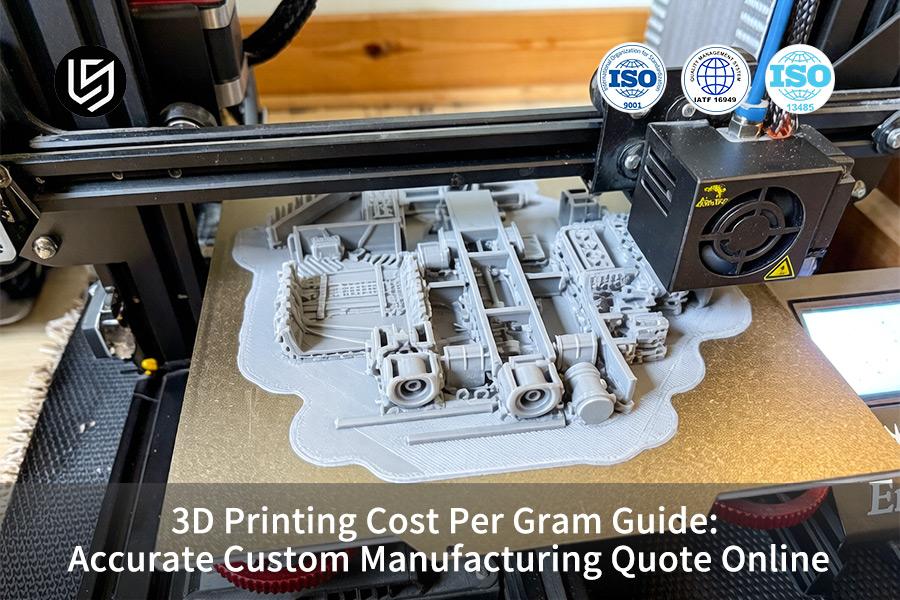
オンライン 3D プリンティング見積もりは、迅速なコスト評価の需要に応える人気の手段ですが、NPI 予算を決定するために 3D プリンティングのグラムあたりのコストはいくらですか という質問への答えを探しているグローバル調達エンジニアを欺くことがよくあります。見積もりには、粉末再循環の劣化、支持重量、温度勾配の歪みなどの重要な側面が考慮されていないため、不正確な計算、機械的特性の低下、後処理の説明不足につながります。
パウダーリフレッシュのコストは、オンライン 3D プリントの見積もりの際に、幾何学的パラメータと熱パラメータを考慮して考慮する必要があります。 3D プリント材料のトレーサビリティを計算するために、再利用サイクル数、酸素含有量、粉末に期待される機械的特性を相関させます。したがって、見積もりはもはや見積もりではなく、正確な計算です。この場合、財務面だけでなく技術面でもサプライヤーの比較分析を行うことができます。
<ブロック引用>
工業用原材料管理は、製造プロセスの定量化可能な指標です。 AS9100 および ISO 13485 規格に準拠した粉末バッチ、リサイクル、密度の履歴に関する総合的な文書を入手できます。これにより、製造される各グラムが疲労寿命を満たすことが保証されます。 金属 3D プリンティングにおける粉末サーマル リサイクルは初めてですか?リフレッシュ率、酸素管理限界、Ti-6Al-4V およびニッケル超合金の正確なグラム当たりコストの計算方法を説明する無料の技術ガイドにアクセスしてください。
ビルド プレート上の高度な 3D ネスティングにより、カスタム 3D プリントの見積もりをどのように最小限に抑えることができますか?
ビルド プレート上の 3D ネスティングの最適化により、セッションあたりのプリント数が増加する結果としてカスタム 3D プリントの見積もりが自動的に削減され、予熱や不活性ガスの使用中に発生するコストなどの諸経費の固定費が分散されます。ネスティングの最適化により、3D プリント サービスのコストがどのように削減されるかを次に示します。
これらの構造境界パラメータは、曖昧な引用仮定を定量化可能なエンジニアリング制約に変換します。 3D プリントのコスト見積もりを使用すると、見積もりの前に粉末の除去、サポート重量、応力除去を考慮することができ、製造コストに対して ±3% 以内の正確なコスト計算が可能になります。これにより、モデリング ジオメトリの不足により15 ~ 20% 多くの予算がかかるという一般的な問題が解決されます。その結果得られた幾何学的最適化構造により、粉体トラップ、過剰なサポート、プレートの歪みなどの隠れたコストを発生させることなく、最終検査段階まで見積コストが保証されます。
ミクロンレベルの寸法公差仕様により、高精度 3D プリントの総コストはどのように変化しますか?
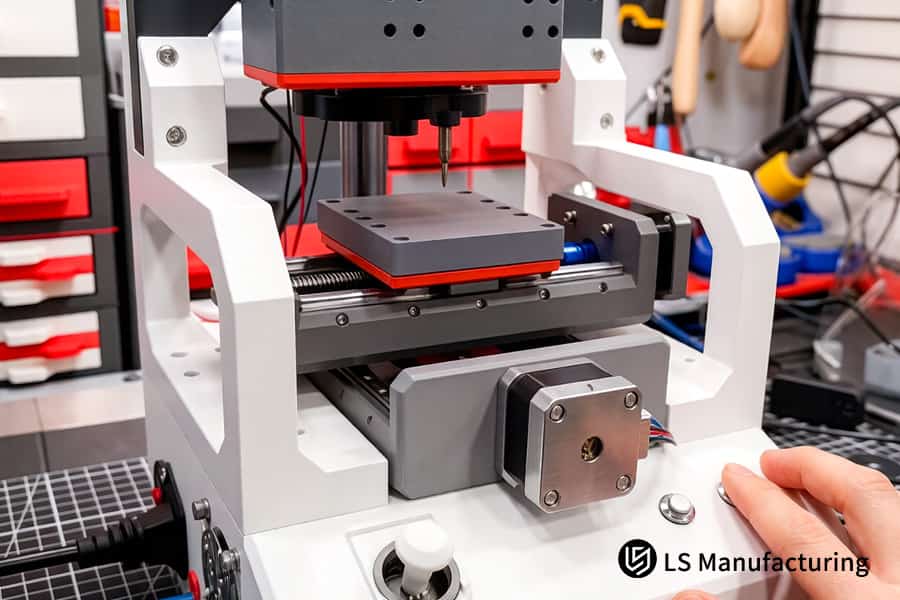
ミクロン レベルの寸法公差が高精度 3D プリント コストに直接影響します。これは、フィーチャーを±0.1 mm から ±0.005 mm まで締め付けると、後処理時間の大幅な増加。精度が0.01 mm上がるごとに、 在庫に0.3 ~ 0.5 mm の追加コストがかかり、 これをCNC 機械加工で除去する必要があります。さらに、 印刷されたままのRa 6 ~ 12 μm の表面粗さを完全に除去して、均質な表面を明らかにする必要があります。以下は、許容範囲と追加の後処理時間の構造化されたラダーです。
<本体>
許容範囲
印刷時の表面粗さ (Ra)
嵌合面の在庫許容量
後処理ワークフロー
部品ごとの追加加工時間 (平均 100 cm3 封筒)
±0.1mm (標準)
Ra 12μm
なし
なし – 完成状態を使用
0 時間
±0.05mm (精製済み)
Ra 8μm
0.2mm
重要な面での単一の軽いフライス加工パス
0.5 時間
±0.01 mm (高精度)
Ra 6μm
0.3mm
5 軸 CNC 荒加工 + 仕上げ。 2 つのセットアップ
2.5 時間
±0.005mm (超高精度)
Ra 6μm(同)
0.5mm
インプロセス プロービングを備えた 5 軸 CNC。応力除去焼きなまし。 4 つ以上のセットアップ
5.0 時間
<ブロック引用>
このラダーを使用すると、非嵌合面の公差を ±0.1 mm まで緩和し、 本当に必要な嵌合面にカスタム パーツの製造コストを使用できるため、あらゆる場所で厳しい公差を使用する場合と比較して、 プロジェクト全体のコストを35~50%削減できます。正確な 0.3 mm の 3D プリント加工時間を利用することで、クリーンアップを保証しながら不要な材料を回避できます。この表は、各ミクロンが実際の価値を追加する場所と後処理仕上げが加工時間を追加する場所について設計チームと交渉するときに使用できます。
図 3: FDM 3D プリントにより、設計の検証とテスト用にマルチマテリアルのプロトタイプが作成されます。
幾何学的な方向のデザインによって、スライス時に専門の 3D プリント サービスの見積もりが大きく左右されるのはなぜですか?
First article (1 pc): Inspection and testing establish the quality standard.
Pilot batch (100 pcs): SPC discovers variations and parameter tuning is performed before mass-production.
Production batch (500+ pcs): Cpk stays at the level of 1.33 and more, meaning consistent quality.
Benefit: This production scale transition ensures quote reflects actual conditions, mitigating 3D printing supply risk.
Zero MOQ Enables Risk-Free Ramp-Up
<オル>
Start with 1 piece: Pay only for single-piece validation.
Scale to 100 pieces: Reduce costs by 40-55% in comparison with prototypes.
Move to 500+ pieces: Close-to-mass-production economics for stock.
Advantage:Supply chain validation happens incrementally; 3D printing MOQ flexibility lets you test before scaling.
<ブロック引用>
This innovative validation process takes you from prototype to production with no initial MOQ requirement. Fixed costs are spread across higher volumes, enabling accurate part economics at each phase. Your accurate 3D printing quote develops from the single-part cost into a production-level price that is based on machine information.
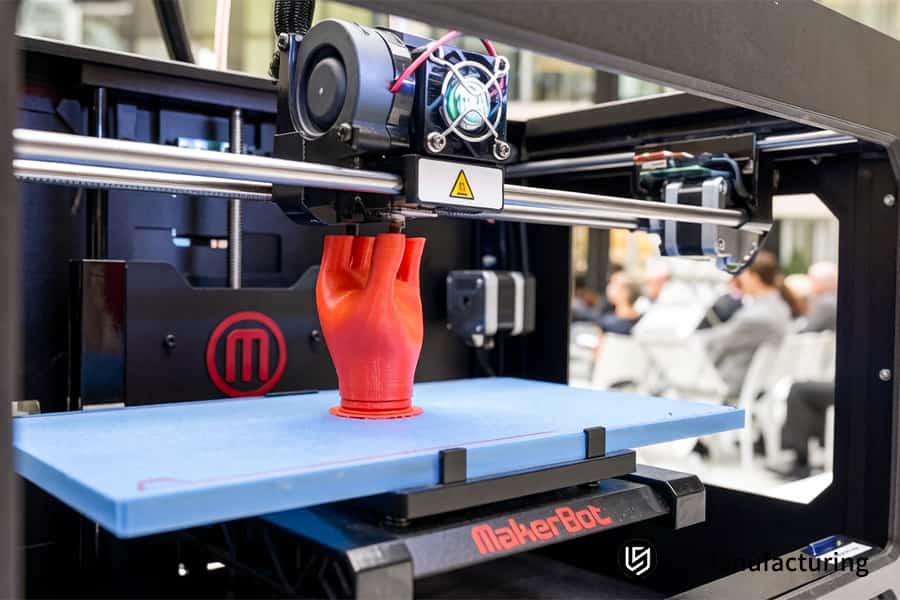
Figure 4: MakerBot 3D printing showcases a red hand prototype on a blue platform.
Case Study: How LS Manufacturing Reduced Critical Component Mass By 42% For An Aerospace Robotics Enterprise Via Customized SLM Technology?
Aerospace robotics original equipment manufacturer struggled with the following problem: their next generation gripper joint skeleton machined from billet metal using 5-axis CNC machining was characterized with 85% of material waste and weighed 320g – too much for the actuator torque and cutting down on flight endurance of the drone. The way LS Manufacturing used the SLM to solve the problem was as follows:
クライアント チャレンジ
Due to its complicated inner hollow structure, the conventional manufacturing process was not an option. Cutting tools did not have access to these interior cavities that were required for weight reduction, meaning the design had to remain at 320g. This high weight burdened the motors of the end-effector, lowering robot dynamics performance by 30% and limiting battery autonomy to less than 18 minutes per cycle. Our client wanted to have a sub-200g part but not at the expense of its stiffness. It became clear that 3D printing lattice core was the only way to go for internal weight reduction.
LS 製造ソリューション
The design team undertook an in-depth DFM analysis along with topology optimization along with TPMS lattice structures. We then re-engineered the part in metal SLM using aerospace grade AlSi10Mg. As a countermeasure against stress caused by the rapid cooling process, we added a 580°C vacuum annealing step, which became a crucial step after seeing 0.08mm distortion in the initial test coupons without the annealing step. The lattice cores remained strong enough to bear loads. Specific 3D printing stress relief technique was designed for this thin-walled part.
結果と値
The final part weight was reduced to 185.6g, which represents 42% weight reduction. There was no loss in tensile strength, which remained above 410 MPa, while the tolerances for critical bores were maintained at ±0.02mm. Per unit price custom 3D printing quote decreased by 30% as compared to machining. Lead time went down from 4 weeks to 6 days. This allowed our client to win a military contract and choose us as their strategic partner. 3D printing weight reduction resulted in improved mission life for their robotic vehicle.
<ブロック引用>
This industrial additive case study proves that the application of advanced DFM technology like topology optimization, TPMS lattice, and 580°C stress-relief annealing allows resolving mass-constrained aerospace engineering problems not resolvable by conventional means. Your 3D printing cost per gram is a key tool in your hands when each gram saved increases mission time. For precision aerospace engineering, this case proves that using SLM with intelligent post-processing ensures weight reduction and mechanical properties qualification within one test cycle.
From 320g to 185.6g without sacrificing strength or tolerance. Need to shed mass from a critical component? Share your target weight and load requirements, and we’ll engineer an SLM-optimized solution.
Why Choosing LS Manufacturing As Your Certified Tier 1 3D printing Service Quote Manufacturer Secures Engineering ROI?
Choosing a certified Tier 1 manufacturer for your 3D printing service quote avoids the risks of unknown quality and protection of intellectual property associated with unapproved suppliers. With dual certifications of IATF 16949 and ISO 9001 standards, all deliveries include 100% CMM inspection reports, independent material chemistry analysis, and SPC/Cpk capability information. This is how your engineering ROI is secured:
Certified Quality Systems Eliminate Rework Risk
IATF 16949 certification ensures defect prevention as opposed to detection via annual surveillance audits. For you, this translates into consistent compliance such that every batch conforms to the same ±0.02mm tolerance without need for incoming inspections. The non-conformity rate is less than 0.3% compared to an industry norm of 2–5% for non-certified shops, which translates to protection of your schedule and warranties. 3D printing quality assurance ensures daily calibration of machines using the reference artifacts.
Full Traceability Delivers Audit-Ready Documentation
Every shipment comes with a digital package containing CMM inspection data for all critical features, OES/XRF for material composition certificate and quality control parameters for each production batch. This reduces the time required by your engineers in qualification of the output of a new supplier from 3-5 hours. In regulated industries like aerospace and medical devices, this document fulfills AS9100/FDA audit requirements for you. A 3D printing certification compliance checklist captures all inspection points based on your drawings.
Digital Asset Protection Secures Your Intellectual Property
The CAD Firewall System architecture ensures that your design data is isolated in an air-gapped server that can be accessed only by the assigned engineers under NDA. The logs of file access are kept for 7 years, and all the transfers are AES-256 encrypted. It ensures that your proprietary geometries remain within a protected environment – a necessity when you are sharing sensitive design data for online 3D printing quote creation for multiple projects. The automatic file expiration after 30 days of delivery ensures 3D printing data protection.
<ブロック引用>
This certification-based system ensures that your V becomes an assured engineering result with documentation at each and every step. Daily machine calibration, compliance checklists per order, and data protection policies eliminate the costs associated with qualifying suppliers. Your online 3D printing quote from a IATF 16949 certified manufacturer ensures systems and quality control parameters of Cpk ≥1.33.
よくある質問
1. What is the baseline industrial 3D printing cost per gram for standard engineering materials?
Weight-based industrial pricing depends on material properties and can be quoted online at prices ranging from $0.30 to $0.80 per gram for industrial standard PA12 nylon. On the other hand, high-end aerospace-grade Ti-6Al-4V titanium or PEEK, which experience substantial loss from thermal oxidation during recycling of powder, incur full production costs of $3.00 to $8.00 per gram.
2. How can I optimize my CAD design file to effectively minimize total weight without sacrificing structural rigidity?
It is possible to use efficient software in order to substitute solid internal areas with a 3D honeycomb or lattice structures (retaining a volume fraction between 15% and 30%) or optimizing wall thickness for shells that are not bearing any load within the recommended range of 1.5mm to 2.5mm.
3. Does your online estimation platform include complex post-processing operations in the 3D printing quote?
はい。 Our 3D printing digital quoting engine is totally transparent concerning manufacturing stages. Depending on tolerance and surface finish that you select online, the algorithm will calculate all necessary labor costs, such as annealing, removing supports, bead blasting, and precision finishing/polishing in order to reach certain Ra surface roughness level.
4. Why do tight tolerances of ±0.01mm exponentially increase the overall cost of precision 3D printing?
This is because whenever the dimensional specifications go beyond the physical limitations of the additive manufacturing process (usually ±0.1mm), additional material is required for post-sintering grinding and trimming. Apart from that, there should be an additional precision machining process where the component will be mounted onto a custom fixture and will undergo 5-axis high-speed CNC milling center operation.
5. What is the absolute minimum order quantity requirement for a custom 3D printing quote?
In order to properly support the technological innovations and rapid prototype development of global hardware research and design engineers, LS Manufacturing has established the official Minimum Order Quantity (MOQ) of a single unit for all custom precision components production.
6. How does LS Manufacturing protect confidential proprietary CAD files upon online document submission?
Prior to any uploading of your 3D CAD file to our online database system, you are free to sign a Non-Disclosure Agreement (NDA), having full international legal power. All data transmission occurs through the use of asymmetric encryption technology, providing 100% protection of your core intellectual property from the very beginning.
7. Can a clear financial matrix compare metal SLM manufacturing vs. conventional CNC machining costs?
Absolutely. As far as LS Manufacturing supply chain analysis methodology goes, in case when a particular part contains complex geometry and a "Buy-to-Fly" ratio (material scrap) during its machining exceeds 80%, then the implementation of metal additive SLM manufacturing technology will help you reduce costs associated with hard alloy tools and raw materials by about 40%.
8. How long must a procurement manager wait to receive an actionable, definitive, and accurate 3D printing quote?
As soon as you send us all the necessary information, including 3D model (STEP/IGS formats), lattice structure, chosen material and tolerances, through LS Manufacturing Customer Service Website, our highly professional DFM review team will send you a final technical proposal within one hour, which is legally binding.
概要
It is crucial for keeping budgets low during NPI development to know 3D printing cost factors and apply DFMA from day one. Optimal tuning of material characteristics, nesting density, tolerances hierarchy, and build direction helps to avoid wastes and eliminate tooling costs. The 42% weight reduction achieved in manufacturing an aerospace robotic joint by LS Manufacturing shows how much return can be expected from high engineering and quality control.
Stop making generic calculations and stressing about budgets. Click “Request Quote/Submit Drawings” and upload your 3D CAD drawings to LS Manufacturing’s virtual manufacturing platform. Within an hour, our senior engineers and materials scientists will give you a complimentary DFMA report on manufacturability, wall thickness issues, stresses mitigation and weight savings.
 日本語
日本語