English



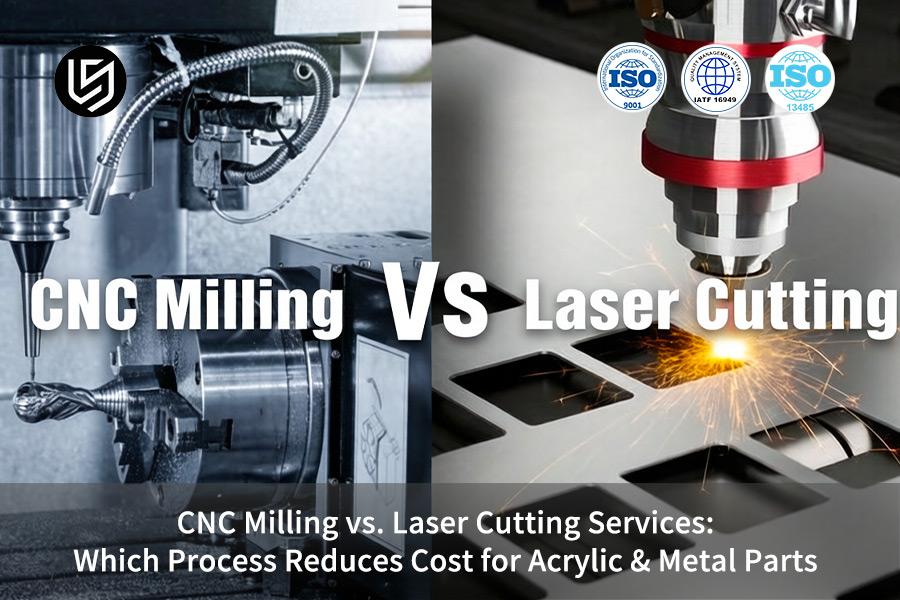
CNC milling vs laser cutting services directly dictate how much does cut acrylic cost, where selecting the wrong process blindly inflates component budgets by 20% to 35%. For precision PMMA and metal parts, this engineering guide from LS Manufacturing reveals how optimizing tolerance ranges (±0.005mm to ±0.1mm) and nesting efficiency can instantly slash over 15% of your total production cost and reduce lead times to 24 hours.
15 years of experience at LS Manufacturing help you get an engineering guide on how to save more than 15% of your costs with vital parameters like tolerance ranges (from ±0.005mm to ±0.1mm) and surface roughness (from Ra 0.4μm to Ra 3.2μm) in your favor. Analyzing orders from 1-50 to 5000+ parts, we convert your crucial parameters into reduced lead time and TPC; let's see how these engineering services influence your budget.
CNC Milling VS Laser Cutting Services: Cost Optimization Quick-Reference
| Cost Factor | CNC Milling | Laser Cutting |
| Setup & Programming Cost | More; requires 3D path generation and set-up. | Less; uses 2D CAD data and little setup. |
| Material Removal Efficiency | Less efficient; uses subtractive technology with waste generated. | More efficient; removes only the profile, leaving less waste (>90%). |
| Operational Speed | Slower; limited by material removal capacity. | Fast; very fast cutting due to speed in travel, especially when working with thin laser cutting materials (<6mm). |
| Secondary Finishing | May be required for achieving finer finishes. | May not be extensive; edges remain smooth after cutting, especially acrylic. |
| Our Cost-Saving Advisory | Better suited for 3D work, pockets, threading, and tight tolerance machining (±0.025mm). | Better suited for 2D work and contouring, especially for high volume parts (±0.1mm). |
Key Takeaways:
- Geometry Dictates Process Cost: Cutting simple geometries is usually more cost-effective with lasers, whereas laser cutting complex 3D geometries requires CNC milling.
- Volume Impacts Economics: Laser cutting’s low set-up costs make it perfect for prototyping and volume manufacturing of 2D sheet components. Set-up costs with CNC milling apply to smaller runs of complex parts.
- Material Thickness Matters: Laser cutting works well on thin materials (<12mm for metal, <25mm for acrylic). CNC milling can handle a broad variety of thicknesses.
- Total Cost Analysis: Take into account material waste, secondary operations, and labor. Laser will be more economical for qualifying 2D part manufacturing, even if the raw material price is higher per kg.
Why Trust This Guide? Practical Experience From LS Manufacturing Experts
You may find numerous theoretical comparisons of subtractive manufacturing techniques. But what about this guide? We’ve got practical expertise of LS Manufacturing engineers who face a decision between 4-axis milling and laser cutting every day. The cost-modelling framework we use when manufacturing high-mix, low-volume components is based on manufacturing efficiency studies of the International Academy for Production Engineering (CIRP).
Our manufacturing is based on those materials that require ±0.025mm burr-free edges, namely: complex titanium bone plates, acrylic light guides used in lithography and requiring optical clarity in laser-cut facets, and copper busbars where thermal deformation during cutting can influence the electrical performance. Validation of our edge quality and HAZ is performed following the standards established by American Welding Society (AWS).
Our expertise arises from an examination of countless quotes and part examinations. We have precise knowledge of the minimum batch quantities at which laser cutting of 3mm aluminum will be more economical than milling. We also understand the type of acrylic that won't crack during the laser-cutting process, and the machine paths for decreasing the time it takes to mill 304 stainless steel by 30%. We reveal our proven expertise and save your company money by guiding you to the right choice, avoiding costs like finishing processes, waste, and inferior performance.
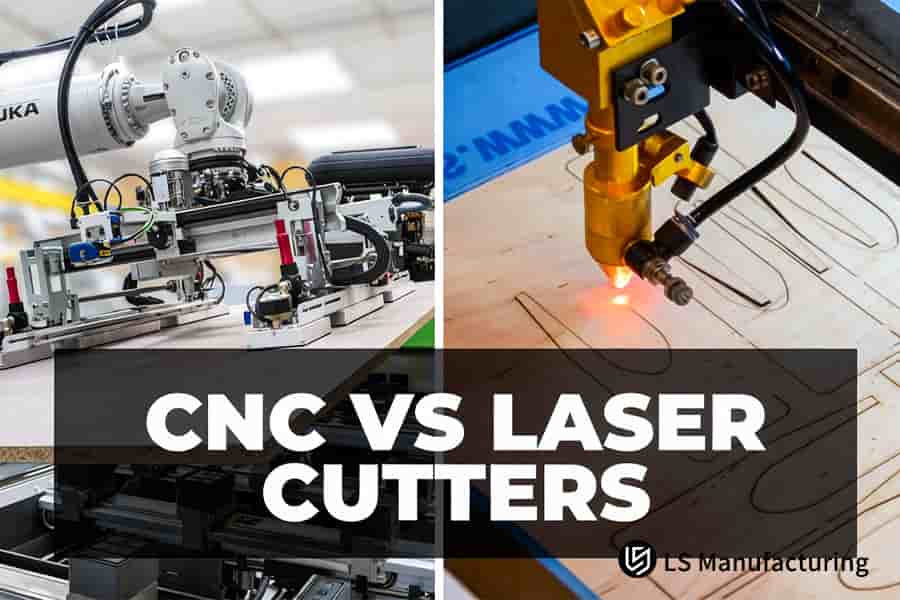
Figure 1: The display contrasts the complex structure of a cnc machine with the high-precision lines of a laser cutter for precision fabrication.
Which Structural Parameters Determine The Real Cost Of Custom Acrylic Laser Cutting?
To assess the real cost of the acrylic products, it is necessary to study the parameters of their construction that determine the total cost. Here is the technical approach for correlating physical characteristics with the best production process:
The Efficiency of Thermal Processing for Thin Sections
Custom acrylic laser cutting is very efficient for components less than 10mm in thickness. Fiber lasers make high-speed profiling possible while locally heating the part to polish the kerf to Ra 0.8μm smoothness. Polishing in place is the main reason why the cut acrylic cost is relatively low, making it great for precision laser cutting of intricate profiles.
When Thermal Effects Compromise Integrity
Above 20mm, the laws of physics begin to play against you. Increased heat stress causes microscopic cracks below the surface. At the same time, the natural kerf tapering starts to go beyond acceptable tolerance values. Hence, thick acrylic laser cutting should not be used for making structural parts because of increased scrap rates.
Switching to Mechanical Precision
For fidelity in thick stock, the procedure transitions into acrylic plastic CNC milling. The subtractive process involves using a tool to remove material, achieving a ±0.05mm tolerance without heat. Polishing is necessary for the matte finish, but with almost a 100% yield on precision parts, the process is the most cost effective cutting process.
The Analysis for Total Cost Optimization
The overall financial result is determined by an all-encompassing analysis that involves material, processing, finishing, and yield. A cheap quote initially for rapid laser cutting of a thick part becomes expensive in terms of overall costs with lower yields. The approach used here provides an evaluation based on a parametric model.
This is how our consultancy works technically. To solve the problem of calculation of costs, we bring in the necessary expertise to make the right selection of the process that will be determined by the physical characteristics of your part. By employing our consultancy services, you will shield yourself against the potential hidden costs associated with using the wrong technique in manufacturing.
How Do Production Volumes Induce A Break-Even Point In CNC Milling Metal Parts Service?
Choosing the best metal parts manufacturing process depends on the order quantity and not only on part geometry. Our analysis provides a model for calculating the break-even point between laser and CNC processes, turning the classic problem of cost estimation into a highly accurate task:
Prototype Speed with Minimal Commitment
- Initial Advantage: With 1-5 piece prototypes, high speed laser cutting does not require any hard tooling.
- Key Detail: Cutting time (for example, 0.8 sec for 6mm thick steel) is the critical factor here; there is no fixture and special programming involved.
- Our Method: We use this method to get fast feedback on the parts during the development phase without making a big DFM investment.
The High Fixed Cost of CNC Setup
- Cost Driver: The initial custom CNC milling service for metals has expensive fixed costs: DFM study, multiaxis programming, and custom fixture design.
- Key Detail: CNC setup can take up to 60% of the entire initial cost for smaller orders.
- Our Method: We put our engineering efforts right here to be sure about part manufacturability and accuracy.
Volume Efficiency and the Cost Crossover
- Efficiency Gain: For quantities above about 150 units, the specialized multi-fixture configurations allow for parallel processing, lowering time per unit dramatically.
- Key Detail: High cost of initial programming and fixtures per piece becomes close to zero in CNC, rendering CNC machining as the most cost effective cutting process for batches.
- Our Method: We conduct a marginal cost analysis, showing at what point CNC milling metal parts will be less expensive than metal sheet laser cutting and secondary deburring operations.
Delivering Total Cost Certainty
- The Outcome: Break even does not stay put. It depends on how difficult a part is to make, what material you need (for example, 6061 Aluminum versus H59 Brass), and any processing needed after forming.
- Our Role as a Supplier: As a technical metal parts supplier for you, we analyze the crossover for your part design in detail and provide you a clear comparison in volume pricing that cuts out the guesswork.
- Process Choice: Ensuring you are never using clean laser cutting for a high volume application when CNC makes more sense economically, or vice-versa.
This analytical framework gives our clients predictive cost knowledge. We overcome this decision problem by providing a comprehensive financial modeling analysis of all processes based on volume orders rather than piece price. Our core competency lies in quantifying measuring the amortization of engineering and setup costs to arrive at the lowest cost option for you. Let us calculate the precise break-even point for your part, eliminating cost guesswork. Submit your design and target volume for a marginal cost analysis and optimized quotation.
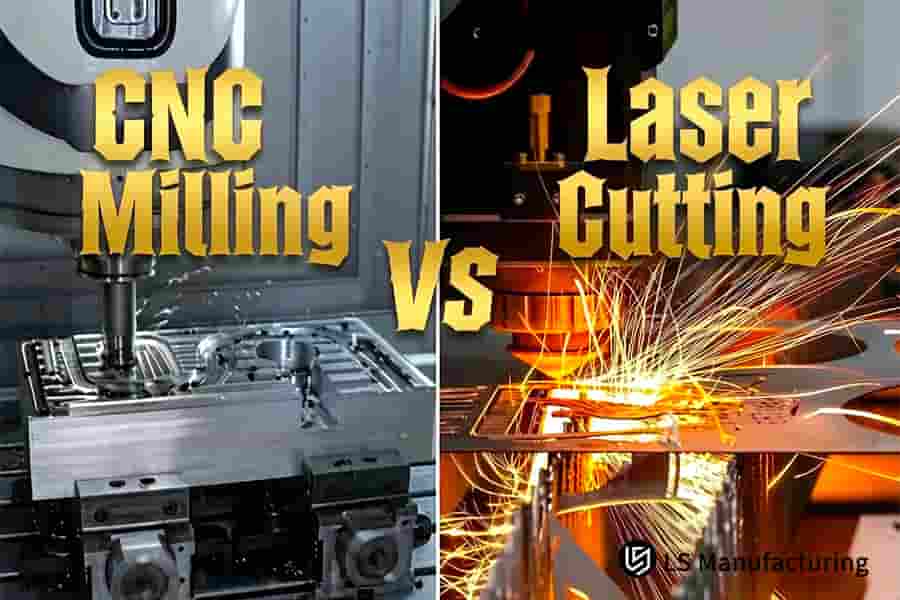
Figure 2: The view contrasts cnc milling that generates steel chips with laser cutting that produces sparks for industrial parts.
Why Do Mechanical Property Differences Impact Process Choices For Precision Laser Cutting Service?
Choosing between the two processes of precision laser cutting service and CNC milling metal parts is a basic choice that will significantly affect the performance of the parts and the overall price. This paper seeks to analyze the change in the properties of the material due to the application of each machining process, thus helping in evaluating their impact on tool wear and part assembly failure:
| Factor | Precision Laser Cutting Service (Thermal Process) | CNC Milling Metal Parts (Mechanical/Cold Process) |
| Material Alteration | Creates a Heat Affected Zone (HAZ), up to 0.1mm–0.5mm thick and changes its structure. | The material’s initial microstructure remains unchanged by the process as there is no application of any heat. |
| Edge Condition | Hardens the edges by ~+5HRC, creating micro cracks in the metal, crucial in metal sheet laser cutting. | Ensures that the metal edges are hardened and have predictable physical properties. |
| Impact on Secondary Ops | Hardeness of the HAZ region increases tap tool wear by ~40%, increasing breakage chances during tapping operation. | Lets us perform subsequent operations on the metal such as threading and bending without risks. |
| Our Mitigation Strategy | We simulate your material's HAZ zone to highlight high-risk areas before manufacturing. | Use 7MPa coolant and coated tools to ensure stress-free stable metal parts. |
| Ultimate Cost Driver | Risk of failure due to delayed assembling rejection. | Increased cost due to guaranteed reliability that leads to reduce cost for acrylic & metal parts. |
This material science framework prevents of the hidden failure potential of parts through an approach that uses mechanical performance rather than geometry to determine what needs to be selected. The above theory of material science is utilized to select CNC milling metal parts where we avoid the HAZ in thermal cutting. This is an important aspect of our manufacturing factory operation.
What Are The Tolerance Boundaries Where CNC Milling VS Laser Cutting Services Segregate?
The decision regarding which manufacturing processes should be used is determined by the dimensions and tolerances that are required in order to perform the function of the part. This comparison creates a very clear benchmark on how to choose between the CNC milling vs laser cutting services.
| Tolerance & Capability Factor | Process Comparison & Boundary |
| Primary Limiting Factor | Primary limitation on general tolerance laser cutting is defined by the laser beam size (0.1-0.3mm) and machine backlash. Primary limitation on CNC is machine rigidity and thermal control. |
| Standard Economic Dimensional Tolerance | Laser: ±0.1mm; CNC: ±0.025mm standard, or ±0.005mm with high-precision CNC machines. |
| Achievable Geometric Tolerances | Laser does not allow tight tolerances on perpendicularity and concentricity; CNC can achieve tolerances as low as 0.01mm. |
| Fit for Precision Assembly (e.g., H7/g6) | Laser does not have sufficient ability to maintain such tolerances as required for press and slip fits; custom CNC milling service is essential. |
| Our High-Precision Solution | With our 5-axis machines and thermal compensation we will be able to achieve these specifications unlike the laser cutting service, ensuring success in the manufacturing of these parts. |
| Impact on Total Project Cost | An economic laser cutting process for ±0.02mm features is destined to fail, meaning scrap and cost. Our process ensures first-time success reduce cost for acrylic & metal parts. |
With this process specification approach, we provide you with an easy-to-understand rule that removes the uncertainty of selecting the wrong process, one which cannot be achieved. This will be done through the evaluation of your engineering drawings within these process specification limits. With our analysis, we will advise you on the processes required, laser cutting alone or the expertise of the precision machining manufacturer.
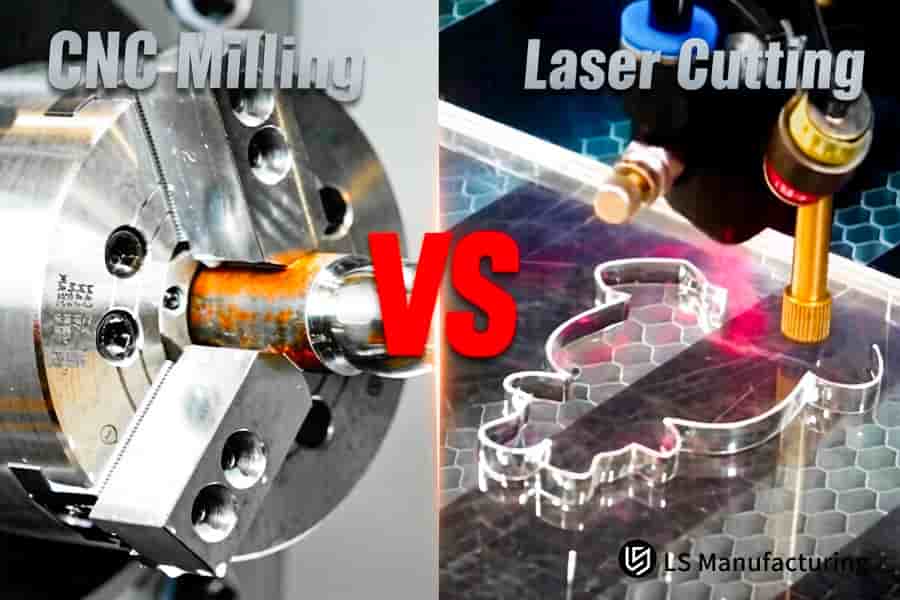
Figure 3: The panel contrasts cnc milling of a rusted metal workpiece with laser cutting of acrylic into shapes for rapid prototyping.
How Does Tool Engagement And Nesting Efficiency Reduce Waste For Acrylic & Metal Parts?
Waste of material is a controllable factor. This article explains a methodical approach that can help minimize the reduce cost for acrylic & metal parts through efficient usage of material. This can be achieved by choosing a suitable manufacturing technique along with an optimal layout of parts to maximize the efficiency of using materials.
Optimizing Layout for Laser-Based Efficiency
High accuracy offered by custom acrylic laser cutting with a kerf of around 0.2mm is an essential aspect for saving on materials. It allows using laser cutting techniques like common line cutting and mirror cutting, whereby different parts can utilize the same cut line. Our optimized placement of parts for standard sizes of sheets yields a material utilization of more than 88%.
Acknowledging the Inherent Waste Profile of CNC
By contrast, CNC milling metal parts involves an inherently subtractive and wasteful operation. Toolpaths are constrained to be spaced by at least 1.5x the tool diameter, generating inevitable voids. Also, the removed material turns into unusable chips rather than scrap. In the case of profiled pieces, this may result in waste ratios that exceed 40%, making it more cost-effective to employ alternative manufacturing approaches.
Designing and Executing a Hybrid Strategy
The most cost effective cutting process is often a hybrid approach. To achieve the highest degree of efficiency, we use fast laser cutting to generate blanks and outer profiles. CNC milling is used only for those additional 3D features such as steps, pockets, and blind holes which cannot be machined otherwise. In this way, we guarantee that no scrap materials are used for the machining steps that could be handled by a laser.
Quantifying Savings Through Data-Driven Analysis
We address the problem of material waste by carrying out a comprehensive pre-production analysis of the geometry of your part. This allows us to determine the expected theoretical material yield and waste rate using either purely CNC technology or hybrid technology of laser and CNC milling. The result of this analysis forms a basis of our justified approach, saving material costs on average up to 22% for compatible part geometries.
This approach illustrates how we tackle cost issues from the very basic stage of material consumption. We reduce cost for acrylic & metal parts not only through machine work but through analysis-based decision-making and proper part placement. This comes from our expertise in evaluating each time when it is enough to apply only nested laser cutting technology and when a hybrid technology must be used.
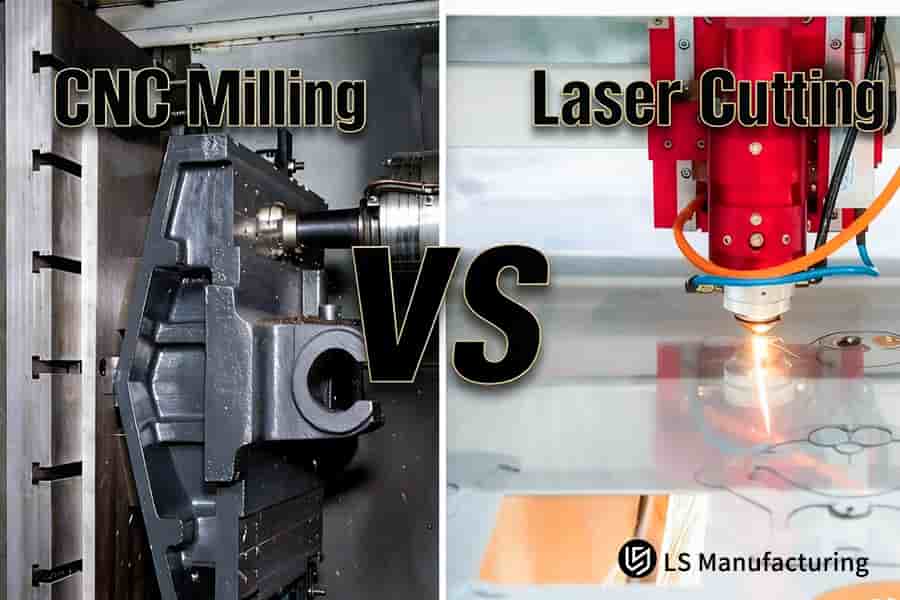
Figure 4: The image contrasts cnc milling of a metal automotive part with laser cutting of a medical device vent at LS Manufacturing.
Case Study: How Did LS Manufacturing Save 35% Costs On An Optical Instrument Housing?
The case study discusses the re-engineering approach that LS Manufacturing undertook to save a crucial B2B business venture by carefully choosing betwee CNC milling vs laser cutting services. Due to high costs and poor quality, the company used value engineering for an optical instrument housing to generate enormous cost and performance savings with technical innovation.
Client Challenge
A client from Europe producing medical devices was at risk of project cancellation because their specifications required a 15mm PMMA window machined via CNC. This made for a cloudy Ra 3.2 μm surface quality. Machining all the complex heatsink holes in a 5mm aluminum case via CNC milling consumed 45 min/part. Prototype manufacturing costing $185 was over budget, and 82% light transmission through acrylic did not meet optical criteria.
LS Manufacturing Solution
A process improvement recommended by our DFM audit became necessary. The acrylic window was manufactured through custom acrylic laser cutting that utilized the capabilities of a 3D gas-assisted laser cutting system in order to produce a Ra 0.8μm optical quality edge in one go. The aluminum housing was cut through a high-power fiber laser cutting service in 35 seconds, while a custom CNC milling service was needed only for ±0.01mm threaded holes and datum surfaces.
Results and Value
There was a 72% improvement in overall cycle time with the optimized process. The unit price reduced to $120.25, thereby saving $32,375 for the first run of 500 pieces. The light transmittance of the acrylic material achieved 93.5% and satisfied all requirements for medical-grade laser cutting and finishing. The highly reliable fast processing of the aluminum housing made sure that the exact geometry was achieved, making immediate scaling up possible as well as securing 2,000-piece orders plus a strategic partnership.
This case clearly reflects how we approach problems in terms of solutions. As a precision manufacturing supplier, we address cost and quality problems through manufacturing process optimization, not just through quotations. Our credibility comes from using the proper technology that ensures performance in both time and money.
Re-evaluate your manufacturing costs and optical clarity. If you wish to achieve a 35% cost savings and 93.5% light transmittance for your housing components, click the button below to request a free process analysis for your project.

FAQs
1. Why do the edges of laser-cut acrylic appear smooth, whereas CNC-milled acrylic features a whitish haze?
In laser cutting, it is based on the rapid melting of the surface of acrylic with very high heat levels, and when it is cooled, it creates an automatic mirror surface effect like the flame polishing process. However, in CNC milling, it is a mechanical type of process whereby due to small tool marks, diffusion reflection happens, producing white appearance, requiring further diamond polish or buffing to restore transparency.
2. My metal parts require a surface roughness of Ra 0.4μm. Should I choose laser cutting or CNC milling?
It is necessary to select CNC milling. This is due to the fact that the roughness of the metal edge created by the laser cutting machine is usually above Ra 6.3 μm due to variations in the nozzles' air flows and thermal effect with slag residues. However, 5-axis CNC milling will ensure consistent surface roughness as low as Ra 0.4μm.
3. For acrylic sheets thicker than 20mm, which custom machining process does LS Manufacturing recommend?
We highly recommend you use CNC milling. In cases where acrylic thickness is above 20mm, the edge tapers too much due to excessive conicity and also scorching from laser cutting, along with thermal stresses causing cracking. The only method to achieve 90% perpendicularity for all edges with an absolute accuracy of ±0.05mm is CNC machining, which is done by utilizing specialized extended reach coated milling cutters.
4. If my metal parts feature both complex laser-cut profiles and high-precision threaded holes, how does your facility handle this?
Hybrid process technology of machining at LS Manufacturing includes using a high-power fiber laser cutting system for rapid cutting of the exterior profile and making rough cutouts. Next, the parts go through a 4-axis or 5-axis computer numerically controlled machine for precise tapping of threads, step drilling of holes, and milling sealing surfaces.
5. Why is the quoted price for laser cutting sometimes higher than that of CNC milling when processing aluminum alloy sheets containing numerous small holes?
As laser cutting entails carrying out the process known as “high-pressure piercing” for each individual hole, in cases where there is a need for hundreds or even thousands of holes in the part design, the accumulated piercing time will be extremely lengthy, and there will be considerable consumption of the nozzles and auxiliary gas as well. In such situations, CNC milling allows the use of multi-flute drill bits or center drills for rapid batch processing of holes in which case the efficiency and economical advantages of mechanical drilling become apparent.
6. When ordering custom acrylic or metal parts from LS Manufacturing, what key design considerations should be kept in mind during the drafting stage to prevent deformation?
In cases involving thin-walled parts (parts thickness not exceeding 1.5mm), the following should be considered when designing the parts: Avoid designing long narrow strip-like parts where possible. When designing laser cut parts, the distance between the adjacent holes should not be less than the thickness of the material. For CNC milling metal parts, all the internal corners should be provided with a minimum fillet radius of R=1.5mm or greater to avoid force concentration and deformation.
7. What are the substantive differences between laser cutting and CNC milling in terms of prototyping and lead times?
No tooling and fixtures are required for laser cutting, and everything is ready to be processed after importing the DXF drawings, which only take 10 minutes; this makes laser cutting highly suitable for urgent requirements that have to be accomplished within a timeframe of 24 hours. On the other hand, for CNC milling, selecting tools, creating fixtures, and doing G-code dry running may take one to two hours on average. Once the preparation is finished, the following process becomes extraordinarily fast for medium-to-large volumes.
8. How can I verify that the custom metal parts provided by LS Manufacturing are made from authentic materials and that their tolerances fully meet the specified standards?
All orders we supply are accompanied by 100% authentic Material Test Reports (MTRs) from the material manufacturers; furthermore, every order undergoes inspection using a Coordinate Measuring Machine (CMM) in accordance with ISO 9001 standards. We strictly prohibit the use of counterfeit materials, and all necessary tolerance data is fully traceable. We will provide you with the most detailed quotation.
Summary
CNC milling or laser cut acrylic and metal parts have unique applications according to engineering parameters such as tolerance level, 3D cavities, and minimizing thermal distortion for CNC machining and fast turnaround without much setup time for laser cutting that can optimize material consumption for flat parts.
Avoid overspending on parts manufacturing. Click here for a FREE custom machining quote and upload your STEP, IGS, or DXF file. Our senior engineer will conduct a thorough DFM analysis, minimize wastage of machining operations, and come up with a hybrid process within 24 hours that will increase material utilization by 15% while reducing scrap to zero percent.
📞Tel: +86 185 6675 9667
📧Email: info@lsrpf.com
🌐Website: https://lsrpf.com/
Disclaimer
The contents of this page are for informational purposes only. LS Manufacturing services There are no representations or warranties, express or implied, as to the accuracy, completeness or validity of the information. It should not be inferred that a third-party supplier or manufacturer will provide performance parameters, geometric tolerances, specific design characteristics, material quality and type or workmanship through the LS Manufacturing network. It's the buyer's responsibility. Require parts quotation Identify specific requirements for these sections.Please contact us for more information.
LS Manufacturing Team
LS Manufacturing is an industry-leading company. Focus on custom manufacturing solutions. We have over 20 years of experience with over 5,000 customers, and we focus on high precision CNC machining, Sheet metal manufacturing, 3D printing, Injection molding. Metal stamping,and other one-stop manufacturing services.
Our factory is equipped with over 100 state-of-the-art 5-axis machining centers, ISO 9001:2015 certified. We provide fast, efficient and high-quality manufacturing solutions to customers in more than 150 countries around the world. Whether it is small volume production or large-scale customization, we can meet your needs with the fastest delivery within 24 hours. choose LS Manufacturing. This means selection efficiency, quality and professionalism.
To learn more, visit our website:www.lsrpf.com.