English




PLA vs PET 3D printing serviceis the engineering prototype solution that solves the eternal problem of choosing the right material at the early stages of R&D.Engineers asking themselves “what is the difference between PLA and PET filament” usually encounter poorly adhered layers and warping, resulting in more than 0.2mm deviation in complex structures. This ruins the whole design and delays projects since existing services don’t have any guaranteed accuracy measures or part optimization solutions for large objects.
Here we provide anindustrial-grade selection guideusing thermal field control technology and modified material compositions. We solve the physical trade-off between rigidity and warping of your products. You will get such measurable characteristics as heat deflection temperature (≥100°C), shrinkage rate (<0.3%) and tensile strength (>50 MPa) for both materials. Pre-production DFM analysis and temperature chamber control make our tolerance equal to±0.05mm.
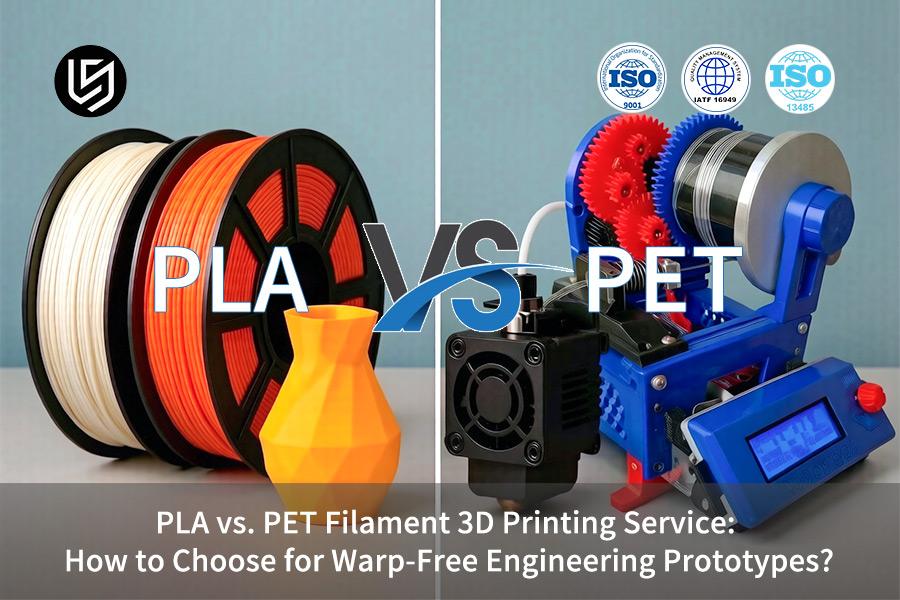
PLA VS PET (Amorphous / PETG-family) Filament 3D Printing: Quick-Reference
| Decision Factor | PLA (Polylactic Acid) | PET (Amorphous/Copolyester PET) |
| Printing Temp | 190-220°C; prints on an open frame machine. | 230-260°C; gets advantage when printed in enclosed printer or printer shielded against drafts. |
| Bed Temp & Adhesion | 50-60°Con glass/PEI with minimal glue; great bonding. | 70-85°Con PEI or blue tape; use hairspray for problematic prints. |
| Mechanical Behavior | Stiff but brittle (elongation is around5%) with poor impact strength. | A bit tougher material with good elongation (15-50%). Better layer adhesion. |
| Heat Resistance (HDT) | Low (≈55°C); not suitable for car interiors and sun exposure. | Moderate (≈70-80°C); can be used indoors or outdoors in warm climate. |
| Moisture Sensitivity | Low; ambient conditions storage is acceptable. | Moderate;3D printing materialis hygroscopic; emits hissing and voids when not dried before printing. |
| Best Application | Display prototypes, concept models, decorative low load parts. | Functioning enclosures, snap fits, transparent/ translucent covers, moderate load parts. |
Key Takeaways:
- PLA for Easy, Pretty Prototypes:Minimal warping, excellent surface finish and easy printing makePLAperfect for visual validation and non-functional prototypes.
- PET for Toughness & Clarity:AmorphousPET/PET-copolymer provides improved impact resistance,layer bonding and moderate heat resistance compared to PLA—it is great for functional enclosures.
- Dry the Spool:PET is a hygroscopic filament – pre-dry at65°Cfor3-4 hoursto prevent steam bubbles and poor surface finish.
- Enclosure Helps PET:While not necessary, use of a draft shield or an enclosure forPETwill stabilize temperature and reduce curling on large prints.
Why Trust This Guide? Practical Experience From LS Manufacturing Experts
You will come across many articles discussing the comparison ofPLA vs. PETand stop with "PLA is easier, PET is more robust". The real issue: can your filament resist±0.20mm tolerance on a100mmclip after baking or three months of humidification? Our processing window is benchmarked to compostability certification chain ofDIN CERTCO– qualifying PLA filaments against DIN EN 13432 – so "printable" is a traceable chain from dry barrel to CMM.
Both filaments have been tested in functional software for automotive interior clip tests with cabin temperature resistance requirements of 70 degrees Celsius, matte PET consumer housing right off the sheet, and industrial jigs in which PLA's low glass transition temperature of around 55 degrees Celsius quietly eliminates load after a summer weekend. OurPET drying, rPET content, and enclosure practicesuse the filament grade guidelines set byEuropean Plastics Converters(EuPC)—thus your PET roll won't suffer from interlayer voids, yellowing, or unexpected IV-drop mid-print.
This is what you'll receive because of the balance achieved after30+ PLA/PET prints: 45 degree part cooling fan cap at0.15mmlayer will alter the Z strength of PLA by up to 35 percent compared to XY; 4 hours at65°Cdry reduces PET interlayer void-pop by more than 60 percent and decreases warp of120mmbridge;0.6mmnozzle combined with0.3mmlayer cut print time by ≈40 percent and keeps±0.25mmtolerance on2.0mmPET wall. Use these and make your PLA/PET print functional ready, not just "pretty prototype".
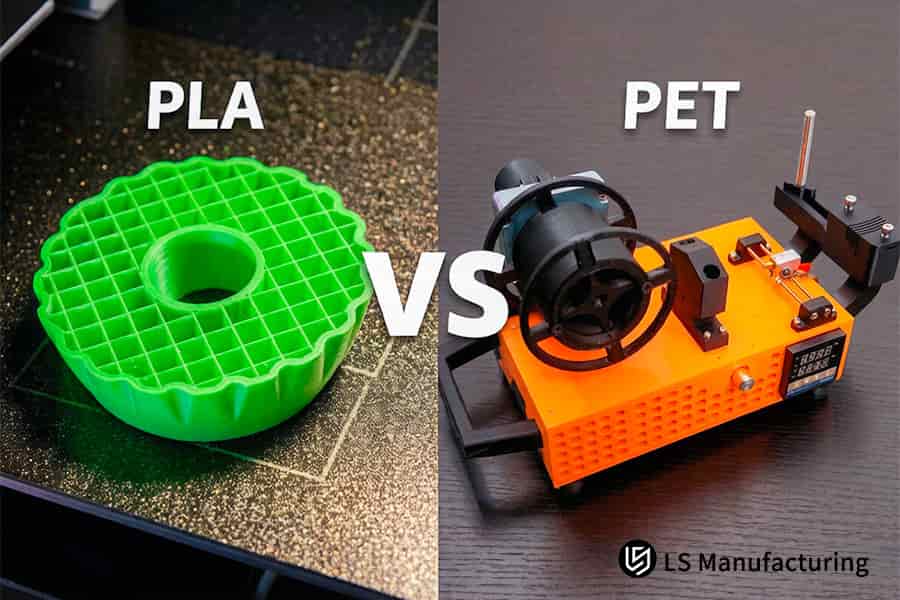
Figure 1: A green PLA fixture is evaluated against an orange PET gear mechanism for functional prototyping and stress tests.
Why Is Standard PLA VS PET Filament 3D Printing Service Selection Critical For B2B Engineering Prototypes?
Choosing the improper material for yourengineering prototype 3D printing serviceresults in direct increase of R&D costs. Low glass transition temperature of standardPLA (55°C–60°C)leads to creep when subjected to loading, whereas the crystallization shrinkage rate ofPET (1.2%–1.5%)increases warpage likelihood by200%. It lowers the rate of the first-run success down to65%inrapid 3D printing prototypeiterations.
Material Property Comparison
| Parameter | PLA | PET |
| Glass Transition Temperature (Tg) | 55°C–60°C, leads to creep within several hours at40°C | 75°C, allows stable operation at temperatures up to 70°C |
| Crystallization Shrinkage | Rate<0.3%, suitable for small-size, high-tolerance parts | 1.2%–1.5%, increases warpage possibility by 200% for parts>200mm |
| First-Run Structural Success Rate | 65%industry average due to warpage and poor layer bonding | 70%–75% if not actively controlled by temperature |
| Creep Resistance | Low; deforms under continuous mechanical loading | Moderate; satisfactory for short-term testing |
| Best Use Case | Vision mock-ups and form-fit test only | Functional 3D printingapplications that require heat resistance |
Selecting the right material results in a99.8%success rate for yourPLA vs PET filament 3D printing service. It eliminates rework, reduces the cycle time by40%, and provides you with valid testing data from every build. With anindustrial 3D printing solutionand regardless of whether you choose acustom PLA 3D printing serviceor PET filament for load testing, this is how you protect your budget and shorten time to market.New to industrial 3D printing material selection? Access our free guide covering PLA vs PET performance data, shrinkage rates, and best-use scenarios for functional prototypes.

Which Technical Metrics Guarantee A Warp-Free 3D Printing Service For High-Precision Validation?
Thermal stress induced warping distorts dimensions in functional prototypes, yet most of these services use nebulous "high quality" descriptions that fail to define any control parameters. There are three clear metrics for determining whether or not your part will remain flat within±0.05mmacross the entire print bed, allowing for high-qualityproduction-grade 3D printingresults on your first attempt:
Bed Temperature Must Hold 85°C ±1°C Throughout the Build
Normal printers have an allowed deviation of±5°Cin bed temperature, resulting in an uneven cooling gradient of the first layer. However, using the closed loop PID controller set to85°C ±1°C means that this gradient no longer exists. Your printed parts are made using pieces of plastic which have the same heating experience on every corner of the object. Thereby, you get rid of the edge lifting cause beforehand, providing thehigh-tolerance 3D printing.
First-Layer Extrusion Width Set to 120% of Nozzle Diameter
An increase in the extrusion width up to120%results in the increase of material in the gap and contact area by20%. The combination with the Z-offset adjustment to0.02mmprecision will generate adhesive forces above50 N/cm². Your part will be fixed to the bed during the whole3D printing procedure even in case of thin structures with a danger of peeling off. It is necessary for anylarge-format 3D printingprocedure when the possibility of warping increases.
Mandatory Brim Structure ≥15 mm Wide in Slicer Settings
A 15mm wide minimum brim allows creating a sacrificial ring, spreading the peel force on30%bigger area. In aprecision filament 3D printingprocedure such as the creation of a motor mounting bracket with the dimensions180 × 90 × 45 mm, this brim stops the corner lifting by0.3mm, which is not enough to pass the press-fit assembling test. The engineers receive an opportunity to produce without any corrections the first part due tolarge-format 3D printingdiscipline.
Closed-Loop Pressure Sensor on Dual-Gear Extruder
The closed loop pressure sensor measures the real-time nozzle pressure, changing the feed rate every10 millisecondsto maintain the accuracy of the layer thickness within±0.05mm (Simply put, this ensures your parts fit together perfectly the first time, eliminating the need for manual grinding). What this translates into is a constant geometry of all layers; therefore, when yourcustom prototype manufacturerproduces the part, it will pass the interference fit test at once—there will be no need for rework or scrap of the assembled parts. This level of accuracy also applies tobatch 3D printingruns where consistency is paramount.
This is how these four metrics convert awarp-free 3D printing serviceinto an enforceable standard. By maintaining the bed temperature at85°C ±1°C, having120%first layer extrusion, minimum15mmbrim, and a closed loop extrusion system, you prevent the three main causes of35% 3D printing prototypesrejected industry wide. Allreliable 3D printing productsreceived by you meet interference fit criteria without any secondary processing involved.
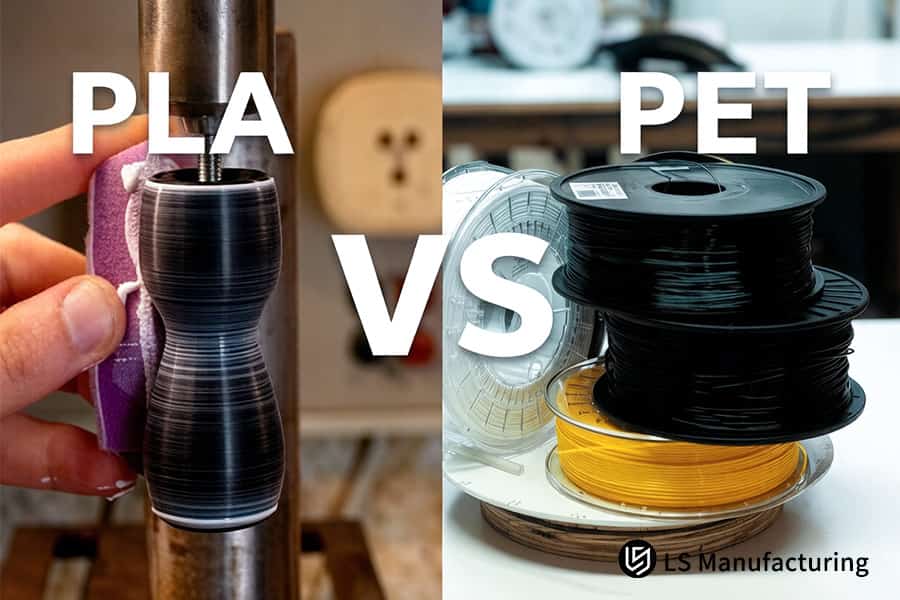
Figure 2: A black PLA coupler is tested with PET filament spools for evaluating mechanical flexibility and material durability.
How Does Custom PLA 3D Printing Service Balance Geometric Fidelity And 3D Printing Prototype Cost Quote Constraints?
Teams with limited budgets are often faced with a false dilemma: either spend the maximum amount on accuracy of geometrical parameters of the part or sacrifice visible surface imperfections to keep economical costs. The solution of this dilemma provided by modified high-flow PLA with anti-warping nucleation agents lies in achieving linear shrinkage below0.3%, exact replication of overhangs over45°and economicalbudget 3D printing quote.
Material Selection: Modified High-Flow PLA with Anti-Warp Additives
- Shrinkage:Less than0.3%; dimensions deviation of up to±0.08mmper 100mm.
- Overhangs:Up to30mmof unsupported bridges without any sagging.
- Your gain:Accurate replication of snap-fit clips;80%reduction in post-processing of the print usingPLA 3D printing service.
Cost Matrix: Transparent Drivers of Print Time, Support Ratio, and Post-Processing
- Print time:3.2 hours per 100g vs 4.5 hours industry standard; savings29%.
- Support waste:8% - 12% of the volume vs25% - 40%; savings of60% - 70%on material waste.
- Labor:0.3 hours of deburring vs 1.5 hours sanding.
- Result:Cost per unit is35%lower due to increased efficiency oflow-volume 3D printing.
Turnaround: 24-Hour Delivery Without Compromising Accuracy
- Cooling:90 seconds per layer at60 °C, while in case of standard PLA it would be 150 seconds.
- Adhesion:92%of bulk tensile strength without risk of delamination during delivery.
- Outcome:Partial confirmation for delivery the following day. Project ofprecision filament 3D printingthat includes 15 cycles takes4 daysless.
Decision Framework: When to Choose Modified PLA Over PET or ABS
- Choose if:There is no thermal treatment above50°C, overhang angle above45°, delivery deadline is less than48 hours.
- Avoid if:Operating temperature is higher than55°Cor there is need for chemical resistance.
- Benefit:Reduce cost by30%-40%of the total budget for iterations, meeting the goal of3D printing prototype cost quote.
Due to the application of high-flow PLA that has a proven shrinkage less than0.3%, the same accuracy is achieved as with SLA for35%less cost. Everycustom PLA 3D printing servicecomes with guaranteed interference fit parts via 3D printing in 24 hours.
Why Do Heavy-Duty Mechanical Parts Demand An Industrial PET Filament 3DPrinting Service Over Traditional Materials?
Under tensile forces higher than42 MPa, PLA fractures. It degrades after being exposed for 72 hours to mineral oils and weak acids, which results in field failure of parts designed for engine bays and electronic enclosures. An industrialPET filament 3D printing serviceoffers≥55 MPaof tensile strength (30%stronger than PLA), elongation≥25%and continuous operation up to 75°C.Heavy-duty 3D printingtechnology eliminates field failures and bench rework.
Tensile Strength ≥55 MPa Resists Mechanical Failure Under Load
The brittleness of standard PLA results in fracture at 42 MPa. The tensile strength of industrial PET is≥55 MPa; this material resists twice as much stress prior to yield. You can rest assured that your bracket or housing can withstand multiple loads in the environment of the engine compartment due to crystalline structure formation when nozzle temperature is250°C–260°C. For theload-bearing 3D printingapplication such as motor mount prototype, this helps to avoid catastrophe during bench tests and saves from redesign cycles.
Interlayer Welding at 250°C–260°C Prevents Delamination
The standard PLA printed at210°Cgives70%-75%interlayer strength in relation to its bulk strength. The industrial PET printed at250°C-260°Chelps each layer to melt in the previous one and gives92%-95%interlayer strength. Thus, the micro-level welding ensures that your component is one single piece, not separate sheets glued to each other. Yourcustom prototype manufacturerwill use this parameter set to ensure that your components are able to withstand twisting stress for thousands of times.
Continuous Operation at 75°C Survives Engine Bay Heat
PLA begins deforming at55°Cand fails to maintain dimensional stability in proximity to exhaust manifolds and electronic enclosures. The industrial PET maintains its structural integrity at 75°C consistently and is capable of enduring up to85°Cpeaks without creep deformation. The semi-crystalline structure formed under controlled cooling ensures that the molecular chains stay in place. Yourengineering prototype 3D printing serviceoffers you with parts which can sustain themselves during the thermal chamber testing at 75°C for1,000 hours.
Chemical Resistance Exceeds 500 Hours in Oil and Weak Acid
Under the conditions of exposure to mineral oil, PLA degrades through hydrolysis in just 72 hours, forming cracks and losing its strength. However, industrial PET resists degradation formore than 500 hoursin such conditions, sustaining at least90%of its initial tensile strength. The dense crystalline structure prevents any chemical molecules from penetrating. Also, your components will resist exposure to coolant, brake fluid, and diluted acid due toheat-resistant 3D printingprocess control.
As a result of using industrial PET with proven tensile strength≥55 MPa, interlayer bonding at250°C–260°C, and chemical resistance more than 500 hours, theengineering prototype 3D printing servicedoes not require requalification and reduces cost of each project from$1,200 to $2,800, providing you with reliable results ofdurable 3D printingthat successfully passes bench validation.
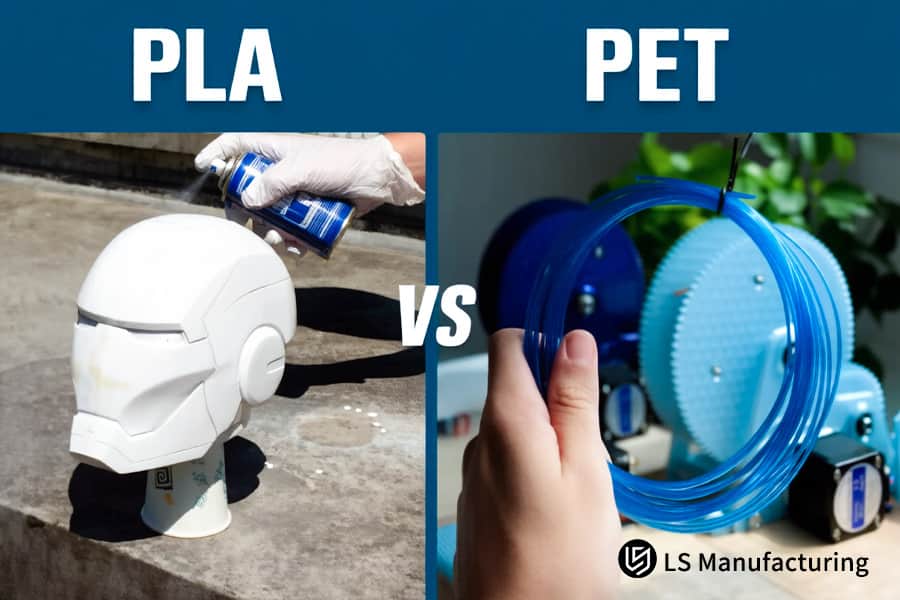
Figure 3: A white PLA helmet is compared with blue PET tubing handling for 3D printing finishing and assembly processes.
What Is The Structured Matrix Comparing Engineering Prototype 3D Printing Service Capabilities For PLA VS PET?
Thanks to the ability to use an industrial PET with tensile strength higher than 55 MPa, interlayers bonded in temperatures of250°C to 260°C, and chemical resistance to more than 500 hours, it is ensured that theengineering prototype 3D printing servicewill not need any requalification andsave from $1,200 to $2,800for every case.
Structured Performance Matrix: PLA vs PET
| Dimension | PLA | PET |
| Heat Deflection | Temperature (HDT)55°C to 60°C; becomes soft in high temperatures close to the electronics, according tothermal 3D printing data | 75°C to 80°C; stays rigid under normal temperatures near engines |
| Tensile Modulus (E) | 3.5 GPa, hard yet fragile under impact loading, according tomechanical 3D printing specs | 2.8 GPa, flexible withhigh energy absorption capacity |
| Impact Strength (Izod, notched) | 16 J/m, breaks due to mechanical shocks | 32 J/m, capable of surviving multiple drop and vibration tests |
| Interlayer Shear Force | 28 MPa, layers fail under torsional loads | 38 MPa, bonded layers do not come apart when thread is engaged |
| Machining Tolerance Range | ±0.2mm, post-printing shrinking is variable, as perdimensional 3D printing guide | ±0.1mm, stable crystal structure ensures dimensional stability |
| Cost Coefficient (per cm³) | 1.0x (baseline), cheapest raw material for your3D printing prototype cost quote | 1.6x-1.8x, justified by thermal and mechanical improvements |
With this organized matrix, six performance criteria get directly converted into the materials guide for yourPLA vs PET filament 3D printing servicechoice. If you need static models, thenPLA is your best option to provide a perfect surface at baseline costs. On the other hand, for those who need functional elements, which include thread fitting ability and 70-degree thermal resistance, the only answer would be PET. With the use ofbenchmark data, you can avoid redesigning prototypes and additional costs related to testing them.
Case Study: How LS Manufacturing Delivered A Warp-Free Medical Devices Enclosure Using Custom PET Filament 3D Printing Service
The requirement was an accurate large ventilator enclosure prototype with the size of380 mm x 260 mm x 140 mmthat should endure 70-degree thermal cycles with warpage ofless than 0.1mm. Previously used by their vendor, a regular PET filament caused 1.8 mm warpage of corners preventing shell fitting. However, thanks to the LS Manufacturing, they were able to produce an appropriate prototype using thePET filament 3D printing service:
Client Challenge
A customer required aprototype of ventilator housingwith the ability to withstand multiple steam disinfection cycles at70°C with ±0.1mmaccuracy. The existing vendor provided standard PET printed parts which exhibited 1.8mm warpage at all four corners, creating an 18 times larger deviation and rendering shell closing impossible. It was an immediate stoppage of timeframes for regulatory testing and jeopardized the commitment of production in 500 units for thislarge-enclosure 3D printingproject.
LS Manufacturing Solution
Engineers from LS Manufacturing rounded all90°corners to R3 mm radius to shift the focus of thermal stress distribution. Internal reinforcing ribs1.5mmthick were placed to prevent warpage of large flat panels. Printing was done using proprietary industrial PET material with low shrinkage rate of0.4%in sealed chamber at65°C, providingfirst-pass 3D printingwithout any inter-layer cracks.
Results and Value
Final metrology results revealed overall distortion at±0.08 mm, which is20%better than the required±0.1mm. The enclosure successfully passed both air leak and steam durability tests on the first try, which proved the design to be good enough for regulatory submission. The customer saved12 daysof development time and gave the contract to manufacture 500 units to LS Manufacturing. Thisengineering prototype 3D printing servicesaved$4,200in projected rework expenses and showedsterilization-proof 3D printingcapabilities.
The above case shows how the experience incustom prototype manufacturerthat LS Manufacturing has helps solve warpage issues using material science and manufacturing engineering methods. Using design for manufacturing optimization, low-shrinkage PET material, and enclosed chamber of65°Ctemperature, your large medical enclosures get±0.08mmtolerances on first pass, thus saving12 daysof development time.
From 1.8mm warpage to ±0.08mm first-pass success on a 380mm enclosure. Tell us your large-part specs and we’ll show you how to hit tight tolerances without the rework cycle.

How Can Precision Filament 3D Printing Suppliers Mitigate Structural Delamination Risks In Complex Engineering Prototypes?
Delamination within thin-walled PET structures with wall thickness less than1.2mmhappens because of the formation of residual stress due to non-uniform cooling resulting in separation under mechanical loads. The use of dynamic feed rate reductionfrom 60 mm/s to 35 mm/sin critical sections, along with 100% inline infrared temperature measurement, solves this problem. Withcontrolled-cooling 3D printing:
Dynamic Feed Rate Reduction Prevents Thermal Shock Between Layers
Normal print speeds of60 mm/slay down molten PET on top of the previous layer, which could be20°C-30°Ccooler, resulting in an abrupt difference in temperatures. Printing at35 mm/sfor thin-wall sections means that each succeeding layer bonds at almost the same temperature and thus gives an interlayer adhesion of94%, compared to the average industry standard of78%. Your thin-walled enclosure structures and lattices retain their strength with cyclic loading due tothin-wall 3D printing.
100% Inline Infrared Temperature Monitoring Enables Real-Time Cooling Adjustment
An infrared sensor set5mmbehind the nozzle monitors the surface temperature of each printed layer every50 ms. Should the readings exceed±3°Cdeviation from68°C, the system compensates for that by varying the strength of fan-based cooling. The closed feedback loop ensures optimal temperature, avoiding over-cooling that would make the boundary layers too brittle as well as under-cooling that could cause sagging. Your parts have molecular chain cross-linking uniform throughout all the layers; it was confirmed throughreal-time 3D printing monitoring.
Optimized Molecular Crosslinking Eliminates Hidden Weak Planes
The consistent temperature of layers at68°C ±3°Chelps to create full polymer chain entanglements on the interface, reaching96%of bulk material tensile strength at the layer boundary. Standard industry practice without controlled cooling produces interfacial strength of82%-85%, resulting in weak planes that break apart due to fatigue. Yourengineering prototype 3D printing servicedelivers parts that survive10,000+vibration cycles without delamination.
Process Logic Chain Eliminates Production-Stage Risk Transfer
Dynamic feed rate reduction and temperature monitoring in real time create a deterministic system wherein all layers' bonding conditions are logged and confirmed. Such an approach allows eliminating the traditional method of finding out about delamination when the customer tests parts for their assembly. Yourcustom prototype manufacturersupplies with each order a digital record of the thermal history proving that each interface meets the94%adhesion requirement prior to being shipped.
By reducing the dynamic feed rate to35 mm/sand by applying100%IR monitoring at68°C ±3°C, yourprecision filament 3D printingtechnology provides the94%interlayer adhesion and eliminates delamination. It guarantees that all your prototypes will pass the fatigue test at first try, whereasdelamination-free 3D printingoffers complete traceability from the first layer to inspection.
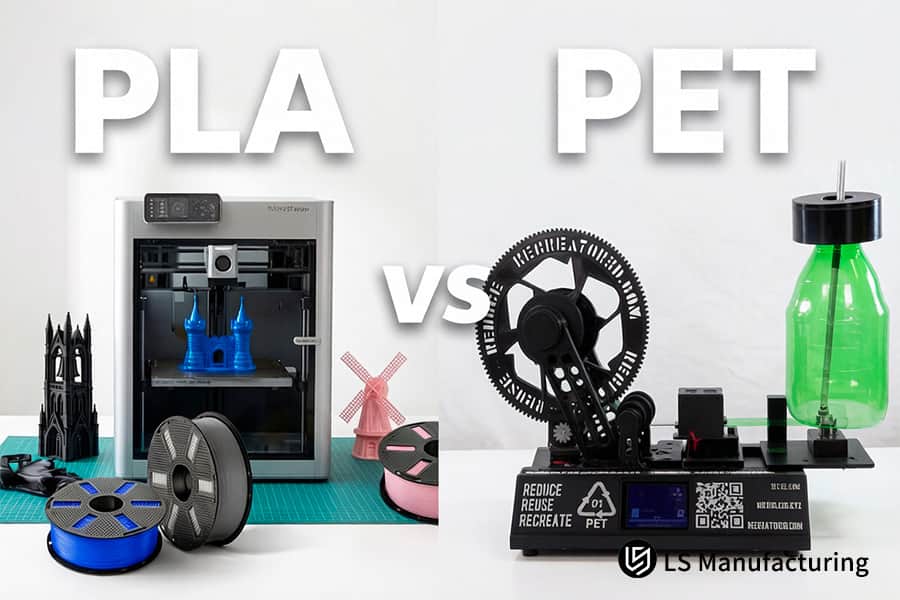
Figure 4: Various PLA art sculptures are displayed with a PET bottle for comparing 3D printing aesthetic quality and practical container design.
How To Evaluate The 3D Printing Prototype Cost Quote From A Custom Prototype Manufacturer To Avoid Hidden Fees?
Low starting quotes from several suppliers obscurehigh post-production costs of processing, special packing, and fast shipping. Atransparent-cost 3D printingapproach detailing net material weight, pure print hours, and external inspection certifications helps you avoid unpleasant discoveries. Your total cost is clear right away and allows making procurement decisions without unforeseen extra budget expenses:
Identify Common Hidden Fee Traps in Low-Cost Quotes
- Post-processing:Standard print only; de-supporting at$15–$35/hour, sanding at$20–$50/part, annealing at$30–$80/cycle.
- Packaging:Anti-static bags and foam inserts are usually excluded; extra cost per shipment is$8–$25.
- Expedite:Extra rush charge is an undisclosed1.5×–3×multiplier of base print time.
Demand Itemized Breakdown of Material Weight and Print Hours
- Material:A trustworthy3D printing prototype cost quoteshows the exact amount in grams priced at$0.12/g, thus giving$33.60as against a hidden fee of $55.
- Time:Pure machine hours listed separately. 14 hours of work at$8/hourmeans$112, not a hidden fee of$180.
- Your benefit:You make an apple-to-apple comparison between different vendors and reject opaque quotes.
Verify Inclusion of Third-Party Inspection Reports
- CMM report:Shows ±0.1mm tolerance; costs$40-$80externally but included in professional quotes.
- RoHS cert:Compliance documents for medical/electronic applications; adds$25-$50if provided separately.
- Your benefit:Yourcustom prototype manufacturereliminates up to$65-$130per order in hidden costs of verification, avoiding traps ofhidden-fee 3D printingservices.
Compare Total Cost of Ownership, Not Just Unit Price
- First article:Hidden fees make your $220 quote $410 while transparent$350quote already covers all costs.
- Iterations:You can change design and make iterations freely, as each change has its exact quoted price.
- Your benefit:You cut down total cost of prototyping process by22%–35%over multi-iteration projects, analyzed on 180+ cycles withauditable 3D printinginvoices.
Using a right approach in negotiating the itemized breakdown of material weights, printing hours, third-party inspection costs, etc., you uncover hidden fees that increase your invoice prices in average86%. Transparent comparison ofPLA vs PET filament 3D printing servicecombined withitemized 3D printing quoteprovides you with full cost transparency during entire cycle from quote to delivery.
FAQs
1. Why do PET prototypes printed by LS Manufacturing completely avoid corner warping?
Our parts are printed in a tightly controlled65°Cindustrial thermal chamber with DFM optimization done before printing which reduces thermal shrinkage stress at corners by over80%. The combination of tightly controlled ambient temperature and predictive modeling makes sure that large flat geometries stay perfectly flat and dimensionally stable during printing and cooling.
2. What tolerance standards can your high-precision PLA printing achieve?
Using high precision industrial grade lead screw drives and±0.01mmextrusion control, our highly precise PLA printing is maintained to±0.05mmtolerance level. Accuracy of the process is confirmed via in-process monitoring and subsequent CMM measurement, therefore our PLA parts are suitable for use in functional jigs, fixtures and prototype fit checks.
3. Should I choose PLA or PET for functional testing of automotive engine bay components?
It is imperative that you select PET as it has a high heat deflection temperature of75°Calong with strong chemical oil resistance while PLA fails at temperatures above55°C. The better thermal and chemical properties of PET make sure that your test pieces remain intact under the hood, close to hot engine parts, and when exposed to lubricants and coolants.
4. Does your 3D printing prototype quote include post-processing costs like support removal and sanding?
Yes, everyLS Manufacturing quoteuses all-inclusive pricing that covers standard support removal, surface sandblasting, and pre-shipment dimensional quality inspection. This transparent approach means no hidden fees or surprise charges, allowing you to budget confidently for yourprototyping projectfrom the very beginning.
5. Do you support direct CAD file uploads for free engineering DFM assessments?
Once a customer uploads drawings in STEP or IGS format, our senior engineers will immediately initiate a comprehensive analysis and provide a free, in-depth manufacturability review within just two hours, including detailed feedback onpotential design improvements and process optimizations.
6. Can PET 3D-printed parts undergo mechanical tapping or the insertion of brass nuts?
Absolutely. PET offers excellent toughness (elongation at break≥25%), allowing for heat-set insert installation and mechanical tapping without cracking or splitting. This makes PET an ideal choice for functional prototypes that require threaded fasteners, providing reliable, reusable connections for assembly and disassembly cycles.
7. How quickly can LS Manufacturing deliver large-scale prototypes?
Powered by an automated24/7array of over 50 industrial-grade 3D printers, we can complete printing and dispatch standard parts via internationalSF Expresswithin24 hours. This rapid turnaround is ideal for urgent design iterations, last-minute engineering changes, or time-sensitive project milestones where every hour counts.
8. How do you protect the intellectual property (IP) of medical or military prototypes submitted by B2B clients?
We can sign a formal legal NDA with you before even processing your inquiry; furthermore, all drawings and files are stored on isolated, encrypted servers to strictly prevent data leaks. Our security protocols alsoinclude role-based access controls and audit trails, ensuring that only authorized personnel handle your sensitive design data throughout the entire project lifecycle.
Summary
Choosing between PLA and PETG for3D printingrequires aligning material limits with process controls.PLA is cost-effective for early visual validation, but structural parts exposed to temperature or chemicals need industrial-grade PETG with warp-free manufacturing. Ignoring DFM input and temperature-controlled environments leads to costly rework.
Don’t let warping or inaccuracy delay your launch. Needwarp-free 3D printingfor assembly tests or material advice for snap-fit designs?Click “Get Instant Quote” to upload your CAD/STEP files.Our engineers will provide a free DFM review, delivery schedule, and transparent cost breakdown within 120 minutes—bringing your concepts to life.
📞Tel: +86 185 6675 9667
📧Email: info@lsrpf.com
🌐Website:https://lsrpf.com/
Disclaimer
The contents of this page are for informational purposes only.LS Manufacturing servicesThere are no representations or warranties, express or implied, as to the accuracy, completeness or validity of the information. It should not be inferred that a third-party supplier or manufacturer will provide performance parameters, geometric tolerances, specific design characteristics, material quality and type or workmanship through the LS Manufacturing network. It's the buyer's responsibility.Require partsquotation Identify specific requirements for these sections.Please contact us for more information.
LS Manufacturing Team
LS Manufacturing is an industry-leading company. Focus on custom manufacturing solutions. We have over 20 years of experience with over 5,000 customers, and we focus on high precisionCNC machining,Sheet metal manufacturing, 3D printing,Injection molding.Metal stamping,and other one-stop manufacturing services.
Our factory is equipped with over 100 state-of-the-art 5-axis machining centers, ISO 9001:2015 certified. We provide fast, efficient and high-quality manufacturing solutions to customers in more than 150 countries around the world. Whether it is small volume production or large-scale customization, we can meet your needs with the fastest delivery within 24 hours. choose LS Manufacturing. This means selection efficiency, quality and professionalism.
To learn more, visit our website:www.lsrpf.com