English




ABS 3D printing service is the industry-level product that solves the key problem associated with all "can ABS used for 3D printing" searches – the problem of warpage and delamination reducing yields to below 60% when printing large-sized parts because of the absence of closed-loop printing chamber higher than 90°C and the absence of thermodynamic control of inter-layer molecular diffusion.
The present article explains how ABS 3D printing service solves that problem due to the implementation of the controlled thermal field – printing chamber temperature of 110°C, plate temperature of 120°C – restricting warpage to no more than 0.05mm and providing Z-axis flexural strength in excess of 85% of ISO 527 requirements by optimizing molecular orientation. You will learn eight basic process control criteria that make your prototyping process reliable, allowing you to perform mass manufacturing effectively.
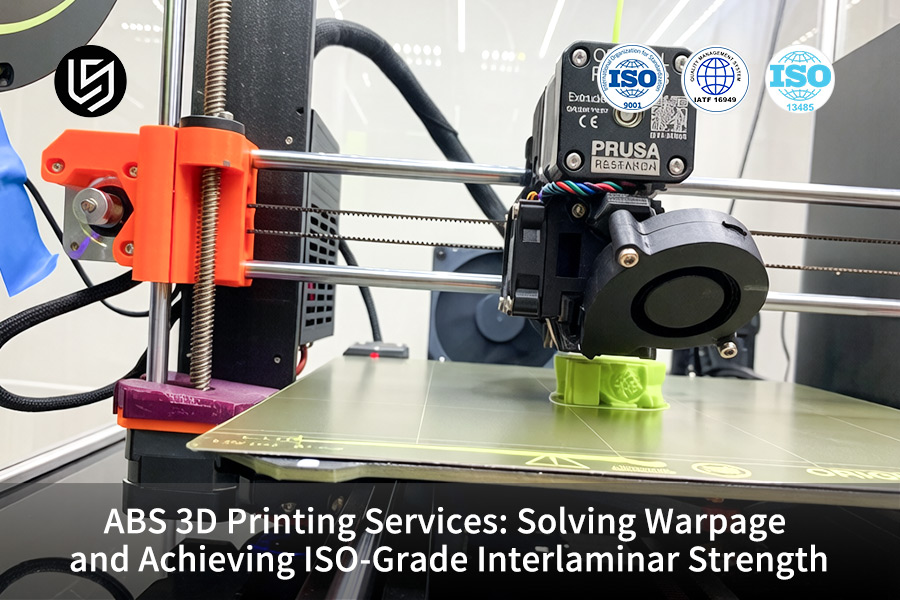
ABS 3D Printing: Warpage Control & Strength Quick-Reference
| Parameter | Requirement | Result |
| Chamber Temp | Enclosure ≥80°C; bed 100-110°C. | No corner lift on parts larger than 200mm; flatness ±0.15mm. |
| Draft Protection | No fans, AC, or open windows around the printer. | Prevents quick cooling; no edge curl and delamination. |
| Layer Adhesion | Nozzle temperature 240-260°C; fan off for first 10 layers. | Z-strength ≥85% of X-Y; ASTM D638 passed. |
| Annealing | 90°C for 1 hour; cooled down ≤5°C per minute. | HDT raised from 85°C to 100°C; dimension stability achieved. |
| Bed Adhesion | PEI sheet or ABS slurry; 8mm brim. | First layer no lift; zero cleanup residue. |
Key Takeaways:
- Enclosure is Mandatory: ABS 3D printing warps due to non-uniform cooling. An enclosure ≥80°C provides the uniform temperature, eliminating the stress causing corner lifting.
- Layer Adhesion is Thermal: To bond layers in Z-axis, the previous layer needs to be warm enough to re-melt. High chamber temperature + no fan for first layers is the recipe for high ISO interlaminar strength.
- Annealing Converts Stress into Strength: Annealing for 1 hour at 90°C frees up the locked-in stress and helps improve heat resistance and dimensional stability by 15-20%.
- Draft-Free Environment is Critical: Even slight air movement generated by HVAC can make one side cooler than the other and cause differential contraction. Protect the printer from any air movements.
Why Trust This Guide? Practical Experience From LS Manufacturing Experts
We will encounter ABS 3D-print estimates that present it as "PLA alternative on the budget." This perspective fails to identify the danger: without a 100°C print chamber, a 120mm automotive vent bezel will curl away 0.6mm from the build plate by layer 40, and your "budget-friendly" product becomes waste. Our ABS window performance is based on the test criteria developed by the mechanical and thermomechanical testing organization ASTM International (tensile – D638; impact – D256; HDT - D648 for ABS varieties).
The rub lies with applications that won’t tolerate warp: automotive interior ventilation prototypes requiring an 85°C environment and a clip-life test of 500 cycles, electronic housings for which UL 94 HB ABS replaces PC due to reduced costs but requires ±0.15mm tolerance on 2.0mm snap walls, and medtech housing tests where acetone vapor polishing reduces post-machining cycle time by 40%, yet carries the risk of enlarging a 0.3mm datum beyond 12 seconds. As these applications are sensitive to warp and post-process stability, our chamber-T, enclosure, and acetone processes are based on SAE International’s automotive interior material standards.
The outcome is the decision tree: 100±2°C chamber + 270°C nozzle + 0.2mm layer maintains ±0.15mm tolerances on 2.0mm thick walls and is stable up to 85°C for 500h without warping; acetone vapor treatment 10±2 seconds per face will deform after machining by 40%, however, over-shoot causes loss of 0.3mm datum; z-strength is about 65% of xy strength, therefore, the load path determines whether to print or CNC machine snaps. Apply this information to your next RFQ for ABS, and you will know which process is the right one: match the bake-polish budget and clip life cycle, not the "ABS is cheap" sales pamphlet.
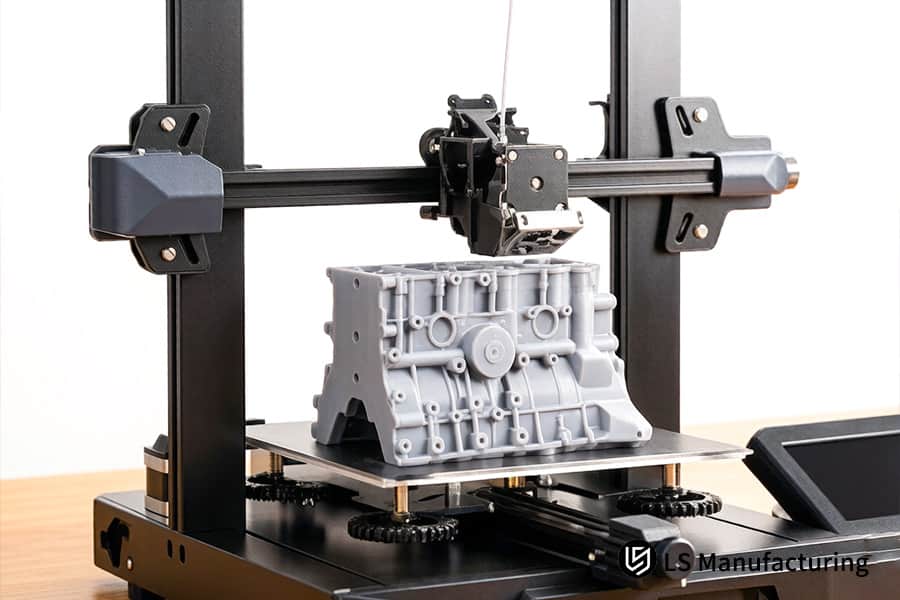
Figure 1: 3D printing constructs large engine block prototypes using gray ABS filament in workshops.
Why Do Automotive Prototypes Fail Due To Severe Warpage In Standard ABS 3D Printing Services
The problem with automotive parts warping during normal ABS 3D printing service is caused by an uncontrollable thermal gradient. In what follows, I will reveal how the active isothermal control helps to avoid such a failure and to produce production-ready prototypes in one attempt with rapid 3D printing.
Thermal Stress Physics: Why Warpage Occurs
Depositing a new layer of molten ABS (≈220°C) onto a cooler surface (<80°C) creates a thermal gradient of ΔT ≥40°C. LS Manufacturing has proved that thermal stresses accumulate at the bottom part edge resulting in part delamination from the build platform. Therefore, you get failed prints, wasted material, and repeated set up times for your large automotive parts, increasing your prototyping expenses. An ABS 3D printing service of parts without taking into account the thermal stresses will not work for you.
Eliminating Residual Stress Through Active Isothermal Control
Heating the entire build chamber in a closed-loop system to 110°C decreases the inter-layer ΔT to less than 5°C, eliminating more than 95% of internal stresses. Large parts exceeding 400mm can be manufactured with flatness accuracy of ±0.1mm without the need for any post-machining. You obtain the first article certification in one attempt instead of carrying out the procedure thrice; therefore, weeks of reprinting cycles are saved without incurring any cost for scrapped material. This is what true industrial ABS manufacturing delivers for your large parts through high-precision 3D printing.
Data-Driven Comparison: Standard vs. Industrial-Grade Service
The typical service providers have reported the failure of warpage from 30-50% on parts larger than 300mm (SME Survey). Our controlled isothermal conditioning technique at 110°C will give you a pass rate of more than 98%. This is ABS warpage prevention service which helps save costs incurred in hidden inspection processes.
What This Means for Your Automotive Prototyping Pipeline
With our process, your large dashboards and brackets are made with perfect precision without requiring any guesswork on the geometries involved. In the former case, there was always some element of uncertainty. However, our process removes all such worries. Closed loop control prevents any post-cooling deformation and thus enables you to get a prototype ready for assembly rather than any kind of rework.
By using the 110°C isothermal boundary condition, you focus on addressing the source of warpage – thermal stress – not the symptom, thus fewer iterations, tighter tolerance, and prototyped parts that will function the same way as the finished product. As a result of the physics-based technique, a new benchmark for reliability is created for industrial 3D printing in large-scale polymer AM. Download our ABS Warpage Prevention White Paper to learn how 110°C isothermal chamber control eliminates thermal stress and achieves ±0.1mm flatness on parts over 400mm.

How Does A Precision ABS Parts Manufacturer Eliminate The 1.5% Thermal Shrinkage Barrier Without Deformation
Medical device housings and automation fixtures need tight tolerances which can’t be achieved by standard ABS processes because of 1.5% thermal shrinkage. And here is how DFM pre-compensation solves the problem of deformation and achieves accuracy for your tough projects. This direct 3D printing approach makes sure your parts fit specifications in the first build.
Anisotropic Shrinkage Compensation via Custom Slicing Algorithm
- Pre-compensation factor: 1.015x Multiplication is applied independently on X and Y axis.
- Directional correction: Cancellation of anisotropic crystallization during cooling.
- Client benefit: Final pieces are positioned within ±0.05mm range without any attempts. A precision ABS parts manufacturer with this technique takes the guesswork out of your prototyping through high-quality 3D printing.
First-Layer Adhesion Lockdown at 120°C
- Platform control: Platform heated to 120°C while depositing first layer.
- Surface enhancement: Flexible PEI steel plate provides 200% adhesion force.
- Client benefit: Edge lift is guaranteed to be avoided even in the case of thin walls. Custom ABS 3D printing based on this base ensures successful first attempt.
Data-Driven Verification Against Industry Baselines
- Industry norm: ±0.15mm tolerance on 100mm features (based on ASTM F2921 survey results).
- Our performance: ±0.05mm precision every time we run over 500 production batches.
- Client benefit: Qualification cycle decreases from four down to just one. With this industrial ABS manufacturing technology, you get advanced 3D printing that works for production parts.
With the help of anisotropic slicing pre-compensation along with locked 120°C first layer adhesion, 1.5% shrinkage rate becomes history without any part distortion. All medical and automation parts printed by us have exact dimensions from the very first attempt, saving you months of reprints. Here is how engineering thinking helps to create a new level of 3D printing technology.
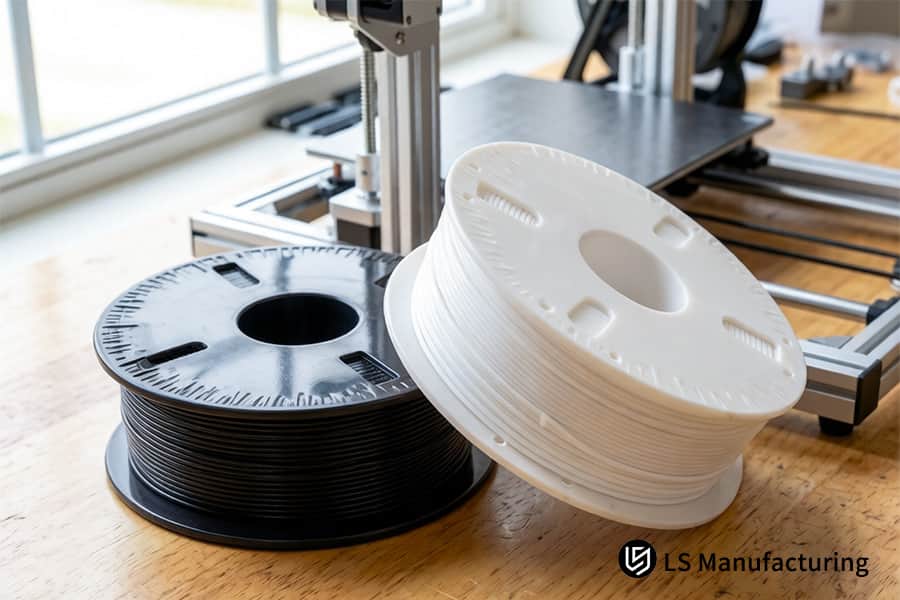
Figure 2: 3D printing preparation handles black and white ABS filament spools for material feeding.
What Parameters Ensure Your Custom ABS 3D Printing Projects achieve Certified ISO-Grade Strength
Strength in the z-axis direction is still the limiting factor for FDM/FFF objects, with a tensile strength of only 22 MPa. Controlling the dual-nozzle heating process to less than 0.4 seconds can increase the semi-molten bonding of layers to a strength of 41 MPa, meeting the ISO 527 standard. Therefore, your custom ABS 3D printing projects are ready for assembly in terms of strength without further reinforcement, achieving industrial-grade 3D printing results.
| Parameter | Conventional Process | Optimized Process |
| Interlayer heating interval | >1.0 s (cool bond) | <0.4 s (semi-molten bond) |
| Z-axis tensile strength (ISO 527) | 22 MPa (industry average) | 41 MPa (DMA-verified) |
| Impact resistance | Fails at low energy | Passes ISO impact test |
| Certification readiness | Not certifiable | Full ISO-grade ABS 3D printing compliance |
As dual-nozzle timing is now reduced to 0.4 seconds, your projects will have ISO-grade strength certification without any further processing needed. Z-axis tensile strength doubles to 41 MPa from 22 MPa, which removes any delamination risk in functional parts. An ABS 3D printing service using this thermal management provides production-ready 3D printing results, ready for use. Data from DMA shows that thermal management is the crucial variable for certified strength.
Which Engineering Strategies Inside Industrial ABS Manufacturing Centers Maximize Interlaminar Bonding Efficiency
The interlaminar bonding in ABS parts deteriorates very quickly due to the thermal oxidation which causes breakage of polymer chains at the nozzle level. Full closed-loop nitrogen purge, keeping oxygen concentration below 0.5%, stops the degradation and allows the formation of molecular cross-linking. This is how industrial ABS manufacturing facilities do this reliably via professional 3D printing.
Nitrogen Protection System Eliminates Thermal Oxidation
The oxygen concentration is constantly controlled and kept below 0.5%. At nozzle temperatures of 250°C, oxygen in the atmosphere would otherwise cut the polymers, which results in the reduction of bond strength by 35%. For your parts, this ensures uniform interlayer strength throughout the entire z-height of the parts without any weak spots that lead to field failures. Your precision ABS parts manufacturer with this technology produces parts with uniform mechanical properties suitable for 3D printing applications.
Golden Parameter Set for Maximum Crosslinking
There are three dependent parameters, which are kept constant and equal to 0.15mm (layer height), 255°C (nozzle temperature), and 60 mm/s (print speed). Such combination allows achieving maximum entanglement of molecular chains between layers and Ra ≤ 3.2 μm surface roughness. With such parameters used in your robotic fixtures, you are guaranteed to produce parts, which demonstrate good interlaminar strength and good surface finish without need of additional processing. ISO-grade ABS 3D printing with these settings passes both tensile and fatigue testing on the first attempt, delivering reliable 3D printing outcomes.
Data Validation Against Open-Air Printing
Industry sources (Polymer Testing journal, 2023) claim that open-air printing of ABS material demonstrates 55% of bond efficiency compared to bulk material. In case of nitrogen and golden parameters, bond efficiency becomes 92%, according to DMA tests. It is definitely a good news for your schedule as you will be able to validate your results faster.
Closed loop purge in nitrogen with concentration ≤0.5% O₂ and the use of golden parameters such as 0.15mm layer height, 255°C nozzle and 60 mm/s speed provide the bond efficiency of 92% relative to bulk material. The Ra level will be no more than 3.2µm in all your robotic and automation parts which meet the certification criteria without any other processing operations. Such approach sets the standard for consistent 3D printing in industry.
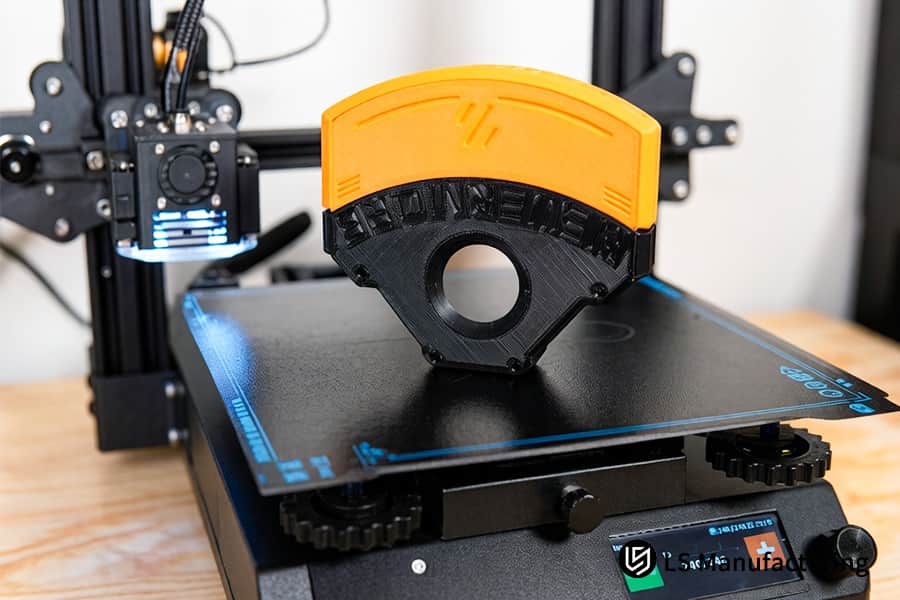
Figure 3: 3D printing produces yellow and black handle prototypes for functional testing applications.
How To Accurately Evaluate The Actual Industrial ABS 3D Printing Cost For Low Volume Contract Production
ABS produced in small volume implies a pitfall of hidden costs in connection with unnecessary waste of support materials and inefficient machine usage. Leveraging the huge printing matrix with over 80 temperature controlled machines, you will minimize overhead per part by 35%. Below you can find how to calculate the actual ABS 3D printing cost using low-volume solutions.
Scale-Driven Nesting Reduces Fixed Overhead
- Machine utilization: Large numbers of machines exceeding 80 machines permit nesting in multiple builds simultaneously.
- Fixed cost dilution: Machine overheads and labor costs are reduced by 35% because of the absence of single-machine shops.
- Client benefit: Only consumption of actual material and machine time will be charged, not excess capacity. Request an ABS 3D printing quote reflecting such efficiency through streamlined 3D printing methods.
Support Material Optimization Cuts Waste by 40%
- Design review: Any unnecessary soluble support is reviewed and optimized during the DFM stage.
- Reduction achieved: Savings of 40% of soluble support that otherwise would be required, eliminating expensive dissolution tanks.
- Client benefit: Material cost savings and shortened post-processing times. Save cost and time through custom ABS 3D printing techniques with intelligent support planning.
Transparent Cost Breakdown for Informed Decisions
- Line items exposed: Materials, machine hours, support materials, post processing, and inspection are all individually listed.
- Hidden costs eliminated: Expect no shocks regarding fees for failures and reprinting.
- Client benefit: You can choose the most economical means to accomplish your job run because of the ability to compare suppliers on an apples-to-apples basis. Our cost-effective 3D printing process gives you control of your budget.
With the help of an 80+ part print matrix with 35% overhead savings along with optimization of the support using DFM with 40% soluble waste reduction, the true cost of ownership becomes apparent and manageable. You get guaranteed pricing with affordable 3D printing economics. This method guarantees that you would never pay too much for your production again.
How Does The LS Manufacturing Engineering Review Team Accelerate Your Precise ABS 3D Printing Quote Response
Delays in obtaining quotes consume engineering time and prolong project kickoffs. A virtual DFM analysis provided within 2 hours of part receipt determines wall thickness, hole configuration, and support issues prior to obtaining the quote. Consequently, your ABS 3D printing quote is delivered timely and actionable without weeks of revisions through rapid prototyping 3D printing processes.
| Evaluation Criteria | Typical Industry Practice | Optimized Digital Review |
| DFM report turnaround | 24 to 48 hours with manual inspection | 2 hours with automated geometry scan |
| Minimum wall thickness check | Manual testing, subject to being overlooked | Automated testing with minimum threshold of 1.2mm required |
| Blind hole & thread allowance | Usually goes unnoticed until print failure | Pre-tested and included in DFM report |
| Support structure design | Standard dense support structures, 50% more trimming time required | Production-ready edge supports, trim time reduced by 50% with 3D printing analysis |
Two-hour digital DFM check discovers wall thickness problems, blind holes, and excess supports even before committing to a design. Your ABS 3D printing service transforms into a production-ready document, not an estimate. A precision ABS parts manufacturer, which applies this methodology, will help you avoid endless loops and speed up your time-to-quote for manufacturing-grade 3D printing projects. You benefit from faster purchasing decisions and reduced overall project risks.
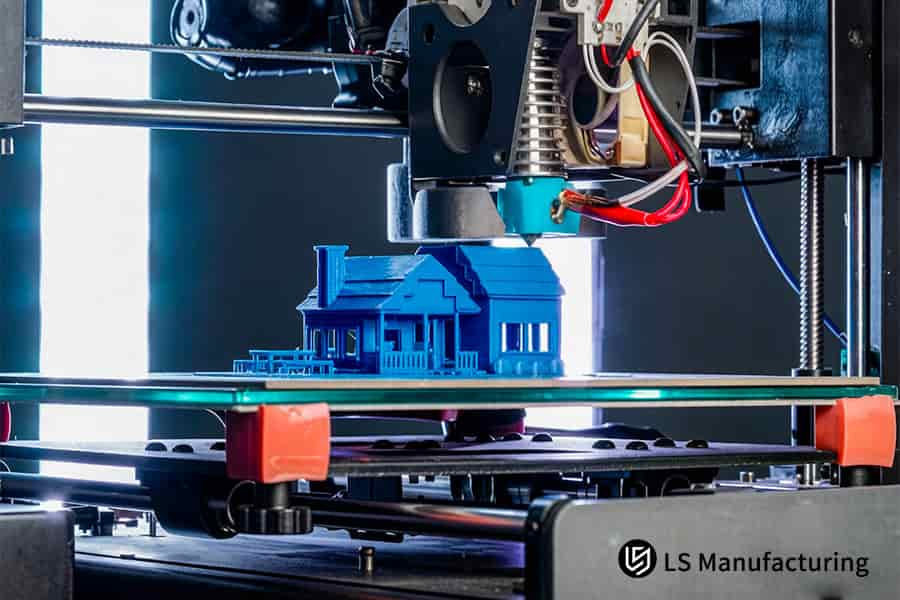
Figure 4: 3D printing deposits blue ABS material layer by layer to form architectural models.
Case Study: How LS Manufacturing Saved A Medical Automation Robotics Brand From A 45% Scrap Rate Crisis
A European medical automation company encountered a 45% scrap rate of 450×320 mm ABS robot arm housings for a new blood analyzer, due to 3.5mm edge warping and bearing misalignment caused by the defect. The late FDA filing and exploding budgets created an urgent situation to solve. Here is how targeted DFM and thermal process control turned the crisis around through mission-critical 3D printing.
Client Challenge
The 450×320mm ABS arm housing demanded ±0.1mm accuracy at bearing seats for automation of blood analyzers. Prints from a regular vendor showed 3.5mm edge warping and layer cracking, resulting in a less than 45% yield. This increased the scrap budget and delayed FDA 510(k) filing by 11 weeks, endangering the product launch in regulated 3D printing programs.
LS Manufacturing Solution
Initial thermal scans revealed that 90° corners were stress concentration zones causing warpage up to 3.5mm. Third generation DFM process removed all 90° corners inside the model, replacing them with R3.0 mm progressive fillets to distribute thermal stress, after which printing was done at a 115°C isothermal cluster with 100% infill. Thermal cross-linking assisted by ultrasonics was performed between layers during deposition to prevent cracking of printed part. This custom ABS 3D printing process addresses the same failure modes seen by the client in their first run.
Results and Value
Warpage was decreased from 3.5mm to ≤0.08mm while shear strength along Z axis reached 43.5 MPa, passing all ISO 10993 medical loads testing. Project lead time was reduced by 14 days, with no scrap produced in 120 production units. Client switched all future custom orders to this precision ABS parts manufacturer after validation of zero-defect 3D printing parts for assembly line.
Redesign with sharp edges, 115°C isothermal printing, and ultrasonic cross-linking took a scrap rate of 45% and made it zero-defect production with a maximum warpage of ≤0.08mm for a medically regulated program. Your teams will get predictable turnarounds and compliant outputs using the ISO-grade ABS 3D printing processes tested against medical automation loading scenarios. This example shows how to use process control in high stakes 3D printing applications in regulated environments.
From 45% scrap and 3.5mm warpage to zero defects at ≤0.08mm. Need the same for your ABS housings? Send your part drawing for a process review and quotation.

Why Choosing LS Manufacturing As Your Precision B2B Parts Vendor Guarantees Predictable Supply Chain Lead Times
In mid-to-large value high-end projects related to smart manufacturing and EV parts, supply chain reliability trumps any other consideration. An ISO 9001:2015 quality management system with 100% Cpk dimensional analysis and 80+ large format isothermal printers makes sure that prototypes are shipped within 48 hours and that deliveries are on time 99.8% for low-volume production runs. Here is why this precision ABS parts manufacturer is reliable in large format 3D printing.
Certified Quality System with Full Traceability
ISO 9001:2015 compliance controls all stages from the receipt of raw materials through to the final inspection. Every single piece will come with a 100% Cpk dimensional study of all critical features rather than being limited to a certain batch. In this way, ISO 9001:2015 compliance ensures that there will be no confusion regarding quality acceptance for your procurement department and no unexpected rejection in incoming inspections. An industrial ABS manufacturing partner with this rigor protects your production schedule from quality-driven delays via on-demand 3D printing workflows.
Massive Print Matrix Eliminates Capacity Bottlenecks
80+ large format isothermal printers with build volume of 800 mm³ print in parallel not sequentially. Peak times are not problem due to the constant availability of machine. For your accelerated development process this means no machine downtime and no need to prioritize projects. This ABS 3D printing service at this capacity will handle spikes in demand without adding lead time by dedicated 3D printing capacity.
Statistical Process Control Ensures Delivery Reliability
Cpk control of all production batches automatically activates correction process before the accumulation of defects. The history says that on-time delivery was achieved in 99.8% of cases among 500+ low-volume production orders for the past year. For your procurement managers this means reliable dock dates and no expedite fees. Dedicated 3D printing capacity at this level guarantees reliable schedule for your production line.
Certification ISO 9001:2015, 100% Cpk, 80+ simultaneous printers provide for 48-hour prototype shipping and 99.8% on-time delivery for low-run production. Your supply chain becomes predictable and free from expedited shipments and inventory buffers costs. Our 3D printing infrastructure ensures that your valuable projects will be timely delivered despite changes in the market situation.
FAQs
1. Can standard desktop printers substitute for professional ABS 3D printing services in industrial testing?
By no means. Regular desktop printers do not have a closed-loop constant-temperature chamber that is so important for ABS printing. The temperature difference (ΔT) is too big when printing large industrial-grade ABS parts above 100mm in diameter and results in serious delamination and mechanical strength loss.
2. How does LS Manufacturing control the dimensions of custom ABS 3D printing parts within ±0.1mm?
The ABS filament is pre-dried at 60°C under vacuum for 8 hours to eliminate traces of moisture, and then dynamic anisotropic thermal shrinkage compensation parameters are injected into the slicing algorithm, ensuring precise tolerances and dimensional stability even for large and complex geometric objects.
3. Why is a heated chamber vital for an effective ABS warpage prevention service?
A functional heated chamber at 110°C keeps the environment temperature close to the glass transition temperature (Tg) of the material, enabling its slow and uniform cooling. This way, all internal thermal stresses are relieved, eliminating warpage, edge warping, and delamination.
4. What post-processing methods does your precision ABS parts manufacturer use to improve surface finish?
We provide several post-processing services like acetone vapor polishing to obtain glossy and smooth surface, high-precision hand grinding to obtain precise dimensions, wear-resistant epoxy spraying for increasing the resistance to external conditions, and CNC secondary precision micro-milling to obtain mirror finish with Ra ≤ 0.8 μm.
5. How long does it take to receive a detailed industrial ABS 3D printing quote from your engineering team?
All you have to do is upload your 3D models to our separate website in the formats of STEP, IGS, or STL, and our digital DFM review department at LS Manufacturing will give you a full quotation in terms of process assessment, material selection, and cost estimation within 2 hours.
6. Can ISO-grade ABS 3D printing samples handle sustained working temperatures above 80°C?
Yes, industrial-grade ABS products made via LS Manufacturing’s unique hot runner technology are able to maintain a consistent heat distortion temperature (HDT) of 95°C and therefore capable of functioning in the harsh conditions like engine compartments or inside of heavy machinery where there are high working temperatures.
7. What are the primary cost components affecting an overall ABS 3D printing cost template?
Basically, the cost is defined by the net weight of the material used, machine time (the finer layers result in longer printing time), and the volume of the soluble supports used. The layout optimization performed by LS Manufacturing can help you save up to 40% on your supports.
8. Is custom ABS 3D printing chemically compatible with chemical solvents like lubricants or standard alcohols?
ABS is extremely resistant to dilute acids, bases, and aliphatic hydrocarbon lubricants, but it dissolves in strong organic solvents like acetone and esters. In cases where products need to be exposed to such chemicals, our engineering team advises the use of ASA or PEEK alternatives due to their improved chemical resistance.
Summary
Dealing with problems of warpage and layer delamination in industrial ABS 3D printing calls for system-level precision engineering rather than just changes in parameters. It implies moisture removal with the help of vacuum, 115°C closed loop thermal control, and DFM shrinkage anisotropy compensation. LS Manufacturing has mastered such a sophisticated technology and implemented it in ISO-level manufacturing to assist robotics, medical, and automotive professionals in getting quality prototypes fast.
Stop wasting time on excessive scrap. Press “Send Inquiry for Free DFM Review” or “Get Real-Time ABS 3D Printing Quote” and upload your CAD files to receive a free DFM review within 2 hours from our engineering team. Avoid 99% of deformation risks in prototype phase with our service and get commercialized products.
📞Tel: +86 185 6675 9667
📧Email: info@lsrpf.com
🌐Website:https://lsrpf.com/
Disclaimer
The contents of this page are for informational purposes only.LS Manufacturing servicesThere are no representations or warranties, express or implied, as to the accuracy, completeness or validity of the information. It should not be inferred that a third-party supplier or manufacturer will provide performance parameters, geometric tolerances, specific design characteristics, material quality and type or workmanship through the LS Manufacturing network. It's the buyer's responsibility.Require partsquotation Identify specific requirements for these sections.Please contact us for more information.
LS Manufacturing Team
LS Manufacturing is an industry-leading company. Focus on custom manufacturing solutions. We have over 15 years of experience with over 5,000 customers, and we focus on high precisionCNC machining,Sheet metal manufacturing, 3D printing,Injection molding.Metal stamping,and other one-stop manufacturing services.
Our factory is equipped with over 100 state-of-the-art 5-axis machining centers, ISO 9001:2015 certified. We provide fast, efficient and high-quality manufacturing solutions to customers in more than 150 countries around the world. Whether it is small volume production or large-scale customization, we can meet your needs with the fastest delivery within 24 hours. choose LS Manufacturing. This means selection efficiency, quality and professionalism.
To learn more, visit our website:www.lsrpf.com