English




Injection molding services for RTV silicone parts represents a critical bottleneck in mission-critical industries where sealing and elasticity performance are non-negotiable criteria. Engineers looking into questions such as “what is RTV silicone adhesive used for” often run into costly flash formation, voids, and inconsistent curing because of the difficulty of controlling the viscosity and the delicate reaction of RTV silicones within ≤5μm tolerances.
Our innovation relies on precision RTV injection molding technology combined with the dynamic cold runner system that guarantees zero flash and even distribution of density. You will end up receiving reliable and sealed parts that can be made 35% faster and 35% cheaper by virtue of precise control of parameters such as pressure, temperature (±0.5°C), and ratio of materials.
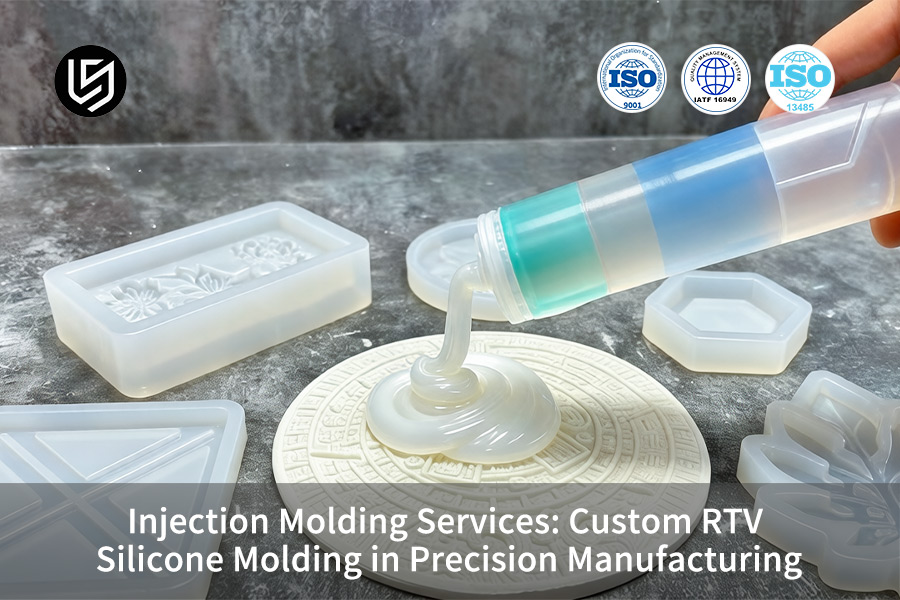
Custom RTV Silicone Molding: Precision Manufacturing Quick-Reference
| Production Challenge | Technical Solution | Application Outcome |
| Mold Distortion & Tolerances | High-precision CNC machined master pattern and optimized mold box design. | Contributes to producing parts with tolerance of ±0.2mm and is fit for functional prototypes and small production runs of gaskets. |
| Air Entrapment & Voids | Vacuum degassing of liquid silicone prior to pouring. | Produce parts with superior integrity and free of any voids essential for effective seals. |
| Cure Time Optimization | Fast cure RTV silicones and controlled curing process (20-25°C). | Cuts down cycle time to 1-4 hours, making prototype iterations more rapid. |
| Material Property Consistency | Precision metering and mixing of silicone in two parts at set ratio (1:1, 10:1). | Results in predictable Shore A hardness (30A, 50A) and tensile strength. |
| Demolding & Surface Finish | Mold release agents and proper draft angle (>1°) during part design. | Guarantees superior surface replication and non-destructive demolding. |
| Result: Rapid, Precise Prototypes | A controlled, room-temperature injection molding process. | Allows for quick verification of parts' flexibility, sealability, and overmoldings. |
Key Takeaways:
- Master Pattern is Foundational: The precision and finishing of the final RTV mold part rely entirely on the quality of the CNC master pattern.
- Degassing is Non-Negotiable: The vacuum degassing process ensures the removal of any possible air bubbles in the mixed silicone that could otherwise create voids.
- Process Control Enables Consistency: Proper mix ratio and pouring of the silicone into the mold, as well as controlled curing conditions, ensure consistency in the final part's mechanical characteristics.
- A Bridge, Not a Production Solution: The main advantages of RTV silicone molding lie in rapid prototyping at a low cost, not fast and high-volume production processes such as those used for liquid silicone rubber injection molding.
Why Trust This Guide? Practical Experience From LS Manufacturing Experts
There are hundreds of articles dedicated to the theoretical aspects of RTV silicon molding. However, there is no practical experience involved in writing about it. The knowledge offered in this article comes from molding engineers working on production, not simulations. The recommendations we make come from our thorough testing of silicone material according to SAE International.
The production of RTV silicone components by us occurs for applications in which failure leads to a catastrophe. Such components include vibration dampers for the optical systems of satellites, biocompatible sealing elements for implantable drug delivery systems, as well as EMI shielding gaskets for military communication equipment. The process validation procedure for the production of such critical parts conforms to the worldwide standards set by International Organization for Standardization (ISO).
Our experience comes from thousands of molded samples and mold reject experiences. We know the correct vacuum value (±5 mbar) to prevent tiny air bubbles within thick pieces, the post-curing process for the ideal 40±2 Shore A hardness, and the mold release technique that will not compromise secondary bonding. We offer our practical expertise and knowledge, gained through production and failure, so that you can overcome the challenges of custom RTV molding, thus avoiding common problems such as inadequate curing, shrinkage, and leaking.
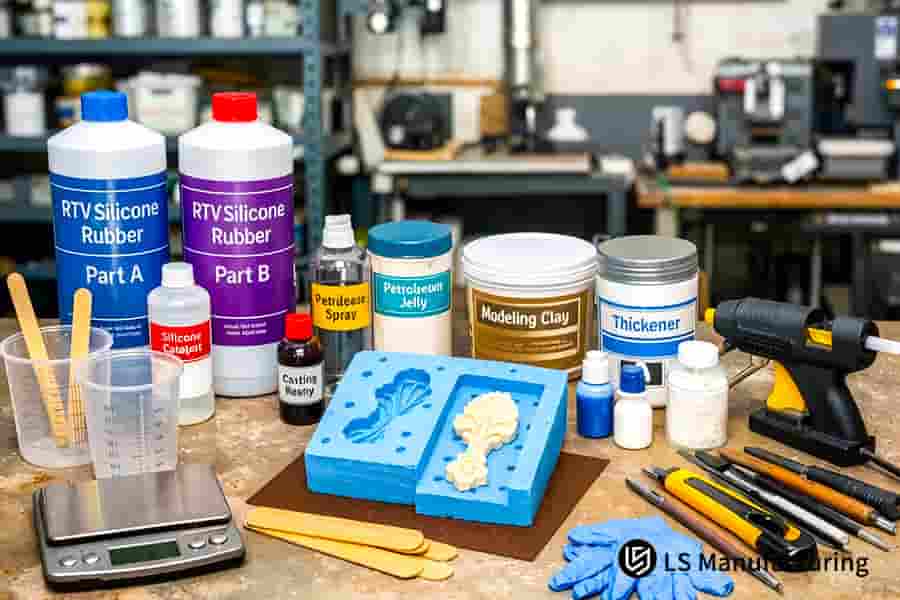
Figure 1: RTV silicone injection molding requires precise mixing of Part A and B components before pouring into molds.
Why Is Precision RTV Injection Molding Critical For Achieving Zero-Defect Seal Reliability In Medical Devices?
Precision RTV injection molding is vital in the manufacture of medical seals since any trapped air in the manufacturing process would result in an explosive failure in the seal. The basic principle involved is the inclusion of vent slots less than 25 µm alongside pressure profiling in order to minimize void formation, thereby ensuring that the defects remain under 0.01% and that 100% seal integrity is guaranteed in mission-critical equipment.
Targeted Micro-Venting for Gas Evacuation
The main difficulty is getting air out of very complicated thin-walled seals without flash. Our solution creates vents specifically designed for this purpose at the end of the injection mold flow. These are made to 0.015mm-0.025mm. This level of accuracy is under the material's capillary limit, thus allowing the air but not the polymer silicone to pass. This carefully engineered route for the gasses is critical for fabricating high precision components with no entrapped air forming leaks.
Multi-Stage Injection Pressure Control
Merely having vents is insufficient without coordinated process control. Our injection molding services utilize a multi-phase pressure protocol. The initial fill phase at 15 MPa ensures complete cavity replication. Pressure is then ramped down in stages to a final 5 MPa pack phase. This controlled reduction systematically purges trapped air through the micro-vents, a core principle of complex injection molding process design for zero-defect outcomes.
Material Synergy and Process Validation
Successful operation depends on the interplay between the properties of the material and tool design. As a committed medical grade silicone supplier, we specify RTV grades based on their rheology that will ensure proper flow within this processing range. Each batch goes through rigorous testing using statistical process control (SPC) on critical variables such as vent performance and cure behavior. In this way, the automated injection molding system can produce seals that can withstand >10,000 hours of dynamic loading.
Holistic System Integration for Zero Defects
Ultimately, it lies in the seamless integration of all factors into a system. The custom RTV silicone molding provider should ensure that there is optimal interaction between vent performance, pressure behavior, and material cure kinetics. Cutting-edge process controls monitor cavity pressure to allow for immediate intervention when needed. The holistic system approach at the cleanroom injection molding process turns an intricate problem into a scientific manufacturing process.
This analysis proves that obtaining zero defects from seal products entails understanding the interdependence among different physical parameters. In other words, our capability is based on the engineering principles and practices involved in making certain choices such as the vent sizing of microns and the nonlinear pressure curve, which ensure there is no way failure can be encountered.

How To Prevent Flashing During Custom RTV Silicone Molding For Complex Industrial Components?
It is absolutely important to avoid flash in custom RTV silicone molding because this is the key to automate the manufacturing process and keep costs low for complicated industrial components. The highly low viscosity of RTV silicone requires high levels of accuracy in terms of clamping force and mold parting line so as to avoid leakage of material, which results in defects and trimming.
Precision Clamping Force Control
- Core Strategy: Employing ultra-fast and completely electrical injection machines.
- Technical Execution: Applying a constant clamping pressure from 50 to 80 tons during the whole process.
- Outcome: No mold deflection due to variable hydraulic pressure will occur, resulting in a permanently sealed cavity for flashless silicone molding.
Ultra-Precise Parting Line Machining & Validation
- Core Strategy: Attaining absolute mold flatness.
- Technical Execution: Grinding the parting lines down to a level of ≤3 μm using CMM scans (Coordinate Measuring Machine, ensuring parting line flatness down to ≤3 μm to prevent leaking) to verify their flatness.
- Outcome: The elimination of pathways through which low viscosity silicone could escape. Essential criteria for an RTV silicone injection molding factory for OEM RTV silicone molding projects.
Material-Process Synchronization for High-Volume Output
- Core Strategy: Harmonize the injection sequence with the material-specific rheology.
- Technical Execution: Configure injection speed and pressure such that the mold cavity is filled before the material viscosity rises enough to create extra pressures at the parting line.
- Outcome: Enables a robust, high-yield automated injection molding production process for industrial silicone parts.
Validated Process for Cost Efficiency
- Core Strategy: Add pre-process control to avoid the need for post-processing.
- Technical Execution: Determine critical parameter settings (clamp tonnage, flatness, injection curve) at the qualification step.
- Outcome: Molding net-shape components without trim processes that would bring labor cost savings up to 25% per unit using high-volume injection molding.
It is essential to note that eliminating flash is not simply achieved through higher clamp tonnage, but a precise technology involving precision machine, metrologically proven mold and proper process coordination. The mentioned strategy provides you with the right way to achieve zero-flash production and brings your custom RTV silicone molding process to the next level in tight-tolerance injection molding. Save 25% per unit with no flash. Get a free evaluation of your component’s design to see if there is room for zero-flawed RTV injection molding.
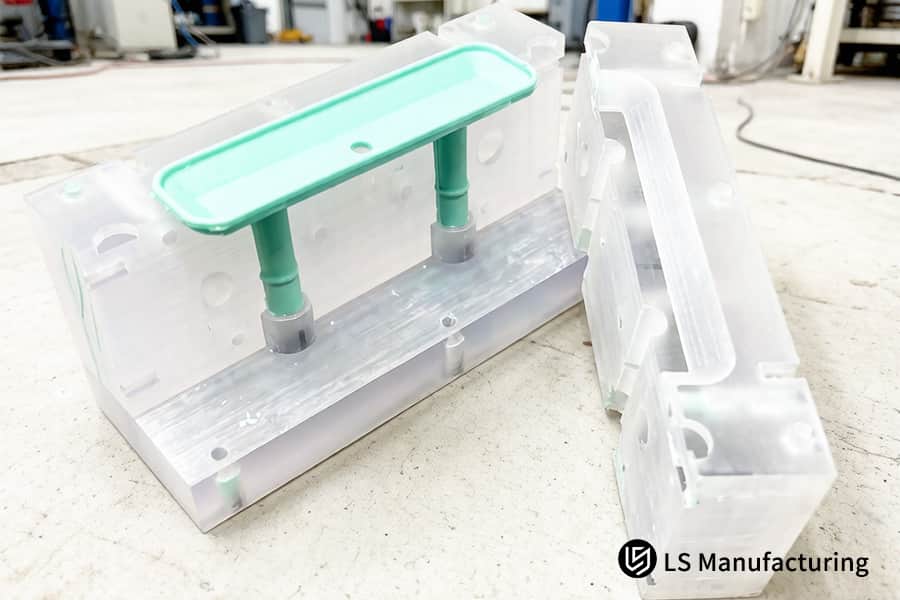
Figure 2: Precision RTV injection molding injects liquid silicone around a green POM insert to form a medical handle.
What Parameters Master The Curing Transition In RTV Silicone Injection Molding To Boost Production Yield?
The most crucial element for achieving the desired yields and cycle times in RTV silicone injection molding process is the correct control of the curing transition. The improper curing transition brings about problems like under-curing, among others. It be used in managing the parameters required for controlling the reaction and hence making the exothermic process controllable in high volume silicone production:
| Parameter Category | Control Target & Rationale | Implementation & Outcome |
| Material Mixing |
Adherence to ratio 1:1 for base:catalyst mixture. |
Ensures initiation of the curing process; failure to comply causes defects. |
| Injection Temperature | Ensure temperature range between 22-25°C. | Prevents pre-reaction for accurate molding – precision manufacturing parameter. |
| Mold Temperature & Stability | Keep cavity temperature within 165-180°C with variation ≤±0.5°C. | Utilize temperature-controlled injection molding with dynamic PID for complete curing. |
| Cycle Time Outcome |
Dependent on stability of thermal process. |
±0.5°C variation results in a 30% reduction of the cycle time as opposed to ±2°C variance. |
The data confirms that yield is governed by synchronizing thermal parameters with material kinetics. Our methodology as a dedicated RTV silicone molding manufacturer implements a dynamic injection molding cycle managed by real-time feedback. This precise control eliminates a major scrap source, ensures dimensional stability, and delivers the predictable speed essential for a reliable custom injection molding service, converting curing from a yield risk into a competitive advantage in a precision injection molding process.
How Does LS Manufacturing Optimize Tool Design For High Precision RTV Molding Without Dimensional Variation?
One of the obstacles when trying to produce high precision RTV molding is the tendency of such material to shrink by 2.5%-3.5% after curing. This means that we will be unable to ensure dimensional accuracy. To solve this problem, our company uses a certain tool design approach that takes this factor into account. It includes:
Predictive, Differential Shrinkage Compensation
By virtue of our mold flow analysis, we generate a bespoke and highly nonlinear model of shrinkage for the mold. By taking into account the particular dimensions and materials of the mold, we can scale the different parts of the mold cavity by up to a tenth of a millimeter based on its thickness, which ranges from 0.5mm to 4.0mm. This advanced injection molding simulation is essential, going beyond simple scaling for volume consideration, and setting the basis for high precision RTV molding.
Engineered Tooling for Lifelong Accuracy
Precision must hold through production quantities. To do this, we construct our molds using highly wear-resistant NAK80 steel, which is milled in a 5-axis process to produce the precise compensated geometry required for precision injection molding tooling. This is important since a well-milled mold will be able to maintain dimensional stability and hold close tolerances of ±0.02mm even after 500,000 cycles, which is essential for achieving precise dimensional tolerance in high-volume runs.
Integrated Design-to-Production Control
Systematic precision is achieved through the connection between the compensated digital model and a locked down production process. The parameters from simulation control the production process to create an efficient, robust injection molding process through closed-loop operation. Our method ensures that the molded part will meet the intended design specification to provide accurate results associated with custom injection molding service through the use of an RTV silicone molding quote.
Engineers can eliminate dimensional variations by deploying predictive models based on physics combined with durable tooling implementation. By combining physics-based predictive modeling techniques with stable production processes that compensate for shrinkage, our process eliminates variations from the mold to the part. This approach forms the basis of our expertise in silicone mold tooling engineering services.
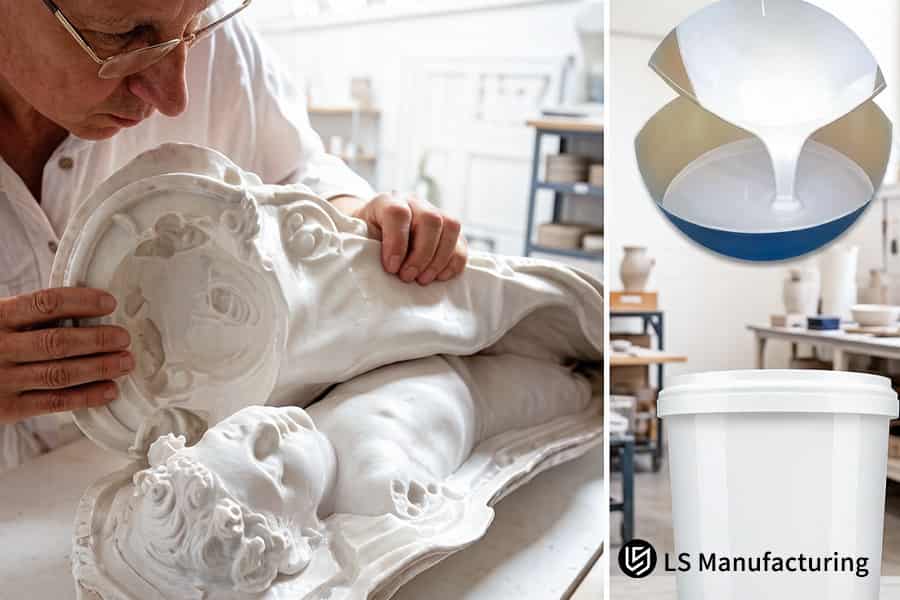
Figure 3: A custom injection molding service manually pours white RTV silicone into a detailed sculpture mold for casting.
Why Should Engineers Balance Material Viscosity And Injection Speed In RTV Molding For Precision Parts?
During RTV molding for precision parts, the correct ratio of material viscosity to injection speed is important in avoiding defects in the finished product that affect aesthetics and quality. Wrong speed results in a lot of shear stress (leading to discoloration and poor parts) or premature curing (creating knit lines) especially in thin walls ≤0.3mm. Our method uses an intelligent injection molding speed that is based on sensing the flow of the material within the mold:
Analyzing the Speed Defect Spectrum
- High-Speed Risk (>50 mm/s): Generates shear that breaks molecules resulting in low tensile strength.
- Low-Speed Risk (<10 mm/s): Material begins curing before filling the mold resulting in weak knit lines and non-functioning parts.
- Core Challenge: Ensuring a specific injection molding speed that is able to fill the mold before changing material viscosity.
Implementing a Staged Velocity Profile
- Our Method: Fast-slow injection speed through frequency variation by servo-controlled speed control.
- Technical Execution: High injection speed at first to ensure filling up of the mold, then auto-reducing the speed at 90% fill to a slow packing stage.
- Outcome: This servo-driven injection molding approach minimizes shear while eliminating knit lines, which is essential for thin wall silicone custom parts and reliable precision RTV injection molding.
Validating Performance with Multi-Physics Analysis
- Our Method: Applying co-simulation analysis to quantify flow, shear and cure kinematics.
- Technical Execution: The simulation confirms the speed profile does not expose the process to areas of high shear and early cure fronts.
- Outcome: The validated injection molding parameters by this process ensures maximum flow efficiency, achieving at least a 15% improvement in tensile strength and a perfectly smooth finish of custom RTV molding components.
Ensuring Repeatable Precision at Scale
- Our Method: Locking down the optimized speed profile in the machine controller on each cycle.
- Technical Execution: The multi-stage injection molding formulation is set in stone.
- Outcome: Consistent, high-quality parts on every run to meet the high bar required by precision silicone contract manufacturing.
As evident from this study, flow dynamics mastery is indeed a technical skill rather than an intuitive calibration of injection parameters. By determining potential shearing hazards, programming the appropriate speed adjustments, and proving the results through simulations, we achieve deterministic solutions that address one of the fundamental physics problems.
As a result, injection speed becomes a way of improving parts' qualities and yields, thus gaining a significant competitive edge in the highly advanced realm of RTV molding for precision parts.
How Does Custom Injection Molding Service Resolve Bonding Issues Between RTV Silicone And Metal Substrates?
Bonding RTV silicone with metal substrates in multi-color or overmolding applications is one of the most important requirements for the success of custom injection molding service. Common interlocks tend to break when subjected to shear stress. In this paper, we present a two-step approach based on our validation data that can be used by engineers and procurement managers to address interfacial bonding issues in multi-material injection molding.
| Process Step | Key Parameter | Result / Metric |
| Metal Surface Preparation | High precision dry blasting with 120 grit size particles. | Uses maximum surface area for better bonding for high-precision injection molding. |
| Primer Application & Curing | Applied via an automated spraying process using silane coupling agent primer (3-5 microns thickness). | Cured at 110°C for 15 minutes to provide an even coating with covalent bonding for OEM RTV silicone molding. |
| Bond Strength Validation | Peel strength test in accordance with ASTM D903 specifications. | Meets the peel strength requirement of 4.5 N/mm essential for silicone overmolding cost justification. |
| Reliability Verification | Dynamic stress cycling test under alternative loads. | Passes over 5,000 cycles with no failures in bonding. |
This two-step bonding procedure effectively addresses silicone-metal delamination issues by yielding a peel strength of ≥4.5N/mm and >5,000 fatigue cycles. This analysis provides evidence of the effectiveness of using this procedure to justify silicone overmolding cost and provide reliability for complex insert molding. The information directly eliminates the problem of custom metal silicone insert molding, allowing us to position ourselves as a precision overmolding supplier.
What Cost Drivers Dictate Custom RTV Silicone Molding Quotes For Small Batch Versus High Volume Production?
Determining cost drivers of custom RTV silicone molding plays a crucial role in sourcing decisions. The core difficulty comes from balancing high initial investment in tools against lower part cost, and finding a different solution for low-volume and high-volume production. Our analysis offers an effective approach that:
Strategy for Low-Volume & Prototyping
For quantities ranging from 100 up to 2,000 parts, cost minimization and lead times become crucial. We use aluminum molds or quick change inserts for our standard molds. With this approach, the initial cost of the molds can be cut down by as much as 50%, allowing us to develop a functioning prototype within only 5 days, which meets the requirement for a low volume silicone molding price and a speedy injection molding.
Strategy for High-Volume Production
In case of production runs in excess of 100,000 pieces, maximizing production volume becomes a necessity. The tooling we use is multi-cavity steel molds with hot runner systems. Although the initial tooling cost will be higher, this will provide the fastest high-volume injection molding solution with cycle times as little as 18 seconds. In this manner, we achieve unit costs of up to 40% lower and position ourselves as the top high volume molding supplier.
Data-Driven Cost-Breakdown Analysis
Cost modeling is performed with absolute transparency where we model the amount of CapEx investment in relation to OpEx cost per part, all depending on volume projection. In this way, we find out at what exact point your business will be able to cross economically over, allowing you to make smart decisions regarding the custom RTV silicone molding cost you face. Analytical services are one of our key offerings, alongside our other comprehensive injection molding services and low-cost injection molding experience.
The multi-tiered approach, from fast, low-cost tooling development to highly efficient systems in mass production, represents a high level of understanding of production economics that goes far beyond mere molding. We address the issue of cost through the design of the most effective technical and financial solution at every stage of the project to enable our clients to budget predictably and plan for success through strategic injection molding partnership.
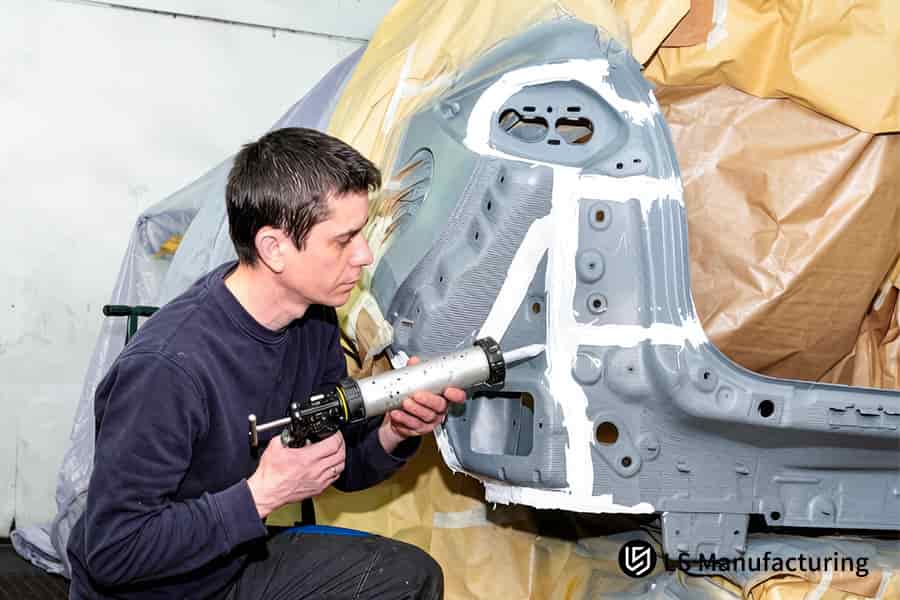
Figure 4: OEM RTV silicone molding applies white sealant to a grey automotive part for a watertight assembly.
Case Study: How LS Manufacturing Saved A Tier-1 Automotive Client 35% In Scrap Rate With A Custom RTV Injection Molding Solution For Electric Vehicle Battery Gaskets
In this case study, our custom-designed injection molding services helped address serious sealing issues in the gasket of an EV battery pack for one of our automotive suppliers, a critical part that needed to operate flawlessly in cycles of -40°C to 150°C. Here is how we were able to convert the high-scrap-rate program into a successful application through process precision control:
Client Challenge
Our customer had issues with an 18.5% scrap rate in manufacturing of highly accurate RTV silicone gaskets for the novel battery pack design of their EV. Leaks occurred frequently, caused by micro-cracks, due to improper venting and uneven pressure in the old manufacturing facility. This created critical production downtime and huge material waste issues, which could affect the release date of the car, requiring professional custom RTV silicone molding.
LS Manufacturing Solution
An immediate DFM was carried out, improving the geometry of the parts to R0.5mm radius to ensure consistent flow. An advanced, four cavity injection mold made from NAK80 steel equipped with pressure sensors was used to continuously monitor processes, maintaining consistent injection pressures of 8.5MPa with a curing temperature of 170°C ± 0.5°C, hence a validated injection molding process designed to solve the problem areas.
Results and Value
A significant amount of savings was generated from the successful solution, cutting down the material cost through minimizing the scrap rate to <0.05%, within a tolerance of ±0.015mm on all parts dimensions. The project duration was also reduced by 12 days, making our firm their preferred OEM RTV silicone molding custom solver and multi-cavity injection molding for critical seals.
This example proves that dealing with difficult molding processes cannot be done without integration. Using validated injection molding process design with real-time control via sensors, we were able to achieve a deterministic result, eliminating any potential risks. It proves our capability in data-driven injection molding as an precision automotive silicone molding manufacturer with the guarantee of reliable performance.
Lock in your own scrap reduction to <0.05% and ±0.015mm precision. To validate a precision RTV process for your seals, contact our engineers for a feasibility review and formal quote.

FAQs
1. What is the minimum order quantity (MOQ) for your custom injection molding service?
LS Manufacturing implements a very flexible purchasing policy. With regards to custom injection molding service in the product development or small scale production stages, our MOQ is only 100 units. Such a policy allows us to effectively assist engineers in product prototyping and design verification tasks.
2. How does LS Manufacturing ensure the dimensional tolerances of RTV silicone injection molding?
This is made possible through the use of highly precise electric injection molding machines sourced from Japan, alongside 5-axis CNC mold machining tools, along with real-time closed-loop molding pressure and mold temperature sensor control systems (tolerance of ±0.5°C), which guarantees that the dimensions tolerance on every batch of RTV silicone injection molding produced always stays at ±0.02mm.
3. What quality standards and certifications does your precision RTV injection molding comply with?
The quality management system across our entire manufacturing factory has been certified to meet the criteria outlined by ISO 9001, IATF 16949 (Automotive Quality Management System), and ISO 13485 (Medical Devices Quality Management System). In addition, for all raw material employed in our precision RTV injection molding service, we are able to supply test reports from a third party covering various quality standards like FDA, USP Class VI, and RoHS.
4. Can you provide a custom RTV silicone molding price quote based on 3D CAD drawings, and how long does it take?
Indeed. Just upload the 3D CAD files (in STEP, IGS, or SolidWorks formats) to the inquiry form on our website. Our team of senior estimation engineers at LS Manufacturing will immediately present to you a customized RTV silicone molding quote along with a comprehensive Design for Manufacturability (DFM) analysis within just 24 hours.
5. How do you address the high shrinkage rate of silicone material in high-precision RTV molding?
As for the designing stage, we apply special Moldflow software for high-precision predictive modeling and compensation for the non-linear shrinkage of thermosetting silicone occurring at high-temperature curing (165–180°C). The exact micron-level dimension adjustment in mold cavities guarantees that the final geometric dimensions of molded parts correspond to the original design perfectly.
6. What types of RTV silicone materials can be processed by your RTV molding services for precision parts?
The service line of custom processing in our company is compatible with almost all kinds of Room Temperature Vulcanizing (RTV) silicone compounds made by leading manufacturers around the world. It includes highly elastic grades, with high tensile/tear strength properties, excellent thermal conductivity (for effective heat dissipation), flame-retardant grades (UL94 V-0 compliant), and Fluorosilicone grades capable of working at both very high and very low temperatures.
7. How does LS Manufacturing protect customer intellectual property (IP) during the custom molding process?
Intellectual property protection is the backbone of our business as a global supply chain partner. Before providing you with any technical drawings or starting any technical discussion about a particular project, we will make sure that a signed mutual, binding Non-Disclosure Agreement (NDA) is in place. Also, our whole factory uses a very tightly controlled and isolated data server access control system to regulate the flow of information to completely exclude any chances of a breach involving any technical information.
8. What is your typical tooling and production lead time for an OEM RTV silicone molding project?
For normal OEM RTV silicone molding orders, aluminum alloy molds or quick change mold frames for the initial fast prototype development stage can be usually produced within 5 to 7 working days, with samples provided. For high volume OEM RTV silicone molding orders requiring hard steel moldings with multi cavity molds and multiple runners, the full cycle from mold making till FAIR provision is completed in approximately 14 to 21 days.
Summary
The process of creating high-quality zero defect, long lifecycle RTV silicone molded products requires high-caliber engineering from product design through mold flow analysis, micrometer accurate cavity milling and process control. The LS Manufacturing solution solves long-standing problems such as dimensional instability and delamination by way of our proprietary flash control technology and multi-phase filling technique. Having a proven track record in the fields of medical, electric vehicle, and electronics, our company offers robust, custom solutions with minimum risk for your high end projects.
Are you developing new silicone overmolding or sealing technologies and require a professional engineering assessment before your project enters production? Does your current silicone manufacturer exhibit excessive defects in its products? Then, why let supply chain inefficiencies hold up the process of bringing your innovation to market? Click "Get a Custom Quote & Free DFM Review" and upload your STEP, IGS or X_T model file.
📞Tel: +86 185 6675 9667
📧Email: info@lsrpf.com
🌐Website: https://lsrpf.com/
Disclaimer
The contents of this page are for informational purposes only. LS Manufacturing services There are no representations or warranties, express or implied, as to the accuracy, completeness or validity of the information. It should not be inferred that a third-party supplier or manufacturer will provide performance parameters, geometric tolerances, specific design characteristics, material quality and type or workmanship through the LS Manufacturing network. It's the buyer's responsibility. Require parts quotation Identify specific requirements for these sections.Please contact us for more information.
LS Manufacturing Team
LS Manufacturing is an industry-leading company. Focus on custom manufacturing solutions. We have over 20 years of experience with over 5,000 customers, and we focus on high precision CNC machining, Sheet metal manufacturing, 3D printing, Injection molding. Metal stamping,and other one-stop manufacturing services.
Our factory is equipped with over 100 state-of-the-art 5-axis machining centers, ISO 9001:2015 certified. We provide fast, efficient and high-quality manufacturing solutions to customers in more than 150 countries around the world. Whether it is small volume production or large-scale customization, we can meet your needs with the fastest delivery within 24 hours. choose LS Manufacturing. This means selection efficiency, quality and professionalism.
To learn more, visit our website:www.lsrpf.com