English



Injection molding services for small batch manufacturing, such as medical and automotive, regularly struggle with the issue of high costs of mold making from steel, which often can be more than $20,000. This results in the dilemma of cost overrun and quality degradation when trying to validate 100-5,000 pieces since getting the necessary ISO 286 tolerance and minimizing the problem of sink marks is hardly possible without applying DFM knowledge; hence, T1-T3 trials are expensive and inevitable.
LS Manufacturing's low volume injection molding service is a budget-friendly rapid tooling solution that allows you to skip high mold costs by integrating advanced modular mold systems. In other words, you get guaranteed production parts at 60-80% cheaper cost and with the mandatory First Article Inspection report. Our unique DFM software, which already contains material-based information about flow and cooling processes, guarantees a manufacturable product design within 24 hours.
Injection Molding: Low-Volume DFM Cost-Quote Quick-Reference
| Design Parameter | Cost Impact for Low Volume | DFM Recommendation for Cost Savings |
| Draft Angles | Slower removal time, risk of part damage. | Draft angles greater than 1° should be applied to all walls that are not parallel to the direction of ejection. |
| Wall Thickness | Results in sink marks, warping, and slow cycle times. | Uniform wall thickness is required (1.5-3.0mm, tolerance ±10%) for most materials. |
| Undercuts | Necessitates side-action mechanisms in the mold, increasing the price of tooling and production. | Parts should be designed without undercuts or simplification of undercuts for manual extraction at small volumes. |
| Ribs & Bosses | Improper use will result in sinks and weaknesses. | Bosses should be placed perpendicular to the main wall surface, with ribs 50-60% thick of the main wall. |
| Tolerances | More stringent requirements mean more machining and inspection time, increased costs for injection molding parts, and higher prices. | Unless otherwise stated, we use ±0.2mm tolerances on our drawings. |
| Our Quoting Input | Our quoting process starts with a solid 3D model using proper DFM techniques, resulting in quick, stable, and affordable pricing. | We include a free DFM report detailing how we can lower your costs. |
Summary: Over 80% of molding costs are rooted in the design stage; optimizing wall uniformity and draft angles eliminates the need for expensive complex tooling.
Key Takeaways:
- Design Dictates Cost: More than 80% of the manufacturability and cost of any part is determined in the design stage; DFM is essential to make low volume economical.
- Simplicity Enables Affordability: The most economical low volume mold is a simple two plate mold. Avoiding side actions and complicated mechanics is the greatest cost savings measure.
- Uniformity is Free Performance: Uniform wall thickness is the most effective means to minimize defects such as sink or warpage without increasing injection molding costs and speeding cycles.
- Communicate the "Why": Knowing what the part will do and its interface points helps us decide which tolerances can be loosened and which need to be maintained.
Why Trust This Guide? Practical Experience From LS Manufacturing Experts
You will find several articles available on injection molding Design for Manufacturability (DFM) in general. This article is different from others. It is prepared by our tooling and quoting engineers who convert your 3D design into an economical low-volume production each day. Our DFM analysis is guided by the principles of systems engineering and lifecycle costs adopted by the International Council on Systems Engineering (INCOSE).
We carry out low-volume projects that involve cost decisions at a design level such as flight-ready prototypes of aerospace ducts, bio-compatible housing units for pilots' medical devices and jigs/fixtures for semiconductor packaging. Scoping and risk management for the projects mentioned above are carried out in accordance with the project, program and portfolio management principles set by Project Management Institute (PMI).
These are some of the cost savings we have achieved through thousands of low volume projects. Our expertise includes reducing the cost of tooling by 30% through simple changes to an undercut, defining the exact wall thickness needed to produce fast cycles without sink in ABS, and the gate point required to make hand-finishing unnecessary. Here is our proven and cost-conscious DFM experience to help you design economically for low volume manufacturing and save on the costs of over-engineering your tooling.
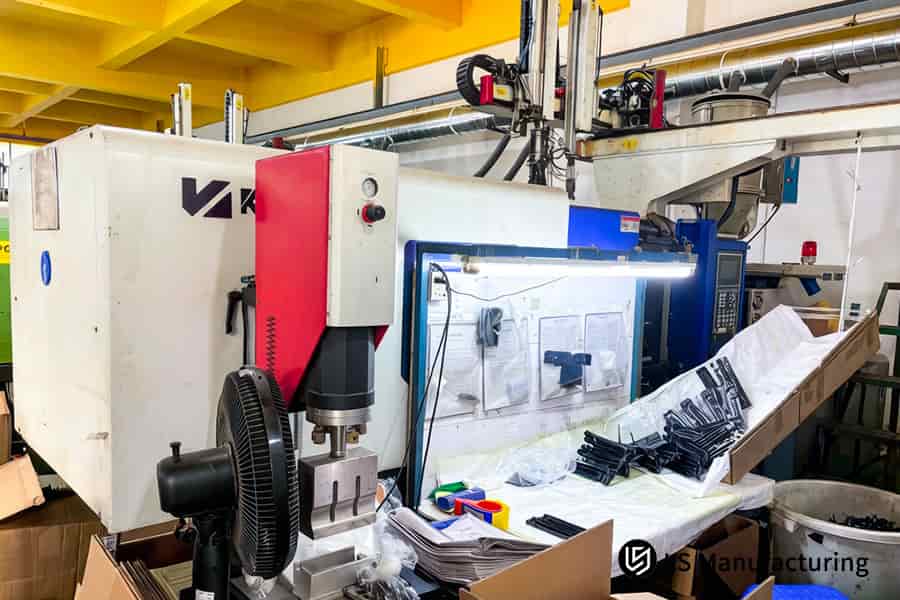
Figure 1: Assembly tools and plastic parts are organized on a workstation for efficient injection molding production support.
Why Is Custom Low Volume Injection Molding The Optimal Bridge For High-Precision NPD Verification?
The problem of verifying performance under production conditions is one of the core challenges of NPD. The prohibitive expense and lead time of developing production molds can stand in its way; but custom low volume injection molding can address this obstacle through the use of special molding systems to mimic normal injection pressure (80-120 MPa):
Engineering Cavity Integrity Under Full Pressure
The key issue lies in avoiding mold deflection that can cause changes in the important dimension of the parts. The solution relies on using a rigid and pre-hardened Master Unit Die (MUD) Frame to accommodate one cavity insert only. Using a single cavity design prevents mold deflection of more than 3 μm at 100 MPa injection pressure while a multi-cavity prototype tool shows deflections between 5-10 μm. Parts of aluminum tool injection molding will retain production geometry.
Optimizing Insert Materials for Performance and Speed
Careful selection of the proper material takes into account both the need for durability and lower costs. While P20 steel inserts are used for aggressive materials or high-gloss finish, 7075-T6 aluminum inserts serve for the majority of precision injection molding applications and are durable enough to produce up to 1,000-3,000 parts. This helps to reduce insert costs by 40-60% as against a fully hardened steel mold and greatly decreases machining time for quick low volume injection molding cost validation.
Accelerating the Iterative Test Cycle
This process separates the lengthy cycle of mold manufacturing from the verification cycle. In using machining of only the cavity/core inserts against an existing MUD frame, the tooling cycle time is brought down to 1-2 weeks. Rapid iterations become possible, such that any problem discovered in the injection molding services can simply be fixed through modifications to the insert. Several iterations can take place before the duration of one traditional tool development cycle has elapsed, reducing risks to the entire process and making affordable low volume molding.
We offer a technically robust bridge between prototyping and commercialization of the innovation, addressing the fundamental contradiction between prototype authenticity and economic feasibility. We achieve this by simulating real-world conditions of the mass production process in low volume.
You benefit from a systematic engineering approach that replaces guesswork. To bridge your NPD verification with production-grade testing, upload your files for an actionable MUD analysis today.

How Can Optimized Injection Molding DFM Cost Saving Be Achieved Through Precision Wall Thickness Design?
Non-uniform wall thickness is the cause of sink marks and warpage, affecting the quality of the parts and fit into assemblies and costing the project money in the end. The engineering process that we use makes optimization of wall thickness a priority at the DFM stage, turning an inherent flaw into the advantage and making injection molding DFM cost saving. It is not just advice, but rather a specific procedure as follows:
Establishing a Material-Specific Thickness Foundation
- Set the Baseline: We set up a benchmark wall based on material rheology, such as 2.5mm for ABS or 1.8mm for PA66, which is the basis of engineering grade injection molding.
- Define the Range: The range with a margin of control (e.g., ±0.3mm) from the target wall is set as the design parameter for uniform cooling.
Executing the ≤1.5:1 Uniformity Rule
- Identify Hotspots: A thorough computer-aided-design (CAD) analysis of the wall thickness transitions and finding hot spots with non-conformable thickness ratios.
- Redesign Features: Redesign Considerations:Our engineers take proactive steps to redesign such sections through the use of ribs, coring, or graded transition in order to ensure uniform material distribution, an essential factor for thin wall injection molding success and a cost effective DFM quote.
Validating Performance with Predictive Data
- Simulate Shrinkage: The use of moldflow analysis injection molding proves that by following the rule of keeping ratio below 1.5:1 ensures shrinkage variance to be less than 0.5%.
- Predict Warpage: A minimal difference in shrinkage translates into minimizing warpage by more than 60%.
Quantifying the Cycle Time and Cost Impact
- Reduce Cooling Time: The use of thin sections instead of thick sections minimizes the cooling time by 25%, making it an essential aspect of a cost-effective DFM injection molding quote.
- Prevent Rework: This early stage engineering process avoids expensive mold changes, resulting in a more effective and faster time-to-market strategy.
Our competitive advantage comes from enforcing a specific rule (wall ratio ≤1.5:1) by performing proactive and predictive design work and simulations. This process ensures that the fundamental cause of warpage is avoided while guaranteeing faster cycle times and avoiding any rework on tools. We have chosen this predictive approach to provide you with reliable injection molding services and allow us to offer low cost injection molding as a result of excellent upfront engineering.
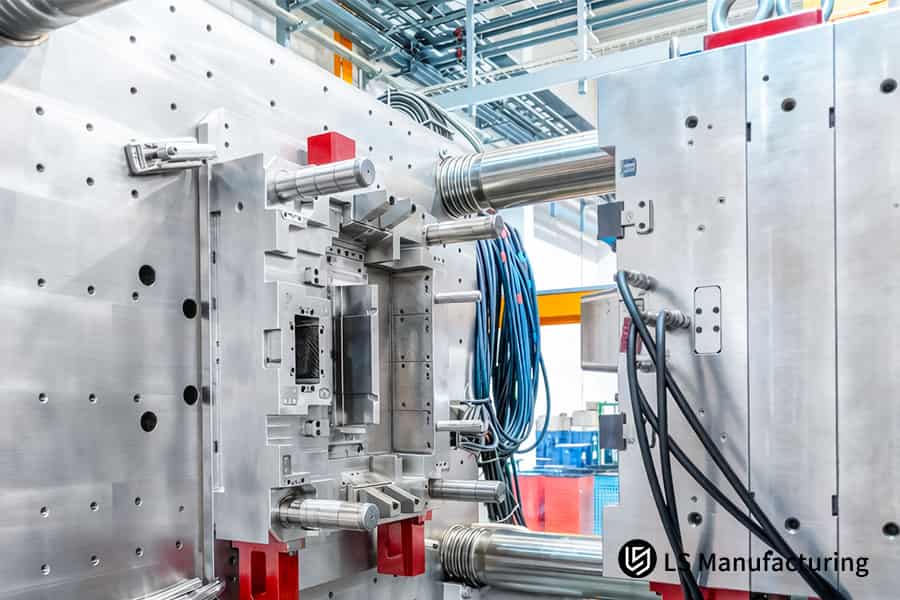
Figure 2: A precision steel mold base with ejector pins and cables is prepared for a custom injection molding service.
What Parameters Dictate The Selection Of Affordable Low Volume Molding Over Traditional Hard Tooling?
The choice between fast and standard tooling for prototype injection molding and bridge molding is an important cost and scheduling decision. This document outlines a comparison of important performance metrics that will enable you to make the decision whether affordable low volume molding can beat expensive hard tooling in terms of cost effectiveness. Our custom injection molding services employ such comparisons in order to provide the best fitting tooling method based on your project stage.
| Mold Material | Thermal Conductivity | Mold Life (Shots) | T1 Lead Time | Relative Tooling Cost |
| Aluminum 7075-T6 | High: ~130 W/m·K | Low: 1,000 - 5,000 Very | Fast: 7-10 days | Low: ~40% of production tool |
| Pre-hardened Steel P20 | Moderate: ~32 W/m·K | Medium: 10,000 - 50,000 | Fast: 12-15 days | Moderate: ~65% of production tool |
| Production Steel (e.g., NAK80) | Moderate: ~41 W/m·K | High: 100,000+ | Slow: 21-30+ days | High: 100% (baseline) |
In essence, this table serves as a perfect guide – use aluminum for quickest cooling and minimal costs in bridge tool injection molding and P20 steel for more extensive pilot runs. The primary importance of the approach outlined above is to avoid investing too much money in the wrong tool since matching tool life with volume will optimize the low volume injection molding cost. This empirical and non-theoretical method constitutes the essence of our technical injection molding services.
How Does A Professional B2B Supplier Eliminate Flow Marks And Sink Marks During Low Volume Injection Molding Cost Analysis?
It may be difficult to achieve good cosmetic results when faced with the issues of flow and sink marks in low volume injection molding. However, we are able to do that due to advanced process engineering capable of overcoming fast tooling shortcomings. We will prove that it is possible to receive a cost effective DFM quote without compromising quality even in cases of rapid prototyping injection molding:
Precision Control of the Fill-to-Pack Transition
The main problem associated with flow marks is an uneven rate of the melt front speed. We overcome this problem by making sure to properly set the V-P switch point at about 95-98% of the cavity volume. This guarantees us a well-defined melt front with no hesitation or jetting, giving us an excellent platform for high quality injection molding.
In plain English: This precise pressure switch means your housings arrive completely free of cosmetic wavy lines, eliminating incoming quality control (IQC) rejection risks.
Scientifically Determined Packing Pressure and Time
This defect is due to lack of enough compensating material when the molten plastic shrinks during cooling. Your parts are packed under 60-80% of max injection pressure, ensuring zero sink marks without inflating your unit cost. What is key in this process is the determination of the gate freeze time from the material data and using it to determine the packing time.
Validating Surface Finish with Quantifiable Metrics
Control of processes is done based on certain standards. For us, the surface finish standard for cosmetic surfaces is ≤0.4 μm Ra (SPI-B1/VDI 24). Through the results obtained from the surface profilometric measurements conducted, we have been able to prove that we can produce parts using our rapid tools to meet the requirements and thus pass the IQC.
Our proficiency in mastering the entire process enables us to achieve product excellence regardless of the investment made on tools. We ensure that in our low volume injection molding cost, we maintain the highest standards in terms of cosmetics using precise parameters including V-P switch and pack pressure/time, which form an integral part of our custom injection molding services.
Where Should The Injection Gate Be Positioned To Optimize The Custom Injection Molding Services Workflow?
Injection gate location is one of the most crucial parameters that impacts the movement of material, orientation of fibers, and hence the size as well as the shape of the part. Gate optimization not only helps us produce the part but also helps in improving the quality as well as cost involved in the production process, especially in the case of custom low volume injection molding. Our optimization process will ensure that:
Selecting the Optimal Gate Type for Application
- For Aesthetic & Automated Demolding: We will make use of submarine gate injection molding or valve gated hot runners to ensure automatic degating without any gate vestige.
- For Simplicity & Thick Walls: Direct gate injection molding or edge gates are selected on the basis of their ease of use as well as thick walls.
Preventing Warpage in Fiber-Filled Materials
- The Core Challenge: For material types like PA66+30% GF, the poor placement of gate increases the shear effect leading to improper fiber orientation and making anisotropic shrinkage jump from a reasonable level of 0.3% to 1.2%.
- Our Solution: Fiber orientation simulation technology is used for placing the gates at an optimal balance of flow length and flow shear, providing uniform fiber orientation to prevent uneven shrinkage and warping strains, which leads to an absolutely guaranteed DFM injection molding quote.
Validating Design Through Predictive Analysis
- Simulating Outcomes: Prior to mold construction, the fill path, weld lines, and fiber orientation simulations are conducted to determine how the part shrinks and warps.
- Making Data-Driven Adjustments: Results require informed changes in terms of gate placement or geometry modification to provide a design resistant to balanced filling injection molding without any warpage problems or others.
With our experience, the gate design is a critical aspect that determines dimensional stability as opposed to being the cause of defects. The process helps us ensure no warping occurs due to simulations in the management of fiber flow and orientation from the very initial stages of filling. It is a crucial component of our custom injection molding services.
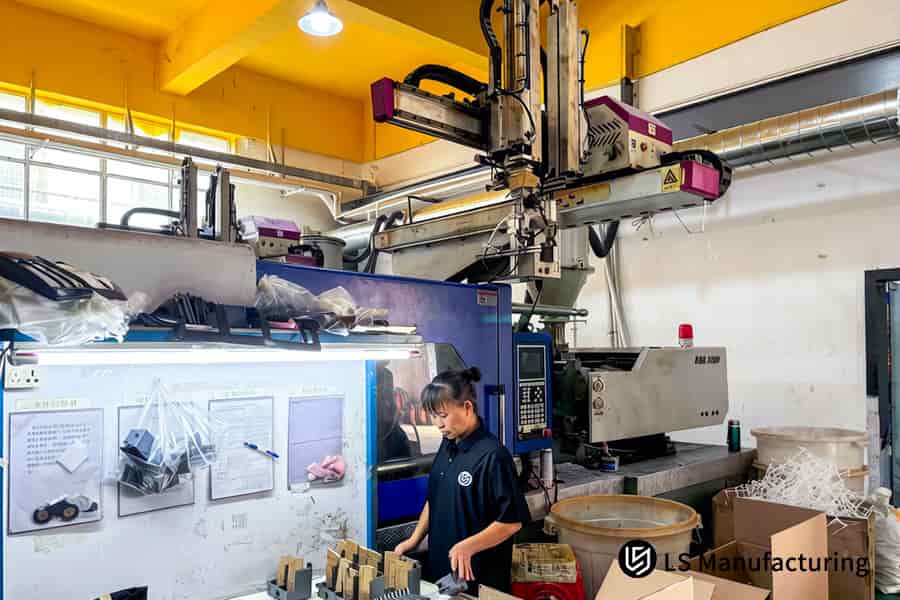
Figure 3: An operator inspects machined components at a workstation to ensure a cost-effective DFM quote for molding.
How Does An Expert DFM Injection Molding Quote Identify Potential Draft Angle Risks Before Mold Cutting?
Inadequate draft angles lead to sticking or scratching when removing the part, resulting in defects and wear on tools. Getting a professional DFM injection molding quote is therefore crucial for identifying such issues prior to beginning the tool-making process. It is only possible to do so through our 3D draft analysis process that runs in 24 hours with strict texture specifications to attain injection molding DFM cost saving:
| Design Feature | Minimum Draft Angle Requirement |
| Standard Smooth Surface | ≥ 0.5° per side |
| Textured Surface (e.g., MT-11010) | ≥ 1.0° per 0.025mm of texture depth (Typical: 3° - 5° total) |
| Deep Ribs or Bosses (Internal Walls) | ≥ 0.25° - 0.5° per side |
| Automated injection molding 3D Review | Full CAD analysis delivered within 24 hours of RFQ |
The quantitative draft guidelines we set through our proactive injection molding design review are mandatory rules, such as adding 1° draft per 0.025mm of texture depth, to successfully implement multi cavity injection molding. This 24-hour process avoids ejection problems and tool damage, and creates the foundation of a cost effective DFM quote that guarantees a 98% or greater T1 success rate. It reduces risks and establishes our professional injection molding services.
Why Should Procurement Managers Evaluate The True ROI Of A Cost Effective DFM Quote Beyond The Unit Price?
A low unit price can mask high total cost from defects, downtime, and tool rework. True procurement savings are found in a cost effective DFM quote that eliminates manufacturing risks upfront. We deliver this by engineering out the hidden costs that cheaper suppliers overlook, transforming your low volume injection molding cost from a simple price into a guaranteed, predictable investment with measurable injection molding DFM cost saving:
Eradicating Cosmetic Defects with Optimized Venting
Trapped air resulting in burned sections is another form of covert waste that we encounter. The solution is incorporating special channels to vent the air (0.02-0.04mm) through at the ends of the fills and at the ejector pin locations. Through this approach adopted in the engineering grade injection molding, the air vents out avoiding any burning and consequently minimizing scrapped items, thus safeguarding your part cost and aesthetic yield.
Ensuring Dimensional Stability with Balanced Ejection
Ejector pins that are inadequately positioned or insufficiently provided will lead to deformity when removing the formed part from the molds. As part of our injection molding DFM assessment process, we determine optimal pin location and recommend a higher number of smaller diameter ejector pins that result in a consistent stress load on the part during the demolding process.
Maximizing Efficiency with Conformal Cooling Design
Slow cycles from inadequate cooling are one of the biggest hidden costs. In our custom low volume injection molding, the cooling channels are strategically designed based on part geometry within the limitations of the mold. Such an effective cooling strategy helps to ensure an even temperature profile and results in a faster cycle time by about 15-20%, compared to the traditional method of drilling.
Our value is quantified risk reduction. We prevent hidden costs by engineering robust venting, balanced ejection, and efficient cooling into the injection molding design from the start. This disciplined approach for production intent prototyping minimizes scrap, ensures dimensional stability, and accelerates cycles, delivering the true ROI embedded in a professional cost effective DFM quote and realizing the promised injection molding DFM cost saving.
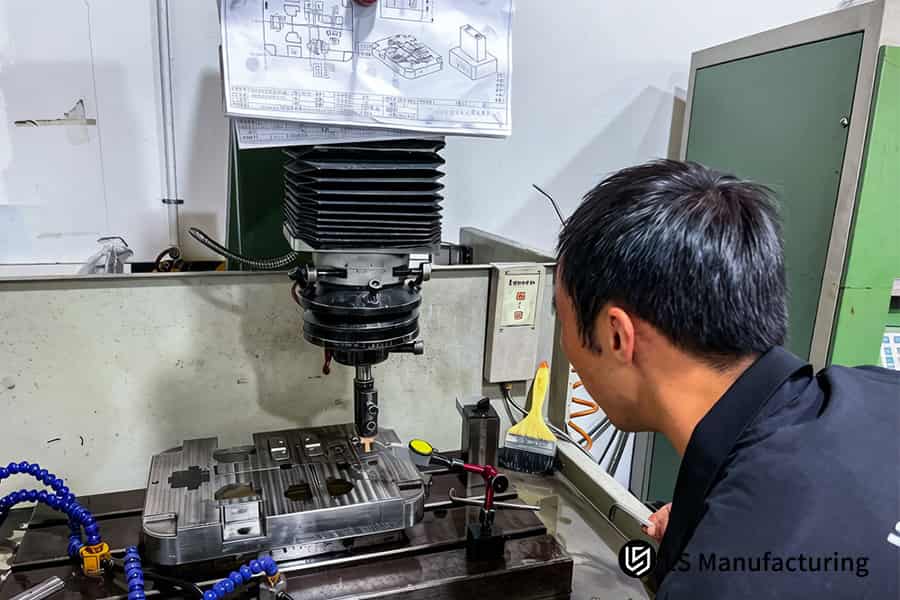
Figure 4: A technician operates a machining center using a technical drawing for affordable low volume molding production.
Case Study: How LS Manufacturing Delivered 2,500 High-Precision Medical Nylon Connectors With 45% Mold Cost Reduction
A top medtech development company had a critical timeframe and financial problem regarding 2,500 pieces for validation. While the need for a custom low volume injection molding process for PA66 connectors that have chemical resistance tolerance of ±0.03mm was a must, the $18k quote and 35-day lead time prevented us from getting ahead on schedule.
Client Challenge
For the Phase II dialysis machine, our client needed to produce 2,500 housing pieces with strict requirements of no voids in production and tolerance of ±0.03mm. The current hard steel mold quote of $18,000 and 35 days in lead times posed an obvious danger for meeting deadlines due to the fact that the product itself is in the phase of redesigning.
LS Manufacturing Solution
During the T1 flow simulation, we identified an air trap near the hinge; our engineers immediately modified the venting channel to 0.03mm, skipping a potential T2 rework. To reduce costs and time while maintaining precision, we implemented a Master Unit Die (MUD) system with machined Al 7075-T6 inserts.
To achieve high precision injection molding of semi-crystalline PA66 with shrinkage of ~1.5%, conformal cooling channels were developed that will keep mold temperature constant at 85°С ±2°С.
The critical areas of walls were hollowed out to avoid sinks, which guarantees uniform shrinkage and dimension stability during the medical device injection molding validation run, an important aspect of injection molding DFM cost saving.
Results and Value
Mold construction took 9 business days. First shot (T1) parts were 100% inspected on CMM with all ±0.03mm tolerance levels satisfied with zero porosity or flashing issues. This strategy resulted in 45% savings in initial tooling costs and allowed our customer to gain an advantage of 3 weeks in terms of obtaining regulatory approval, demonstrating the effectiveness of our engineered medical device injection molding.
This case study shows exactly what we specialize in, which is addressing difficult engineering problems using economic sense during the manufacturing process. With our fast aluminum tooling combined with unique thermal management systems, we have successfully solved the problem using an economical approach that we always use when delivering our reliable and risk-reducing injection molding services.
Achieve the same 45% mold savings and 3-week schedule advantage. To validate a fast-track solution for your connectors, request a MUD system feasibility review and a formal quote.

FAQs
1. What is the typical minimum order quantity (MOQ) for your custom low volume injection molding services?
Our MOQ for injection molding with fast turn-around time is incredibly low, beginning with only 100 units. This is specifically designed to help customers in the areas of medicine, automobiles, and industrial electronics in their NPD prototyping stages, as well as low-volume pilot runs and clinical trials.
2. How does LS Manufacturing maintain strict tight dimensional tolerances of ±0.05mm on aluminum molds?
LS Manufacturing guarantees this tight tolerance by having superior quality 7075-T6 aircraft aluminum used for mold insert materials that work on high-speed CNC machines running at 24,000 rpm. These are accompanied by a closed loop of cavity pressure sensors to ensure that each run of the mold will have dimensional stability and consistency comparable to hardened steel molds.
3. Can you perform comprehensive DFM analysis for glass-filled resins like PA66+30%GF before mold cutting?
Yes, definitely. Our free, detailed review employs highly advanced Moldflow software to calculate anisotropic shrinkage and simulate the orientation of fibers. Thus, our team can adjust gate placement, runners, and holding pressure settings according to the requirements of the chosen material and prevent issues such as warpage and weakness long before machining.
4. Why does the low volume injection molding cost from LS Manufacturing include a proprietary modular mold frame system?
It contains this technology since it applies to the concept of Master Unit Die (MUD). The custom core and cavity inserts of either aluminum alloy 7075-T6 or P20 steel fit into these universal and reusable mold frames. In such a way, clients never have to invest in outer mold bases, thus saving up to 40% to 60% of initial tooling costs. Submit your design for a rapid-turn tooling analysis and an instant quote.
5. How do you solve severe warpage and shrinkage defects in thick-walled injection molded parts during DFM?
At the DFM phase, we automatically identify nominal wall thicknesses that exceed 4.0mm. Then, we suggest a design with effective internal coring structures complemented by an even ribbing system, which is usually engineered at 40% to 60% of the nominal wall thickness. These techniques significantly reduce the weight, ensure uniform heat distribution, minimize cycle time, and practically eliminate any sink marks and warping.
6. What surface finish standards can be accomplished with your affordable low volume molding solutions?
With our affordable low volume injection molding process, we can offer an array of surface finishes certified by SPI, ranging from the basic SPI-C1 finish and a high gloss finish such as the SPI-A2, to textured surfaces complying with the VDI 24/30 specification and other unique finishes created via advanced EDM texturing or bead blasting methods.
7. How does your DFM injection molding quote ensure full intellectual property (IP) protection for industrial clients?
IP protection is guaranteed through the secure processing of all incoming CAD files (STEP/IGS) on our highly secure, encrypted enterprise network. Our IP policy also includes signing of rigorous, bilateral NDAs and use of dedicated, air-gapped offline machines for sensitive analysis, providing absolute guarantees of 100% confidentiality and security for your proprietary designs at each stage of quotation and development.
8. What is the average turnaround time from custom injection molding services approval to T1 sample shipment?
Our average timeline for rapid tooling projects featuring aluminum 7075-T6 inserts is very quick indeed. From the moment your project receives our approval, our specialists will carry out a thorough DFM assessment, followed by CNC machining and the first molding runs. We can deliver functional, production-ready T1 prototypes to you within just 7-12 business days.
Summary
Smaller batch injection molding does not mean that quality or accuracy is compromised. Cost efficiency is attained through proper DFM and mold flow analysis at an earlier stage of design. With the use of modular tooling, tolerance accuracy of ±0.03-0.05mm and a professional analysis, LS Manufacturing eliminates the misconceptions that low volume equals expensive prices and aluminum molds lack accuracy, assuring optimal cost-performance and certainty from the very start of the R&D process.
Planning to develop a medical, automotive, or electronics product and concerned about mold costs or shrinkage issues? No more guessing games. Simply upload your STEP/IGS files and get a free DFM analysis and quotation instantly. Within 24 hours, you'll have a comprehensive injection molding analysis report of wall thickness, gate location, and draft angles along with an affordable quotation for your low-volume project.
📞Tel: +86 185 6675 9667
📧Email: info@lsrpf.com
🌐Website: https://lsrpf.com/
Disclaimer
The contents of this page are for informational purposes only. LS Manufacturing services There are no representations or warranties, express or implied, as to the accuracy, completeness or validity of the information. It should not be inferred that a third-party supplier or manufacturer will provide performance parameters, geometric tolerances, specific design characteristics, material quality and type or workmanship through the LS Manufacturing network. It's the buyer's responsibility. Require parts quotation Identify specific requirements for these sections.Please contact us for more information.
LS Manufacturing Team
LS Manufacturing is an industry-leading company. Focus on custom manufacturing solutions. We have over 20 years of experience with over 5,000 customers, and we focus on high precision CNC machining, Sheet metal manufacturing, 3D printing, Injection molding. Metal stamping,and other one-stop manufacturing services.
Our factory is equipped with over 100 state-of-the-art 5-axis machining centers, ISO 9001:2015 certified. We provide fast, efficient and high-quality manufacturing solutions to customers in more than 150 countries around the world. Whether it is small volume production or large-scale customization, we can meet your needs with the fastest delivery within 24 hours. choose LS Manufacturing. This means selection efficiency, quality and professionalism.
To learn more, visit our website:www.lsrpf.com