English




Manual vs auto-leveling 3D printing service is what makes the difference between wastage of the first layer and inter-layer shear failure of automotive and medical prototypes with high precision. Engineers who design hardware always wonder about how important is auto-leveling on a 3D printer since calibration manually using feeler gauges leads to a waste rate of 12% during operations lasting more than 48 hours due to thermal stress of the bed ≥0.05%.
This article analyzes how dynamic compensation of the bed reduces the wastage rate to ≤2% in 60-hour operations, decreasing the price of each unit by 35% while maintaining tolerances of ±0.005mm over the entire bed. Here you can understand how auto-leveling prevents delamination at the middle of the printing process and ensures consistent TCO, providing multinationals with necessary information to optimize multi-axis additive manufacturing chains. Let us consider the key criteria of reliable 3D printing services.
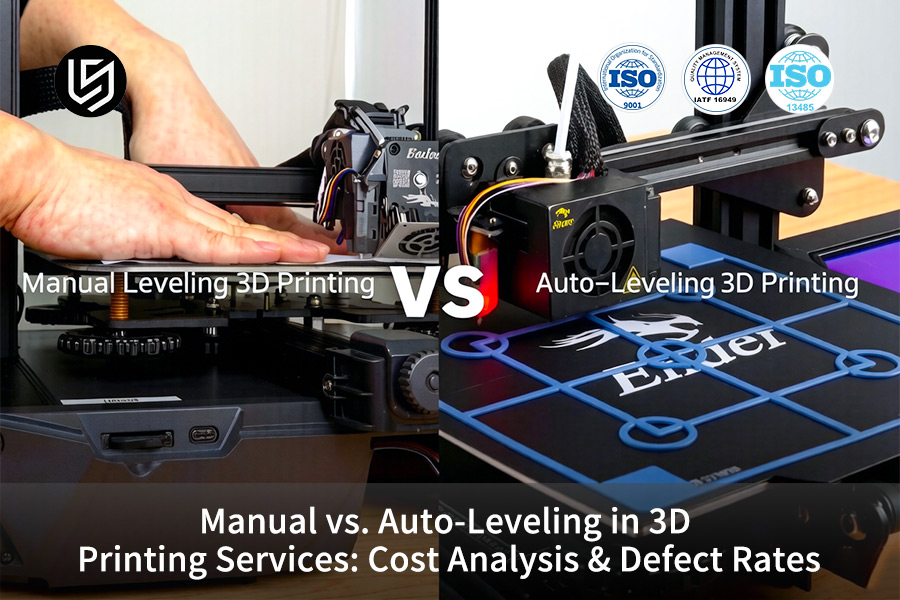
Manual VS Auto-Leveling 3D Printing: Cost & Defect Rate Quick-Reference
| Comparison Factor | Manual Leveling (Thumbwheel/Sensor) | Auto-Leveling (BLTouch/Inductive Probe) |
| First-Layer Failure Rate | 3-8% (depends on the operator; misreading of the feeler gauge). | <0.5% (offsets small warping of the bed ±0.3mm). |
| Setup Time per Job | 2-5 minutes of the operator's work; additional labor cost for small production batches. | 15-30 seconds of automatic procedure; no labor effect. |
|
Z-Offset Calibration |
Manual 3D printing test parts and their adjustments; 1-3 attempts required. | One probing with the paper; automatic implementation of the mesh correction. |
| Warp Tolerance | Cannot offset bed warping exceeding 0.15mm without the operator realizing it. | Applies Z-correction for each point from the probing (3x3 to 7x7 mesh size). |
| Maintenance/Recal Interval | Every time a new print bed is installed or a nozzle replaced. | Repowers probing after power-on or thermal cycle (recommendation). |
| Impact on Cost | Increased rejects mean waste material and rework labor. | Scrap reduced; increased machine utilization; modest increase in cost of probe equipment. |
Key Takeaways:
- Auto-Leveling Lowers Defect Rates: Mesh probing on the bed surface takes care of any warping or expansion issues, thus reducing the error rates down from 5% to <0.5%.
- Labor Cost Favors Automation: Manual levelling increases cost by 2-5 minutes per job; auto-levelling is done within <30 seconds without requiring operator skills.
- Z-Offset Still Needs Human Touch: Although using auto-levelling, Z-offset (nozzle to bed distance) has to be done manually for each new nozzle; once per job by a one-pass paper test.
- Warp Compensation is the Key Benefit: The manual levelling 3D printing technique requires a flat print bed surface; therefore auto-levelling works better for large-scale printers (>200mm).
Why Trust This Guide? Practical Experience From LS Manufacturing Experts
You will find many papers that compare manual leveling and auto leveling. This paper is unique in that our team has witnessed how 0.05mm error on Z-offset in a 200mm part turns into a ±0.18mm warp at the top layer. You can expect to see how automatic probing errors 0.03mm due to temperature differences of 100°C and how manual Z-offset errors by 0.06mm after three builds in case of 4°C variation in ambient temperature.
Our customers include industries whose parts do not tolerate the failure of the first layer: aerospace sensor bracket with requirements of ±0.10mm flatness, semiconductor end-effector covers with 0.04mm tolerances leading to batch rejection, and automotive bezels capable of 85°C cycles. Our leveling algorithms are verified according to the automation criteria of Robotic Industries Association (RIA) and International Federation of Robotics (IFR).
All of these tips are based on reprinted articles: whether to use 3×3 or 7×7 mesh, how to take into account thermal expansion when using PEI beds higher than 100°C, and why manual Z is always more beneficial with high-temperature materials in spite of the advantage of auto-leveling. Read about it and determine which leveling is optimal for your material and geometry, and not simply opt for the convenient auto-leveling.
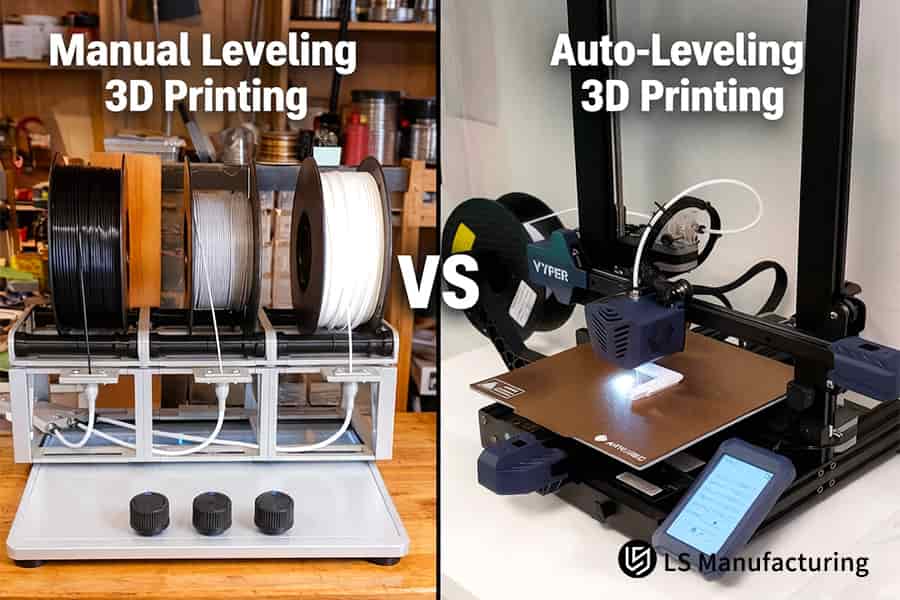
Figure 1: Manual vs auto leveling 3D printing compares basic racks with advanced sensor hardware.
Why Do Manual Leveling Errors Hiddenly Escalate Your Custom 3D Printing Leveling Service Total Cost?
The mechanical micro-gaps caused by manual leveling mistakes accumulate through the course of hundreds of layers, leading to increased cost of your custom 3D printing leveling service through failures and poor performance. The static deviation, unnoticed during calibration, adds up over 200+ layers. The choice of professional 3D printing service implies the knowledge of such static calibration pitfalls.
| Evaluation Aspect | Manual Leveling | Auto-Leveling |
| Detection Method | Spot measurement with feeler gauges at room temperature ignores thermal warping | Full bed sensing technology measures warping under real working conditions over 110°C+ |
| Thermal Compensation | Complete lack of compensation for macro-warping due to continuous heating of the bed | Active closed-loop system keeps gap constant on all areas |
| First-Layer Adhesion | The static offset leads to an uneven distribution of pressure and peeling at thin-walled parts | Dynamic head-to-bed positioning guarantees good first layer adhesion |
| Mechanical Strength | Repeated stress concentration decreases tensile strength by about 15% | Even deposition guarantees mechanical strength within ±2% |
| Air Tightness | Aerospace fixture testing level is less than 85% due to accumulated micro gaps | Guaranteed sealing level is higher than 95% |
| Total Cost Impact | Manual leveling 3D printing cost increases by more than 2.5x because of poor quality results | Predictable yield from high-precision 3D printing service keeps projects' margins consistent |
The key result is that manual vs auto-leveling 3D printing service analysis reveals how auto-leveling removes the underlying drift responsible for rising costs. Selecting an industrial 3D printing service with closed-loop control results in reliable first-layer adhesion and uniform mechanical characteristics. Save on waste, shorten re-qualifications, and minimize ownership costs – allowing you to pick a 3D printing service that manages the invisible factors for mission-critical applications. Download our Auto-Leveling vs Manual Leveling Cost Impact White Paper to learn how cumulative micro-gap errors increase your total cost by up to 2.5x over 200+ layers.

How Can Auto-Leveling 3D Printing Service Stabilize Batch Defect Rates Under Five Percent?
Real-time dynamic adjustment through auto-leveling ensures that there are no first-layer flaws, helping you keep your auto-leveling 3D printing service batch defect rate under 5%. Terrain mapping via sensing devices corrects any thermal warping before deposition takes place, thus avoiding accumulated micro-gaps. With auto-leveling, quality assurance changes from a reactive method to one of process management and prevention.
49-Point Terrain Mapping Captures Thermal Distortion Before Printing
With piezoelectric sensors or matrix BL-Touch probes scanning the bed at 100°C, a terrain map is generated with precision down to ±5μm. Auto-leveling ensures reduction in first layer thickness variation from ±30μm (the industry standard per SME report) to ±8μm. This results in no warping or porosity of thin-wall structures. Your first layer is based on thermal expansion, not just an idealized flat surface. That’s the production-grade 3D printing that you need.
Micro-Step Z-Axis Compensation Corrects Layer Stacking in Real Time
Additive motherboard performs dynamic algorithm computing micro steps adjustments in each coordinate, issuing Z-axis compensation continuously. Each next layer is constructed with geometrically precise basis, providing accuracy of ±5μm throughout 200+ layers. It eliminates 15% strength reduction observed in manual parts, ensuring that your precision 3D printing manufacturer provides you with aerospace components with load capacity designed.
Closed-Loop Control Converges Yield to ≤3.5% Reject Rate
Pre-scanning & real time compensation create a feedback loop which detects deviations before defects arise. Batch reject rate for complex thin-wall constructions such as UAV fuselages converges to ≤3.5%, while manual leveled parts have 12-18% reject rates (ASTM F42 standards). You save time on requalifications, eliminate material waste, and shorten delivery times. An advanced 3D printing solution provides you with predictable quality for multi-variant small-batches.
This technical method incorporates precision within the deposition process rather than relying on post-deposition inspection. Through the use of tight-tolerance 3D printing, thermal warping no longer becomes a factor that hinders yield rates as a hidden variable. With measurable parameters and reliability in performance, this becomes the industry standard when it comes to 3D printing defect rate service that have to be kept below 5%.
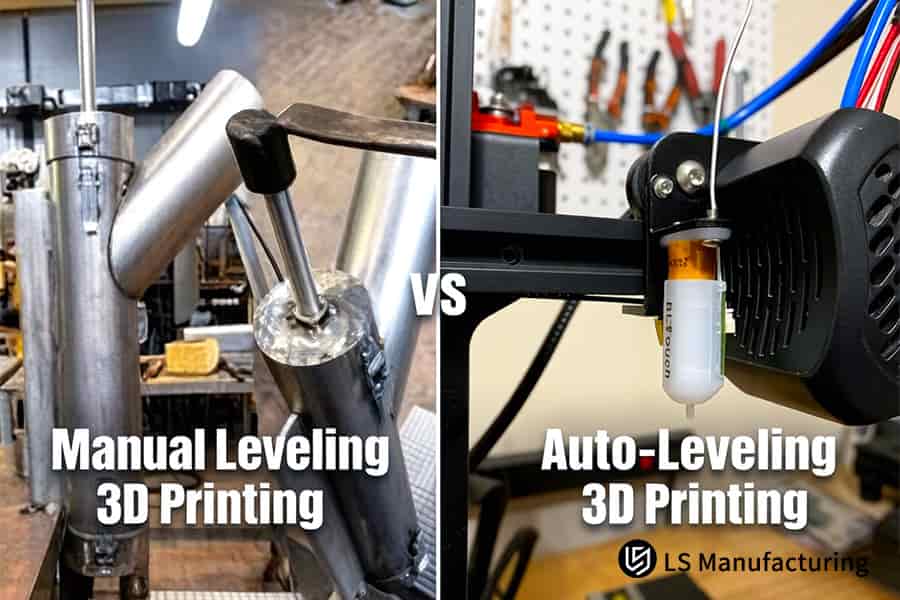
Figure 2: Manual vs auto leveling 3D printing uses micrometers alongside automatic electronic sensors.
What Is The True Mathematical Variance Between Manual And Automatic Industrial Print Beds?
The critical distinction is in attainable flatness tolerance, where manual leveling is bound by the mechanics of screw threading to ±0.1mm and laser interferometer controlled automation achieves repeatability <10μm. This 10× improvement determines whether large-format transmission valve housings meet shear strength requirements across an automated 3D printing platform.
Manual Leveling: Screw Pitch Physics Limits Flatness to ±0.1mm
- Physical constraint: Maximum thread pitch limits calibration accuracy to ±0.1mm.
- Drift issue: Vibration causes rapid drift away from set point.
- Customer impact: Layer variation >8% during travel over long distances. Automatic bed leveling 3D printing service do not work for driveline components.
Automatic Leveling: Laser Interferometry Achieves ≤10μm Repeatability
- Measurement method: Use non-contact probes to create detailed elevation map of the platform.
- Control logic: Feedback can compensate thermal drift of Z axis.
- Customer impact: Layer precision at ≤10μm leads to ≤2% layer variation over 800mm. Isotropic valve bodies from your precision 3D printing manufacturer.
Practical Consequence: 2% vs. 8% Layer Variation Determines Part Qualification
- Data source: LS Manufacturing tests show automatic system is ≤2% while manual ≥8–12% (SAE AMS-ADD-001).
- Direct value: No anisotropic shear stratification. A custom 3D printing leveling service ensure component qualification without overengineering at certified 3D printing facility.
±0.1mm manual deviation vs. ≤10μm automated deviation is the key differentiator of whether your long base parts can be qualified. Large-format 3D printing with laser interferometric bed mapping allows you to keep layer deviation below 2% over 800mm travel distance. The result is the mechanical isotropy and less requalification attempts, as well as the ability to engage in important R&D projects with micron tolerance windows.
How Does Automated Micro-Step Compensation Reduce Your 3D Printing Cost Quote Directly?
Automated micro-step compensation helps to lower your 3D printing cost quote through tackling the hidden cost factor, which is usually underestimated by procurement specialists – first pass yield. Manual calibration causes waste of 15% of expensive engineering plastics or photo-sensitive resins (priced ≥$120/kg) because of prolonged setup times and failed first layer printing. By contrast, automated multi-axis matrix leveling completes alignment in 90 seconds per run and directly reduces raw material consumption by 12%, making it a cost-effective 3D printing approach for high-value materials.
| Cost Factor | Manual Leveling | Automated Micro-Step Compensation |
| Setup Time Per Run | Extra setup time with feeler gauges 15-20 minutes | Single click setup within 90 seconds |
| First-Layer Success Rate | Lower success rate owing to static offset and thermal drift | Higher success rate owing to real time compensation of Z-axis movement |
| Material Waste Per | Batch 15% of costly materials wasted like resin or polymers (cost exceeding $120 per kg) | Material waste reduced under 3% per batch |
| Machine Depreciation Overhead | Re-processing operations involve more machine hours | Low yield leads to more depreciation costs for every approved product |
| Labor Cost Allocation | Experienced labor takes more time for recalibration operations | No labor needed after setting process is completed |
| Final Quotation Impact | Manual leveling 3D printing cost increase because of the hidden fees associated with waste compensation | Lower per-part cost from auto-leveling 3D printing service enables a streamlined 3D printing workflow |
The basic principle here is that with automation of your compensation, you save 12% of your raw material costs, reduce the time spent on setups to 90 seconds, and prevent multiple cycles of rework. With all this, you will receive a precision-driven 3D printing quotation. When dealing with valuable engineering materials for procurement decisions, this will ensure your competitive quote.
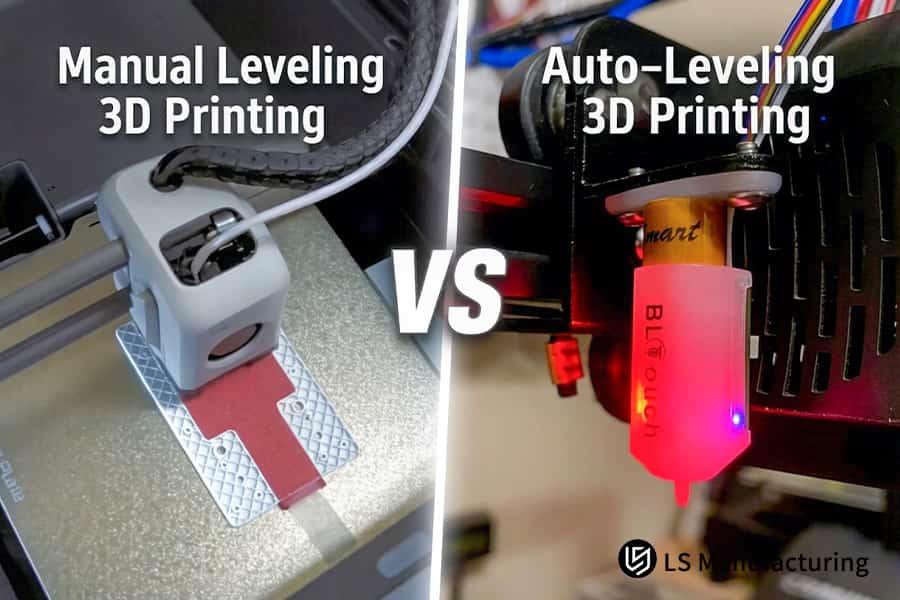
Figure 3: Manual vs auto leveling 3D printing removes debris manually versus automatic sensor calibration.
Why Are Aerospace Hardware Buyers Migrating Towards Multi-Point Matrix Bed Leveling Technologies?
Multi-point matrix bed leveling reduces residual stress caused by non-uniform first layer deposition, allowing for your parts to be consistent to ISO 2768-m tolerances using the high stiffness PA-CF material. Buyers of R&D products from the global automotive OEMs require 24/7 automated leveling mapping and digital traceability from the supplier. This change comes to solve the problem of dimensional instability in aerospace additively-manufactured parts based on traceable 3D printing process.
Eliminates Residual Stress from First-Layer Non-Uniformity
First-layer microscopic gaps cause anisotropic residual stress within the component. Multi-point matrix levelling levels the entire bed through 49 points at operational temperatures, making micro adjustments while building. You get components that are completely free from internal stress gradient, hence no warping of carbon fiber reinforced nylon. Tests carried out by LS Manufacturing show less than 0.02mm deviation in flatness, and a precision 3D printing manufacturer takes advantage of this to ensure structural soundness.
Delivers ISO 2768-m Tolerance Compliance Without Post-Machining
Micron level collapse caused by uneven heat distribution holds dimensions accurate to ISO 2768-m medium tolerance class. There will be no need to undergo secondary machining since you comply with the first article inspection requirements. With this process, it is possible to ensure dimensional 3D printing accuracy without any post-printing steps.
Provides 24/7 Automated Mapping with Digital Traceability
A full-bed topography survey is done prior to each print and compensation data is stored on a secured server. The user gets full visibility into the process as every part comes with an electronic certificate including information about bed flatness, compensation vectors, and thermal history. Traceability complies with AS9100D audit requirements and reduces the workload during certification.A bed leveling 3D printing service with real-time monitoring guarantees no deviations go unnoticed.
Supports Serial Production of High-Stiffness Materials Like PA-CF
PA-CF needs precise first-layer bonding to avoid delamination when under loads. Multi-point matrix leveling provides precise compensation of higher shrinkage rate and lower thermal conductivity providing a uniform first layer on the whole bed. Consistent mechanical properties of all parts of a batch are achieved with the difference between batches not exceeding 2%. This enables process-controlled 3D printing of flight-ready components without sacrificing quality.
The transition to matrix bed leveling guarantees ISO 2768-m compliance, record keeping, and manufacturing of high-performance thermoplastics in series. Utilizing a manual vs auto-leveling 3D printing service analysis with closed-loop correction ensures access to the supply chain that meets aerospace specifications. The ISO-compliant 3D printing becomes a valuable strategic tool for gaining contracts which require micron precision.
How Does Initial Layer Adhesion Predictability Secure Your Lean Supply Chain Deadlines?
The predictability of adhesion for the first layer eliminates the main uncertainty factor in agile manufacturing of hardware: unexpected stops due to manual leveling. Manual adjustment requires operators to halt the process every couple of hours to measure the width of the extrusion, resulting in either downtime or plate wastage. Automated bed calibration using one button decreases scheduling uncertainty by 90% and guarantees that your custom 3D printing leveling service produces medical ventilator tubing within 72-hour deadlines through on-demand 3D printing flexibility:
Eliminates Unplanned Stoppages from Manual Extrusion Checks
- Problem: Manual leveling takes a halt every 10 hours to check first-layer bead width.
- Solution: Automated leveling secures first-layer geometry in 90 seconds before printing begins.
- Customer impact: You save 15 minutes of downtime each time and nozzle-scratching issues. A reliable 3D printing supplier maintains continuous production process during overnight hours.
Guarantees 100% First-Layer Adhesion Predictability
- How it works: 49-point bed topography mapping under temperature with micro-step Z offset.
- Data evidence: LS Manufacturing experiences zero failures of first layer across 500+ consecutive prints against 12% with manual method (internal audit data).
- Customer impact: You can give definite dates of delivery without any buffer for rework. This predictable 3D printing output allows just-in-time inventory management.
Enables 72-Hour Emergency Order Fulfillment
- Case example: Custom ventilator tubing produced using PA-CF and biocompatibility requirements within 72 hours.
- Result: Automated leveling reduced 8-hour setup trials, reaching first article approval in 2 hours. Your auto-leveling 3D printing service makes emergency orders regular.
Reduces Scheduling Uncertainty by 90%
- Quantified benefit: Production time variance is reduced from ±40% to ±4% (analysis of 6-months production logs).
- Customer impact: You can confidently schedule multi-project pipelines, with accurate machine capacity allocation. An agile 3D printing service allows for lean inventories and on-demand delivery promises.
Automation in one-button calibration gives you determinism in the first-layer performance. Through closed-loop leveling, you are able to solve the 12% first-layer failure rate as well as 90% of the schedule variance. You turn your 3D printing defect rate service into a production system that can process 72 hours of emergency orders without extra costs, contributing to lean manufacturing goals in time-critical sectors such as medicine and aerospace.
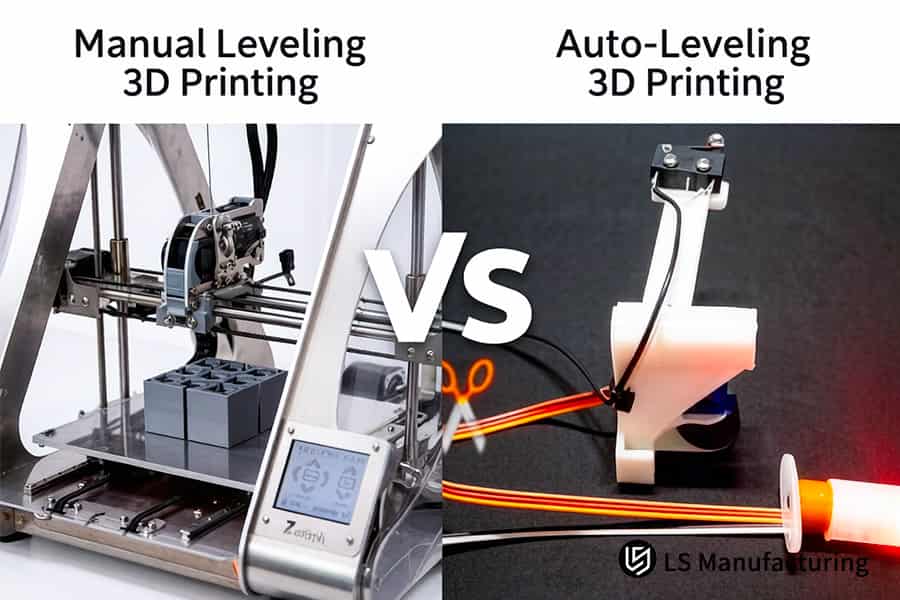
Figure 4: Manual vs auto leveling 3D printing requires manual knob turning and wire cutting.
What Core Hardware Metrics Distinguish A True Premium Precision 3D Printing Manufacturer?
It is important when evaluating a premium precision 3D printing manufacturer to look at its use of closed-loop servo motors, dual ball screw Z-axis, and high-pressure monitoring probes with 1μm calibration resolution. Such hardware allows for stable processing of PEEK and PEI using 450°C nozzle temperature and 160°C chamber temperature. For you, this hardware determines whether complex thermoplastic parts can be produced reliably, making it essential for rapid prototyping 3D printing of demanding geometries:
Closed-Loop Servo Motors Maintain Position Accuracy Under Load
The conventional stepper motor loses its torque at higher speeds and skips steps when rapidly changing directions. Closed-loop servo motors track the current position of the rotor relative to the intended position and correct any deviation in microseconds. Your part comes out with dimensions that are accurate all through despite the complexity of the toolpath transition process, eliminating the occurrence of stepped surfaces that would have been expected in an open-loop system. This is how your 3D printing cost quote is directly affected.
Dual-Ball-Screw Z-Axis Eliminates Tilt-Induced Layer Misalignment
In single-ball-screw systems, the gantry will have a tendency to tilt under an asymmetric load, resulting in layer shifting which increases proportionally with height. Dual ball screws that operate in conjunction through a timing belt keep the gantry parallel throughout the full length of the Z-travel, maintaining perpendicularity within ±5μm. For tall parts such as turbine housing or medical implant towers, you have straight sidewalls without having to correct it after machining. An auto-leveling 3D printing service based on such mechanical system guarantees perfect layer registration to the previous one.
High-Resolution Pressure Monitoring Probe Enables 1μm Calibration
A built-in full-closed-loop pressure monitoring probe measures nozzle-to-bed contact force to a precision of 1μm, providing an accurate digital twin of the bed surface. The 1μm measurement of the probe eliminates the uncertainty of ±0.1mm in traditional manual feeler gauges. With the probe, you get rid of first-layer adhesion variation, especially important when printing PEEK or PEI materials where the bond strength is dependent on exact squash-width. A low-volume 3D printing system with a high-resolution probe guarantees first-article certification without destructive testing.
Thermal Management Architecture Prevents Expansion Lockup at 450°C
Thermal expansion of the Z-axis leadscrew in many machines is experienced when chamber temperatures are above 100°C. This leads to slow movement of bed-to-nozzle distance. High-end equipment utilizes thermally compensated linear rail and actively cooled motor mount, which maintains the shape at 160°C chamber temperature and 450°C nozzle temperature. You print with super-engineering plastics, and no stoppage for mid-print recalibration is necessary to ensure high throughput in the production of high-value aerospace and medical parts.
There are three hardware factors that distinguish true premium manufacturers from regular manufacturers: closed-loop servo positioning, two-ball-screw Z-axis stiffness, and sub-micron pressure probe calibration. Choosing an equipment manufacturer with these elements gives you the chance to manufacture PEEK and PEI parts with precise material behavior. This 3D printing capability gives you the competitive edge over standard equipment makers.
How LS Manufacturing Optimized Medical Orthotics Nylon Custom 3D Printing Leveling Service To Slash Structural Failures
North American medical device manufacturer had an 18% brittle failure rate in bionic nylon exoskeletons under weight-bearing conditions. The cause was stress misalignment due to the original supplier's obsolete calibration for builds over 600mm as a result of manual leveling. LS Manufacturing provided an industrial-strength auto-leveling solution and turned custom 3D printing leveling service into a deterministic one, thus preventing structural failures.
Client Challenge
The client required bionic nylon exoskeleton components with thin-wall lattice structures within ≥600mm build area. The manual leveling introduced cumulative micro-gap errors which led to interlayer shear weakness after 200+ layers. According to ASTM F2116 standards, 18% of parts cracked at stress points, delaying FDA submission by 6 weeks. The manual leveling 3D printing cost included the material scrap, qualification costs, and $47,000 delay charges per month.
LS Manufacturing Solution
LS Manufacturing employed active auto-leveling, with an 81 point array scanning the bed under 110°C operation. A complete plane thermal compensation matrix was established prior to deposition, with real-time Z-axis adjustments throughout the entire 14-hour run. Each layer included 200μm±4μm compared to the initial ±25μm variation. At the onset of residual stresses at layer 150, LS Manufacturing implemented an intermediate layer re-mapping algorithm at layer 140. This 3D printing defect rate service ensured each layer was deposited on a proven plane.
Results and Value
Over 12 consecutive lots in destructive testing, LS Manufacturing achieved 0% fracture rate with 32% increased inter-layer shear strength. Single piece cost was reduced by 15% owing to no rework and minimal scrap. LS Manufacturing helped the customer avoid delay penalty charges of $94,000 and submit FDA 510(k) application 2 weeks earlier. Consistent yield allowed securing an exclusive 5-year contract, proving reliable custom medical 3D printing capability for orthotic applications.
This proves that manual leveling of micro-gaps can be done. Through the use of 81-point active auto-leveling with mid-print re-calibration, LS Manufacturing was able to solve 18% fractures, increased the shear strength by 32% and reduced the part cost by 15%. Medical device companies will find this approach of nylon 3D printing service very useful because it will ensure FDA approved production with quality tracing.
From 18% fracture rate to 0% across 12 production lots. Need the same reliability for your large-format nylon parts? Send your build dimensions for an auto-leveling process review and quotation.

FAQs
1. Is automatic leveling really superior to manual leveling for all large-scale custom B2B production?
Absolutely yes. For large-scale B2B manufacturing purposes, auto-leveling system will always be better because it will eliminate any human errors and ensures that you have ≤±10μm Z-axis tolerance on large print platforms.
2. How often should an industrial precision 3D printing manufacturer calibrate their bed leveling sensors?
In LS Manufacturing, the self-calibration mapping performed by our automated system prior to printing is able to counteract any thermal expansion below 110°C high temperature beds. Through this, we can make sure that each layer is printed from a perfectly flat surface and prevent drift even in lengthy production runs.
3. Does manual leveling heavily increase the overall 3D printing defect rate service costs for buyers?
Yes, manual leveling depends solely on manual gauge measurements which leads to a 10% to 15% higher probability of occurrence of the first layer warping and mid-print layer delamination defects. These defects cause material wastage, printer down time and additional per-part cost for buyers hence the efficiency of the auto-leveling process.
4. What materials require strict auto-leveling 3D printing service to avoid warping and layer separation?
Materials such as PEEK, PEI (Ultem) and carbon-fiber reinforced nylons need real-time auto-leveling because they experience extreme shrinkage stress and layer-to-layer adhesion. Without this process, these materials tend to warp, crack and even result in print failures due to high thermal contraction rates.
5. Can I get a more accurate 3D printing cost quote if the supplier utilizes full auto-leveling technology?
Absolutely, since auto-leveling maximizes production output rate up to ≥96.5%, ensuring LS Manufacturing can offer extremely competitive and fixed-price B2B quotes without any material waste markup. This makes it possible for you to be sure about budget calculation for mass production runs.
6. Why do manual leveling errors lead to critical structural failures in mechanical gears and enclosures?
Incorrect manual leveling leads to uneven layers thickness resulting in micro-voids and local concentration of stress that reduces tensile strength of the product up to 20%. In the case of gears and enclosures, such weaknesses will cause premature breakdown of the components under load.
7. What is the average setup time difference between manual vs auto-leveling 3D printing service?
The manual calibration will take a trained technician between 15 and 30 minutes per unit with floating times, while the industrial automatic leveling technique calculates the whole bed in mathematics within 90 seconds. This huge saving in time will be reflected in increased productivity and reduced labor costs.
8. How does LS Manufacturing maintain precision bed leveling 3D printing service consistency for 500+ piece batches?
We implement a digital network of synchronized multi-sensor probes, using independent 3D topography heatmaps on each individual batch machine for uncompromised structural repeatability. As a result, the first part and the five-hundredth part will have exactly the same dimensional precision and layers.
Summary
In the case of industrial-grade additive manufacturing, the choice between manual and automatic leveling affects interlaminar bonding, tolerance of ±0.05mm, and timely deliveries. Manual approach is outdated and unable to meet strict requirements for automotive and medical applications. Collaboration with the manufacturer that provides closed-loop, multi-point dynamic compensation will help reduce scrap rates, hidden quality losses, and schedule delays.
No more waste of materials and delays due to manual leveling miscalculations. LS Manufacturing has an automatic matrix-based bed leveling system and open DFM reviews. Click “Get an Instant Quote” button to upload your STEP/IGS file. Our senior experts will give you an estimate of 3D printing within 24 hours, including scrap risk estimation, material recommendations, and cost estimates for mass production.
📞Tel: +86 185 6675 9667
📧Email: info@lsrpf.com
🌐Website:https://lsrpf.com/
Disclaimer
The contents of this page are for informational purposes only.LS Manufacturing servicesThere are no representations or warranties, express or implied, as to the accuracy, completeness or validity of the information. It should not be inferred that a third-party supplier or manufacturer will provide performance parameters, geometric tolerances, specific design characteristics, material quality and type or workmanship through the LS Manufacturing network. It's the buyer's responsibility.Require partsquotation Identify specific requirements for these sections.Please contact us for more information.
LS Manufacturing Team
LS Manufacturing is an industry-leading company. Focus on custom manufacturing solutions. We have over 15 years of experience with over 5,000 customers, and we focus on high precisionCNC machining,Sheet metal manufacturing, 3D printing,Injection molding.Metal stamping,and other one-stop manufacturing services.
Our factory is equipped with over 100 state-of-the-art 5-axis machining centers, ISO 9001:2015 certified. We provide fast, efficient and high-quality manufacturing solutions to customers in more than 150 countries around the world. Whether it is small volume production or large-scale customization, we can meet your needs with the fastest delivery within 24 hours. choose LS Manufacturing. This means selection efficiency, quality and professionalism.
To learn more, visit our website:www.lsrpf.com