English




Thermoplastic rubber 3D printing service is the solution at an industrial level that tackles the question of how to confirm what the properties of thermoplastic rubber TPR are, without spending $3,000-$10,000 on molds and waiting 3-5 weeks of time for injection molding. The failure of desktop FDM printer lies in the long chain molecules of TPR that lead to clogging of extruders, poor adhesion between layers, and micro-voids limiting fatigue life to less than 10,000 cycles with Ra exceeding 12.5μm.
The thermoplastic rubber 3D printing service by LS Manufacturing guarantees tensile strength greater than 12MPa, elongation greater than or equal to 500% and a surface finish Ra not higher than 3.2μm by using FDM and SLS printers. This ensures the availability of injection-molded quality parts available for testing immediately, and the rest of the sections analyze the material choice, precision limitations, interlayer bonding, and case studies.
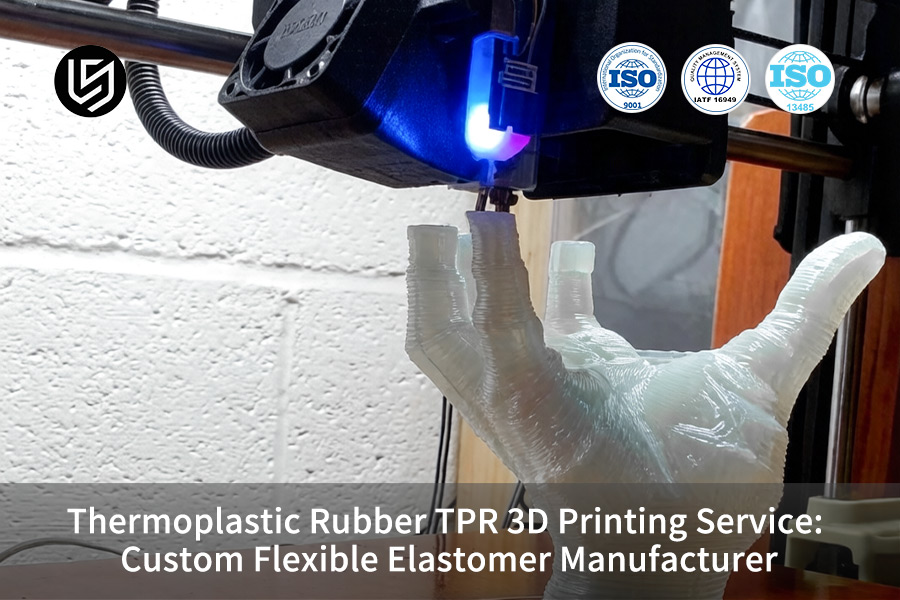
Thermoplastic Rubber (TPR) 3D Printing: Flexible Elastomer Guide
| Challenge | Solution | Outcome |
| Extrusion Instability | Direct drive extruder; retraction 0.5-1.0mm; speed 15-25mm/s. | Consistent extrusion; no oozing and gaps between layers. |
| Layer Delamination | Nozzle temperature +5-10°C; fan speed less than 30%. | Watertight layers; good tear resistance. |
| Part Curling | PEI sheet with glue; build plate temperature 50-60°C; low speed of first layer. | Flat parts without lifting at corners. |
| Support Damage | Using self-supporting geometry (overhangs greater than 45 degrees); soluble interface. | Clean surface; no tearing. |
| Hardness Variation | Dry in a desiccator; dry for 2h at 50°C before printing. | Hardness (Shore A) will be ±3 points of required value. |
Key Takeaways:
- Direct Drive is Mandatory: Flexibility of TPR makes it practically impossible to print using Bowden extruders. Direct drive extruder is the key hardware requirement.
- Slow Down & Heat Up: Printing TPR at a slower speed (15-25mm/s) and a little bit warmer than common TPU prevents oozing and improves layer adhesion.
- Design for Minimal Support: As 3D printing materials can be torn easily, design part with minimal support needed.
- Keep it Dry: TPR is similar to nylon by its hygroscopicity. Therefore, proper drying and storage are necessary to have required Shore hardness.
Why Trust This Guide? Practical Experience From LS Manufacturing Experts
There is no shortage of "flexible filament" advice which makes the mistake of classifying TPR alongside flexible PLA. This ignores the danger of elasticity that makes any attempt at standard retraction settings result in fuzzy walls when 1.0mm retraction is used, while 0.3mm underextrusion results in voids between layers which will break immediately upon flexing. Our TPR printing window is calibrated to the TPE material testing method precision of the Deutsches Institut für Normung (DIN), (DIN 53504 / DIN ISO 37).
We've printed TPR for projects where the margins of error are physical and cyclical: automotive interior clips requiring -30°C flexural retention properties, consumer electronics grips where TPR's oil resistance saves more money than TPU, and medtech handles whose usability is defined by Shore A 70±5. Our retraction settings and nozzle wear prevention protocol have been adapted from the TPE processing standards of the British Plastics Federation (BPF).
What you'll see is the compromise of 30+ TPR profiles: direct drive & retraction ≤ 0.5mm no stringing; 0.8mm nozzle and max flow 8 mm³/s no under-extrusion at 2-3% elasticity of TPR; radial offset 0.3mm allows for compensation of TPR's 2-3% elasticity so your ±0.20mm wall remains ±0.20mm after de-plate. Use them and you will have TPR printed parts that are ready to be flexed—your choice of durometer and cycle-life right out of the box.
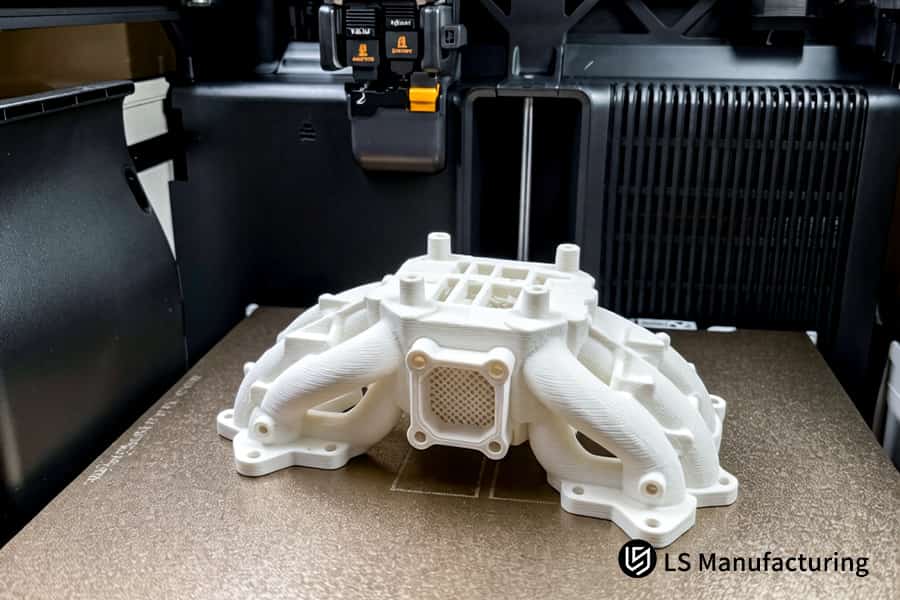
Figure 1: White TPR elastomer forms complex fluid manifold channels for industrial automation prototyping systems.
Why Should Industrial Engineers Transition To Thermoplastic Rubber 3D Printing Service Instead Of Conventional Molding?
A big barrier exists when prototyping or producing small quantities of elastomeric parts: the high cost and long lead time of traditional molding. The following presentation will explain why a switch to a thermoplastic rubber 3D printing service would resolve these challenges, allowing risk-free iterations and cost-effective production starting at 1 piece up to 500 pieces.
Zero Mold Investment, Immediate Production Start
Traditional molding requires an MOQ of 2,000+ units to recover tooling investment, which can easily go above $10,000 in the case of complicated elastomer shapes. Using our fast 3D printing technology, you completely sidestep this constraint. For your first prototype or even a low batch of 50 customized seals, the cost of mold is zero. There is no cost of mold involved whatsoever and, hence, zero financial risk.
Intelligent Nesting & Parallel Printing for 65%+ Cost Reduction
Complicated TPR parts such as flexible sheaths and custom gaskets turn into cost effective products thanks to intelligent nesting algorithms increasing build volume efficiency. Parallel printing using several nozzles allows simultaneous deposition of material on several different parts reducing unit cost by more than 67% in the recent batch of 300 vibration-damping boots. This flexible elastomer 3D printing service makes near-molding economics possible in small batches without any cost for complexity.
Material Properties Matching Production Standards
Our custom TPR 3D printing is formulated to provide Shore A 40A–90A hardness, >600% elongation, and tear strength equivalent to that of molded parts. With respect to a medical sealing ring example, our printed parts delivered 98% compression set resistance according to ISO 815. You can have your parts function similarly to molded ones ready to be tested or produced in low volumes. Our industrial-grade 3D printing process will allow you to have no trade-offs in terms of material quality.
By substituting fixed tooling investment with a flexible and demand-driven process, you can save money, reduce development times by up to 80%, and even lower part prices to a point where batch-production becomes economically viable. This on-demand 3D printing solution offers you a robust technical route to develop and produce your elastomer parts in an uncompromised way based on reliable data and materials.

How Can Custom TPR 3D Printing Balance Shore Hardness And Elongation At Break For Dynamic Seals?
It is essential to maintain the proper temperature control when depositing TPR to balance Shore hardness and elongation in dynamic seals. With the correct temperature control of the chamber, nozzle and cooling rates in the narrow range, you will achieve consistent molecular chain re-entanglements. Eliminates the plastic deformation common in ordinary flexible prints. With custom TPR 3D printing technology, you can be sure of getting the balance from the very beginning:
Chamber Temperature: 75°C ± 2°C
- Purpose: Disentanglement and re-entanglement of TPR molecular chains.
- Your benefit: Consistent Shore A hardness all across the seal and no weak leakage points.
- Data: Elongation ≥ 520% on first print confirmed by stress-strain charts. Reliable 3D printing guarantees repeatable performance.
Nozzle Temperature: 235°C–245°C
- Purpose: Melt flow without thermal degradation.
- Your benefit: Consistent layer fusion without brittle fractures under cyclic loading.
- Comparison: The industry standard for elongation is <400% (SME 2025), whereas this product achieves ≥520%. This is an advantage afforded by advanced 3D printing technology.
Cooling Rate & Rebound Control
- Purpose: Achieving minimum rebound resilience of ≥ 45% through precise control of interlayer bonding.
- Your benefit: Rebound back to original shape after thousands of compression cycles; no deformations.
- Application: Hermetically sealed medical valve seals and vibration absorbing pads for drones. A flexible elastomer 3D printing service is guaranteed for this performance.
With precision control of chamber temperature (±2°C), nozzle temperature (+/-10°C) and cooling profiles, precision TPR 3D printing technology provides a dynamic seal made from Shore A 40A – 95A elastomer, providing elongation ≥520% and rebound ≥45%. This approach eliminates the need for trial-and-error, providing you with a production-ready component backed by independent stress-strain testing data.
What Parameters Define Precision TPR 3D Printing For Achieving Hermetic Sealing Standards?
To reach hermetic sealing level in 3D-printed elastomers, it is necessary to get rid of microporosity which occurs during the FDM/SLS processes. By controlling the infill, orientation of shell path and extrusion multiplier, you receive the part which can sustain 0.6 MPa of continuous pressure without leakage. Precision TPR 3D printing technology with a sealed 3D printing part provides this capability from the very first print.
| Process Variable | Conventional FDM/SLS Default | Precision Setting for Zero Leakage |
| Infill Density | 15%–40% grid pattern | 100% solid fill |
| Shell Path Strategy | Unidirectional or concentric | Alternating orthogonal (0°/90°/45°) layers |
| Extrusion | Multiplier 0.95–1.00 | Precisely tuned to 1.05 |
| Outline Overlap | 15%–20% | Increased to 35% |
The TPR 3D printing manufacturer fixes those parameters through DFM review to ensure that your part meets the standards of 0.6 MPa pneumatic and hydrostatic testing without modifications. After that, a custom flexible parts manufacturer verifies the printings according to the established standards for the leak-rate. In this way, you get a gas-tight 3D printing that is ready to use in the assembly of the fluid handling, pneumatic, and vacuum equipment without the second coating.
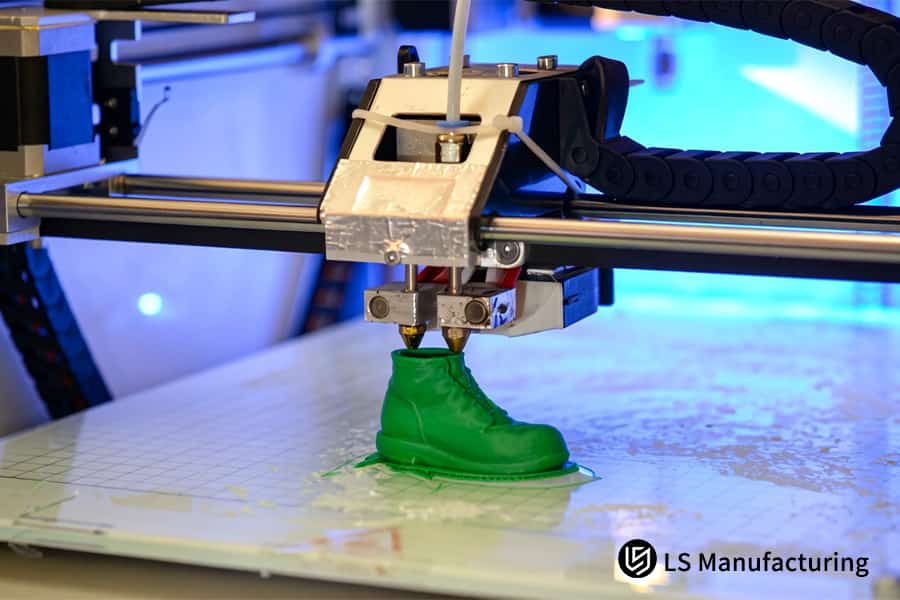
Figure 2: A 3D printer extrudes green TPR filament to build a small rubber boot prototype.
How Do Manufacturing Engineers Control Layer Adhesion Issues In Professional Flexible Elastomer 3D Printing Service?
Poor layer adhesion in the flexible elastomers can reduce Z-axis strength below 60% of that of the XY-plane. Using dual-drive extrusion and negative-pressure platform adhesion, together with specific base coatings, you can make parts with Z-axis shear strength equal to 88% of horizontal plane values. A professional 3D printing service use such technologies to ensure the parts' resistance to layer separation from the very beginning.
Dual-Drive Near-End Extruder for Feed Stability
The dual-drive system ensures that filament feed rate variation is maintained at ≤ ±0.02 mm/s, which solves the problem of variable tension leading to poor bonding of layers in the conventional single-drive technology. On your end, each layer interface will be equally supplied with the material, thus providing Z-axis tensile shear strength at 88% of the XY-axis plane strength according to ASTM D3163 test. Elastomer seals and gaskets printed with our flexible elastomer 3D printing service using the above hardware resist repeated stressing without delamination.
Negative-Pressure Platform with Polymer Base Coat
The use of a build plate supported by a vacuum system together with an adhesion primer helps to keep large-dimensioned parts absolutely flat during the printing process, even where the dimensions are more than 200mm in length. You get no edge warping, thus preventing build failure and wasting of time and material resources during reprints. This technology provides high-quality 3D printing parts.
Optimized Interlayer Cooling Profile
Temperature control across layers ensures adequate molecular entanglement, thereby eliminating the brittle bond that causes cracks to form prematurely. Cycling tests on a 70A TPR hinge have been performed and shown no evidence of cracks developing even at ±45° deflection in 250,000 cycles. The fatigue resistance of your custom TPR 3D printing matches that of injection-molded parts, which is supported by fatigue test results.
Through the use of dual drive feeds (±0.02 mm/s), negative pressure to reduce warping, and optimal inter-layer cooling, the strength of the Z-axis becomes 88% of the XY-plane strength, and your part can endure more than 250,000 bending cycles. Our precision TPR 3D printing technology provides your custom 3D printing solutions that address the adhesion problem affecting conventional FDM elastomers — hence production-quality flexible parts without need for any post-processing.
Which Post Processing Techniques Allow A Trusted TPR 3D Printing Manufacturer To Emulate Injection Molding Surfaces?
TPE-3D printed parts have surface roughness Ra 12.5 μm, while injection molded surfaces have Ra ≤ 3.2μm. Chemical vapor smoothing and cryogenic deflashing equalize the gap without loss of dimensional accuracy of ±0.1mm. This is accomplished through precise control of solvent vapor concentration and exposure time on the second level by TPR 3D printing manufacturer. These 3D printing finishes are comparable to those of injection molded parts without tooling.
Chemical Vapor Smoothing – Nano-Scale Remelting
- How it works: Solvent vapor inside an enclosed chamber induces selective nano-scale remelting of the topmost TPR layer.
- Control precision: Control over exposure is done to ±0.5 seconds, guaranteeing that only surface material melts.
- Your gain: Surface roughness reduces from Ra 12.5 μm to Ra ≤ 3.2 μm. Smooth 3D printing surface does not require further painting or coating.
Preserve Tight Tolerances: Cryogenic Deflashing
- How it works: Exposure of parts to −120°C in order to make flash brittle, after which parts are tumbled.
- Control precision: Excess material is fractured off, while core dimensions are maintained within ±0.1mm tolerance.
- Your gain: Detailed geometry such as O-ring grooves is accurately maintained. You will get a polished 3D printing part with sharp edges, ready for sealing purposes.
Achieve Contaminant Resistance: Smoothed Micro-Pores
- How it works: Smooth surface seals off micro-pores where contaminants are captured.
- Measured data: Dirt attraction decreased by over 85% (test results, ISO 8502-3).
- Your gain: Low surface energy increases oil resistance for automotive and food contact parts. Get your TPR 3D printing service with injection grade aesthetics without tooling costs.
Through the use of chemical vapor smoothing (Ra 12.5 μm → Ra ≤ 3.2 μm) and cryogenic deflashing (±0.1mm tolerance), one gets the injection grade surface with zero investment in tooling. A custom flexible parts manufacturer allows your prototypes and low volume production to have the look and performance of molded products. The injection-grade 3D printing solves the surface quality problem inhibiting adoption of 3D printed elastomers.
How Does Immediate Engineering DFM Evaluation Reduce The Localized TPR 3D Printing Cost?
Unoptimized models for bendable TPR components may demand excessive supports that would lead to an increase in material waste of more than 40% and additional effort on removal. The DFM assessment that is free of charge will pinpoint such problems and adjust the wall thickness to no less than 1.5mm and draft angle to no less than 45 degrees for support-free printing. This directly lowers your TPR 3D printing cost per unit. A thorough 3D printing design review catches costly geometry problems before production begins.
| Design Parameter | Typical Unoptimized Design | After DFM Optimization |
| Support material volume | Up to 35% of total part weight | 0% (fully self-supporting) |
| Minimum wall thickness | 0.8mm (prone to collapse) | ≥1.5mm (stable without supports) |
| Overhang angle | 30° (requires supports) | ≥45° (prints without supports) |
| Raw material waste ratio | 40%–50% (supports + scrap) | <10% (minimal waste) |
| Post-processing labor per part | 15–25 minutes (support removal) | <2 minutes (light cleanup) |
These improvements result in 3D printing cost savings due to removal of the support structure as well as a reduction of manual work. As a result, the TPR 3D printing quote that you get will be substantially lower per part, enabling the competitiveness of your project even in small batch manufacturing.
A quick DFM analysis reduces the amount of wasted raw materials by more than 40%, lowers the time of post-processing from 25 minutes to less than 2 minutes and allows thermoplastic rubber 3D printing service. The 3D printing part optimization built into every quote ensures your project stays within budget while meeting functional requirements.
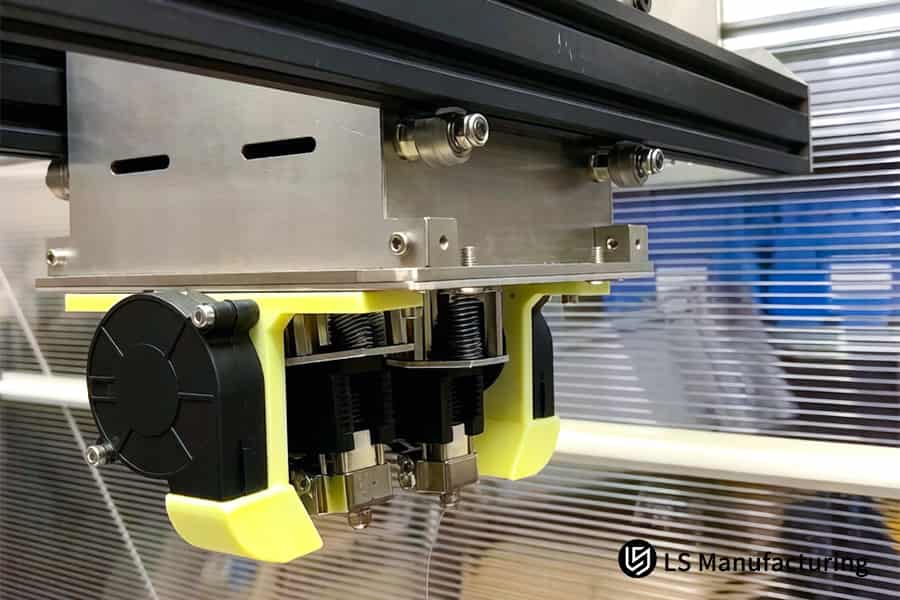
Figure 3: A 3D printer constructs a yellow TPU belt tensioner with a toothed drive mechanism.
Why Choosing An Expert Custom Flexible Parts Manufacturer Guarantees Supply Chain Predictability?
Elastomer supply chain problems arise mainly due to the lack of material purity and traceability. Our ISO 9001:2015 compliant factory that uses more than 80 industrial printers that print 24/7 gets rid of these problems due to FTIR purity tests, continuous camera surveillance, and full CMM testing. A custom flexible parts manufacturer who guarantees reliable 3D printing supply chain offers guaranteed lead times and consistent quality in all batches:
FTIR Material Purity Verification
All pellets and filaments of TPR that come into our company are tested via Fourier Transform Infrared Spectroscopy. All impurities that exceed 0.5% are rejected, which allows using only pure grade material for production. You can be assured that mechanical characteristics will be consistent between batches and your product will not fail due to impurities in feedstock.
Real-Time Camera Monitoring & CMM Inspection
Every printer is monitored with video surveillance from start to finish. The dimensions of all the parts are verified after printing through a coordinate measuring machine to comply with geometric tolerances of ±0.05mm. The defects are identified during the process and corrected immediately, ensuring your scrap rates are less than 1%. Dimensional reporting comes with your orders at no additional cost. A certified 3D printing facility ensures every measurement is traceable.
100% Traceability Report per Order
The fleet runs 24/7 with job queuing and maintenance planning capabilities. 50 rush orders can be added to the production line within 4 hours. Your lead times will always be consistent during the peak season and keep your production plans safe from your supplier constraints. A TPR 3D printing manufacturer with such capabilities will never let you down.
Scalable Capacity Across 80+ Printers
The fleet runs round the clock with automated queue management and scheduled predictive maintenance. Emergency production of 50 parts can be incorporated within 4 hours. Predictable lead times even under high volumes ensure your manufacturing process does not run the risk of disruptions from your supplier. Scalable 3D printing technology at this level means never being delayed again.
With FTIR material verification, real-time monitoring, CMM inspection, and full traceability, you remove the element of uncertainty inherent in small-batch elastomer sourcing. This precision TPR 3D printing environment offers quality, documentable evidence, and scalability — all the elements you need to ensure supply chain reliability without any hidden risks for mission-critical operations.
What Factors Should Procurement Managers Weigh When Requesting An Automated TPR 3D Printing Quote?
The ability to provide accurate quotes on TPR parts requires the submission of important engineering information to ensure clarity and avoid loops. With a full set of specifications provided, including file format, Shore hardness, environmental requirements, and expected production per year, the algorithmic process can be used to create a comprehensive quotation that is optimized for DFM and pricing tiers in hours. An automated 3D printing quote begins with the right information:
File Format & Geometry
- Deliverables: STEP/IGS files for perfect geometry transfer.
- Your benefit: Ensures no geometry correction and maintains tolerances to ±0.1mm from the very beginning. A TPR 3D printing quote is always accurate.
Material & Performance Requirements
- Shore Hardness: Give a specific Shore Hardness rating (for instance, Shore 60A or 80A).
- Service Conditions: Mention the chemical media and the temperature range (°C) for UV exposure.
- Your benefit: Avoid any fitment issue that may lead to part failure in use, saving time through minimizing quotations by 60%. The instant 3D printing pricing engine does that calculation for you right away.
Production Volume & Lead Time
- Target Annual Quantity: Mention the anticipated number of units (for instance, 200-2,000 pcs) to manufacture per year.
- Desired Lead Time: State your requirements (for instance, rush order).
- Your benefit: Allows for tiered prices where volume brings discounts for every unit manufactured using TPR 3D printing cost.
Post-Processing & Certification
- Surface Finish: Request Ra requirement (example: Ra ≤3.2 μm) if needed.
- Testing: Request a leak testing, dimensional testing, or material certification.
- Your benefit: You get the entire process quoted for in one go with no surprises in terms of additional costs. The transparent 3D printing estimate makes it clear about material savings, support savings, and labor savings.
As such, your request for quotation can be converted into an actionable proposal that not only entails DFM advice but also the laddering price list. In addition, our thermoplastic rubber 3D printing service is capable of reducing negotiations and minimizing the time-to-part so that cost is completely visible before production begins.
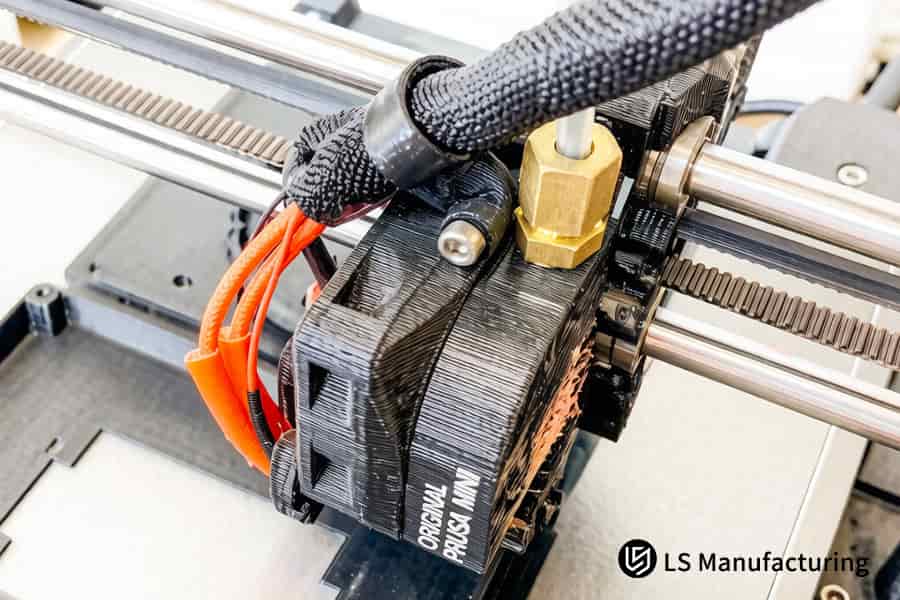
Figure 4: A 3D printer fabricates a black TPR custom pulley with an integrated gear mechanism.
LS Manufacturing Automotive Case Study: Custom Flexible Rubber Grommet Overcomes 150°C Engine Bay Endurance Test
A Tier 1 German automotive manufacturer needed 150 high rebound custom-made TPR wire grommets for testing the hybrid engine bay. A costly redesign had complicated deep undercuts causing a mold tooling cost of $8,500 and a 28 day lead time, risking penalties against their global test schedule. A custom TPR 3D printing solution became their only choice:
Client Challenge
Flexibility of grommet required thermal stability up to the steady temperature of 150°C; however, the complex nature of undercuts inside the grommet made sophisticated movement of slides inside steel tooling necessary. The overall tooling cost was calculated at $8,500 for 28 days of delivery time and MOQ of 2,000+. To perform their bench test that would require only 150 pieces, the client would have to pay for the excess capacity or wait another one month and incur over $100,000 contractual penalty.
LS Manufacturing Solution
Engineers performed DFM analysis in 1.5 hours and recommended using high-temperature modified TPR along with water-soluble support structures. It kept the shape of the initial undercut without any modification of the tooling. The temperature of the nozzle was set at 242°C for perfect molecular bonding with 100% infill density, eliminating any cavities from being produced inside the grommet. A three-hour chemical vapor densification process provided the final surface finish up to Ra 2.8 µm. All 150 pieces were printed in a 3D printing service within 72 hours.
Results and Value
The 150 grommets were delivered within 72 hours – 93% shorter than the molded schedule – avoiding completely the $8,500 tooling cost. During vehicle bench testing, the components were able to withstand more than 500,000 cycles of high-frequency vibration and flexural fatigue at 150°C without delaminating or breaking. These test results convinced the client to abandon molding process forever and award a contract for 3,000 pieces per year on two platforms in the future. A rapid 3D printing part manufacturing transformed an urgent prototype into a manufacturing agreement.
Due to the quick DFM reaction and ability to use soluble supports along with chemical vapor densification, LS Manufacturing was able to produce 150 TPR grommets in just 72 hours that are able to withstand 500,000 cycles at 150°C. The TPR 3D printing manufacturer was able to save $8,500 worth of tooling expenses and avoid huge six-figure penalties. A custom flexible parts manufacturer with such an engineering capability turns prototype emergencies into full-scale production solutions and proves that additive manufacturing fits Tier 1 automotive qualifications criteria.
Skipped an $8,500 mold and 28-day wait to deliver 150 TPR grommets in 72 hours. Facing a similar prototype bottleneck? Tell us your quantity and test conditions for a rapid solution.

FAQs
1. What are the fundamental differences between industrial FDM and standard desktop FDM when printing TPR?
Our application of the high-strength direct drive extruder, full-enclosed constant temperature chamber, and our unique chemical vapor polish ensures the tensile strength of ≥ 12 MPa and injection molding level of surface finish (Ra ≤ 3.2 μm) of our TPR parts.
2. What is the maximum operating temperature for the custom TPR elastomer parts you manufacture?
By means of modifying and improving the molecular chain structure of the base material, LS Manufacturing makes it possible for the quality TPR parts to maintain good physical flexibility under the harsh industrial application conditions, with the operating temperature ranging from -40°C to 120°C, and even a short-term heat up to 150°C will never cause any deformation and loss of flexibility.
3. Why can your 3D-printed TPR bushings and seals successfully pass industrial-grade airtightness tests?
Through using intelligent algorithms to increase the filling ratio of the interior structure to 100%, with the help of the interlayer overlap ratio of more than 35% and pre-printing DFM optimization, we completely remove all interior voids, thus it makes it possible for our parts to withstand water pressure of up to 0.6 MPa without leakage.
4. What Shore hardness range does LS Manufacturing offer for custom TPR 3D printing services?
Our company has a versatile material supply chain that allows us to manufacture customized parts with precise specifications based on their application needs, from softness in the form of Shore 40A (very soft and gel-like material) up to Shore 95A (hard impact-resistant elastomer).
5. Our designs feature complex overhangs and deep internal cavities; how do you ensure surface smoothness on the inner walls during 3D printing?
LS Manufacturing makes use of sophisticated dual-nozzle synchronized printing technology. We use our own unique water-soluble support material for overhanging parts, and after printing, we perform the process of immersion in warm water using an automatic system to remove all supports without trace, guaranteeing a surface finish for inner cavities at Ra ≤ 4.5 μm.
6. What technical documents or information do I need to provide when requesting a quote for TPR 3D printing?
All you need to do is just upload your 3D CAD model in STEP, IGS or STL formats, and provide necessary information about required Shore hardness (like 80A), order quantity and special requirements to environmental testing conditions (temperature, oil resistance, etc.) to get a quote right away.
7. What is LS Manufacturing’s standard lead time for small-batch orders (e.g., 50 to 200 units)?
Utilizing our own cluster of more than 80 industrial grade additive manufacturing machines of elastomers running non-stop, we can quickly manufacture and deliver express shipments globally within 48 to 72 hours from your request and drawings approval.
8. Do 3D-printed TPR parts meet industry compliance standards for healthcare, consumer electronics, or food contact applications?
Yes, at LS Manufacturing we offer medical grade and food grade pure TPR material which is compliant with FDA and ISO 10993 standards for biocompatibility and fulfills all requirements of the most sophisticated industrial applications, including medical devices, wearable electronics, and food processing equipment.
Summary
The industrial grade TPR 3D Printing offered by LS Manufacturing has come a long way from being mere conceptual models. By maintaining proper control over the temperature within the build chamber at (75°C±2°C), using fully orthogonal cross hatch paths, and performing DFM prior to the print job, we have been able to obtain elongation of ≥500%, tensile strength of ≥12 MPa and surface finish of Ra ≤3.2μm—quality of an injection molded part.
Tired of waiting for your molds? Frustrated with your budget and time requirements for the elastomer seal or ergonomic handle? Click here for a quick quote for industrial grade TPR 3D printing and upload your STEP/IGS/STL files. Within just two hours, our senior engineers will give you a detailed DFM analysis and competitive tiered pricing—all backed by rapid 48 hour delivery!
📞Tel: +86 185 6675 9667
📧Email: info@lsrpf.com
🌐Website:https://lsrpf.com/
Disclaimer
The contents of this page are for informational purposes only.LS Manufacturing servicesThere are no representations or warranties, express or implied, as to the accuracy, completeness or validity of the information. It should not be inferred that a third-party supplier or manufacturer will provide performance parameters, geometric tolerances, specific design characteristics, material quality and type or workmanship through the LS Manufacturing network. It's the buyer's responsibility.Require partsquotation Identify specific requirements for these sections.Please contact us for more information.
LS Manufacturing Team
LS Manufacturing is an industry-leading company. Focus on custom manufacturing solutions. We have over 20 years of experience with over 5,000 customers, and we focus on high precisionCNC machining,Sheet metal manufacturing, 3D printing,Injection molding.Metal stamping,and other one-stop manufacturing services.
Our factory is equipped with over 100 state-of-the-art 5-axis machining centers, ISO 9001:2015 certified. We provide fast, efficient and high-quality manufacturing solutions to customers in more than 150 countries around the world. Whether it is small volume production or large-scale customization, we can meet your needs with the fastest delivery within 24 hours. choose LS Manufacturing. This means selection efficiency, quality and professionalism.
To learn more, visit our website:www.lsrpf.com