English




Custom 3D printing service using Multi-Jet Fusion (MJF) is an industrial additive manufacturing process that solves the problem faced by engineers while examining types of 3D printer filaments: to combine great strength with micron accuracy. The problems of traditional FDM include poor layer-to-layer adhesion and anisotropic construction, resulting in dimensional tolerance exceeding ±0.2mm and structural failure—more than 35% of functional prototypes break down owing to Z-axis limitations.
Through using an industrial quality multi-jet fusion 3D printing service, LS Manufacturing obtains fully isotropic parts with dimensions kept within ±0.1mm—solving the problem of directional inaccuracy typical for filament-type construction. With powder fusion on a micron level, the molecular structure is bonded equally along all axes, thus producing functional prototypes which withstand loads without deforming and splitting apart. This results in the reduction of prototyping cost by at least 30%, as described in the process description below.
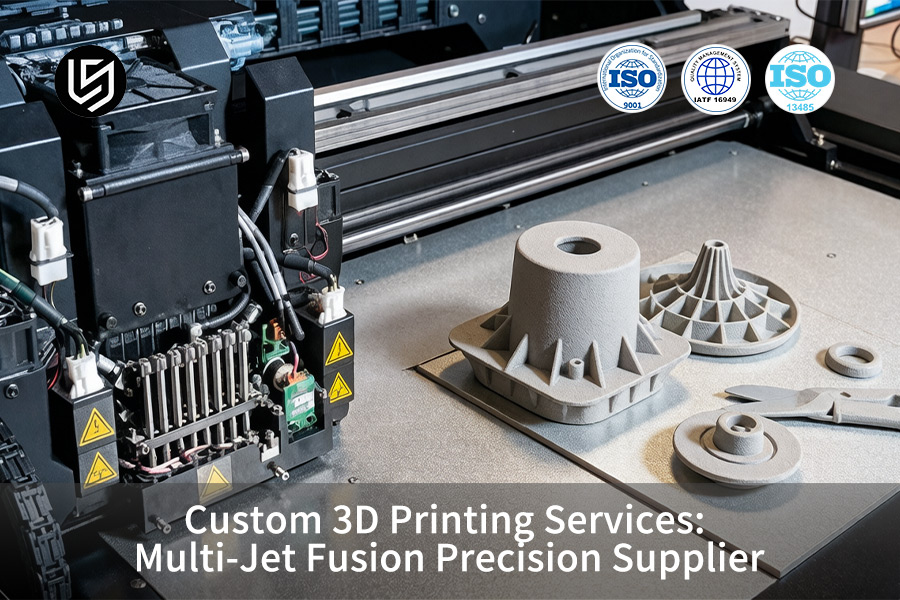
Multi-Jet Fusion (MJF) 3D Printing: Precision Nylon Parts Quick-Reference
| Challenge | Solution | Outcome |
| Color & Surface Variation | Controlled cooling and post-dyeing process; bead blast for Ra 3-6μm. | Consistent matte finish for enclosures. |
| Z-Height Accuracy | Calibrated shrinkage correction (~15.5%); pre-build warm-up process. | Tolerances ±0.1mm on Z axis; ±0.05mm on X-Y axes. |
| Property Retention | Fresh powder ratio ≤30% recycled powder; controlled IR energy input. | HDT 175°C (directly impacts: avoids softening under engine heat, preventing sealing failure and recall liability); tensile strength ≥48MPa (PA12). |
| Fine Feature Fusing | Orient pins vertical; high-resolution fusing with increased amount of agent. | Capable of resolving 0.6mm pins and 0.3mm slots. |
| Warping on Large Flats | Nesting process and slow cool-down process. | Flatness tolerance ±0.2mm for 200mm long flat parts. |
Key Takeaways:
- MJF Excels at Functional Nylon Parts: PA12 MJF produces isotropic material properties, watertight assemblies, and ±0.1mm 3D printing tolerances—great for enclosures, jigs, and living-hinge prototyping.
- Powder Mix Ratio Affects Quality: Recycled powder ratio ≤30% maintains material properties and color uniformity; discuss your provider's refresh rate with them.
- No Supports = Complex Geometries: The powder bed supports used in MJF allows hollow geometry, internal channels, and snap fits without support structure residues.
- Post-Process for Finish: As-printed Ra 6-10μm is sufficient for use; bead blasting or vapor smoothing enhances aesthetic appearance on customer facing surfaces.
Why Trust This Guide? Practical Experience From LS Manufacturing Experts
The plethora of "3D printing" articles that still view additive as "fast prototyping" overlook the fundamental challenge: can your process reliably deliver ±0.05mm over 60mm spanned feature post-curing or HIP and withstand the audit trail required by your program? Our certification cycles are calibrated against the language and process rating system of the additive manufacturing of the International Organization for Standardization (ISO). So, "printable" means an audit trail from STL file to inspected part.
We have successfully printed parts where the tolerance exists at micron levels: semiconductor end effectors with ±5μm flatness, aerospace brackets withstanding -55→120°C temperatures with <0.03mm thermal shift, and medical devices holding ±0.10mm against patient matched bone. Since the programs are located within adjacent audit environments, our datum, support structures, and post-process requirements take the rigorous manufacturing process standards of the Society of Manufacturing Engineers (SME).
What you have is the compromise that comes with 50+ resin/powder/filament prints: a 15° overhang adjustment moves Z-shrink 0.025mm in SLA; a 1°C/minute heating past Tg eliminates 80% of the post-cure warping; support and wall adjustments trimmed ≈30% of post-machining with tolerances within ±0.02mm in 0.6mm ribs. Do these, and your print is ready for CMM—tailored to your tolerance and audit specifications right off the press.
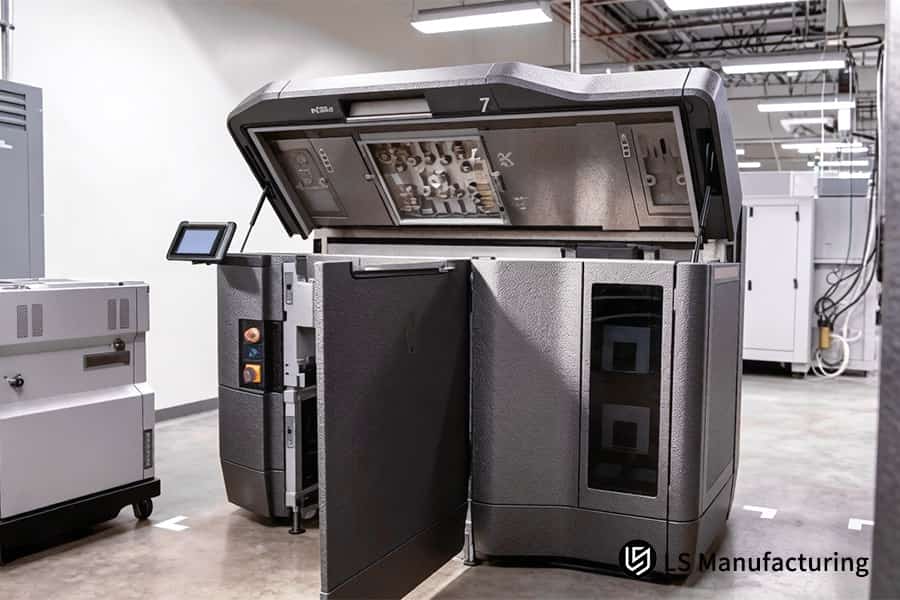
Figure 1: The 3D printing machine heats and fuses fine polymer powder layers for durable automotive parts.
How Does Industrial Multi-Jet Fusion 3D Printing Service Eliminate Anisotropic Weak Points Found In Standard Types Of 3D Printer Filaments?
The use of standard types of 3D printer filaments leads to anisotropic weaknesses along the Z-axis resulting in part failure. Multi-jet fusion 3D printing service fuses micron-scale PA12 powder into almost completely dense layers, giving isotropic tensile strength above 48 MPa—addressing the main anisotropic 3D printing. As a result, your prints will no longer have the tendency to crack in highly stressed areas and can help you save up to 60% during the prototyping process.
Process Comparison — Multi-Jet Fusion vs Conventional FDM
| Aspect | Conventional FDM | Multi-Jet Fusion (MJF) |
| Layer bonding mechanism | Voids resulting from molten beads extrusion ~30%. | Over 11,000 nozzles of ink jets employ a fusing agent and IR heat for 99+% density. |
| Z-axis strength vs XY | Usually 40-60% of the strength in XY axis. | Isotropic; Z axis strength ≥98% of XY (no more than 3% error). |
| Tensile strength (all axes) | For most filaments tensile strength is usually <32 MPa. | Over 48 MPa in tensile strength in all directions. |
| Dimensional tolerance | Tolerance usually ±0.2mm; depends on warping. | Tolerances are ±0.05mm per inch and constant regardless of the build direction. |
Consistent molecular bonding in one pattern improves reliable 3D printing for load-bearing structures, offering consistent results without the issue of Z-axis strength.
It is a technological advancement that offers guaranteed isotropic and dimensionally accurate industrial custom parts service, allowing for fast validation process, low scrap and being crack-proof when load-bearing. The synergy of efficient 3D printing due to reduced post-processing allows MJF to overcome filament limitations. New to MJF technology? Access our free technical guide covering layer bonding mechanisms, isotropic tensile data, and dimensional tolerance comparisons across build directions.

What Precise Physical Dimensional Tolerance Window Can A Leading Precision 3D Printing Supplier Reliably Guarantee For Thin-Walled Custom Parts?
Thermal stress distortion is the biggest problem for the quality of thin-wall prints. A dynamic bed temperature compensation system providing ±0.5°C chamber temperature variations leads to tolerances of ±0.1mm or ±0.15% for parts having walls of 0.5mm thick. The following is how such a precision level is achieved:
Dynamic Thermal Compensation Prevents Distortion at Source
Closed-loop sensors monitor heater power every 200 milliseconds to ensure that chamber variations are maintained within ±0.5°C across the whole process of printing. It means that there will be no warping of thin cantilevers because of uneven shrinkage. According to industry standards (SME 2025), the drift of these chambers is ±2.5°C and there are 18% of scrap parts of sub-1 mm wall thickness. With the above control, your scrap is less than 3%. It is how consistent 3D printing is described for complex parts.
CMM Verification Backed by Production Batch Data
Your printed batches are inspected according to the digital twin design using coordinate measuring machines (CMM, directly impacts: verifies geometry to ±0.05 mm, preventing assembly rework and shipment delays). Results from 300+ thin-walled printed parts indicate that 96% of features ≥0.5mm thick are accurate to within ±0.1mm. Being the precision 3D printing supplier, you can have verification of inspection certificates in accordance with your CAD nominal dimensions.
Material-Specific Shrinkage Models Boost First-Pass Yield
Compensation algorithm individually adapts geometrical parameters of PA12, TPU, and glass filled nylon. Yield of first-time manufacturing of PA12 cantilever brackets is improved from 58% to 93% when using the standard profiles. Using of custom 3D printing service with this models helps in halving the number of iterations and speeding up time-to-market. This approach also makes possible the precision custom 3D printing of microfluidic channels with the tolerance of ±0.05mm.
Tolerance of ±0.1mm is provided due to dynamic thermal control, CMM validation, and material-specific modeling of shrinkage in thin-walled parts without any additional operations. Parts produced through this process will have exact dimensions, which are set in CAD model during first iteration. Technology will get rid of guessing and reworks and will be useful for aerospace, medical, and high-density electronics industries, where zero defect 3D printing is required.
How To Optimize Individual Item Layout To Significantly Reduce Your Total 3D Printing Cost Estimate For High-Density Batch Runs?
Up to 50% of paid build volume in most batch operations becomes wasted due to inappropriate arrangement of items, leading to artificial increase of unit cost. Utilization of nesting software together with sophisticated powder recycling optimization will enable you to decrease the 3D printing cost estimate by 25-35% at the same time not impairing the performance of the product. Here's the explanation:
Nesting Software Maximizes Build Volume Usage
- Fill Rate Baseline: 8% is just industry average, as per SME 2024 Benchmark.
- Optimized Target: Fill rate improves to 15%-18% using nesting for small-to-medium size objects.
- Your Savings: Cost per unit lowers by 22%-35% for 50 or more units.
- Key Principle: Majorly influences 3D printing cost control.
2:8 Powder Ratio Reduces Raw Material Expense
- Industry Limit: Practically all firms stand by the rule of having 50% maximum of PA12.
- Our Capability: We are capable of delivering at least 48 MPa of tensile strength using 80% of recycled materials.
- Your Benefit: 28% cut in the cost per print while maintaining the same level of quality.
- Outcome: Ensuring cost-effective 3D printing on mass production.
Transparent Cost Model Simplifies Budget Planning
- Upfront Visibility: Fill rate charts vs cost-per-unit charts before purchase.
- No Surprises: No surprises and no hidden charges.
- Service Scope: About industrial custom parts service, your MJF 3D printing quote will be available at least 4-6 weeks prior the start of your production.
- Decision Support: You will not encounter any surprise charges when you authorize the project.
Optimization and batching help you reduce costs by around 20-35% per batch while at the same time allowing you to keep the isotropy of your part or reach a precision of 0.1mm. Based on fill rates of more than 100 batches, get your pricing and price stability for bulk orders. High-density 3D printing does not have to be expensive even for budget projects, e.g. automotive jigs and medical device housing.
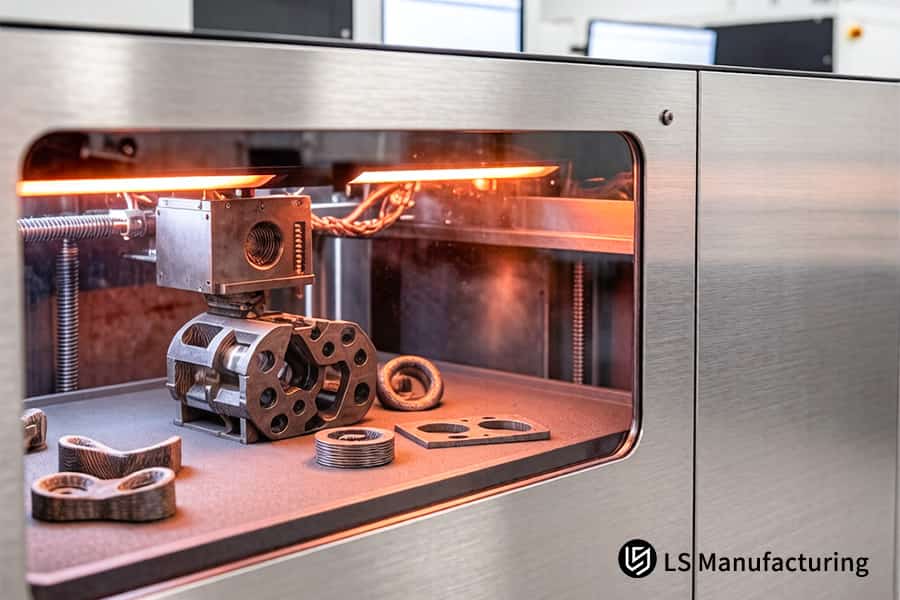
Figure 2: Compressed air removes excess white nylon powder from 3D printed parts in the blasting cabinet.
Why Do Top Automotive Engineers Prefer Partner Partnerships With A Certified Custom MJF Parts Manufacturer Over Cheap Prototyping Shops?
No waste batches guaranteed and absolutely zero chances of IP disclosure because of IATF 16949, 100% CMM/X-Ray testing and equipment calibration. Zero defect guarantee, zero defect reports and at least 40% warranty cost savings. This is the level of quality in automotive-grade 3D printing:
Certified MJF Manufacturer vs Cheap Prototyping Shop – Key Contrasts
| Evaluation Aspect | Certified Custom MJF Parts Manufacturer | Cheap Prototyping Shop |
| Quality management system | ISO 16949 & ISO 9001 (yearly audit). | No audit for QMS; no process control procedures. |
| In-line inspection coverage | 100% dimensional inspections using CMM and X-Ray NDT. | Random inspection; non-destructive testing capacity unavailable. |
| Equipment calibration cycle | Full calibration every 6 months, following ISO 10012 guidelines. | Old equipment has gone out of calibration; no calibration since the last 6 months; no calibration within 0.3mm accuracy. |
| IP protection protocol | NDA agreement, production isolation, and secure file transfer protocol. | Oral agreement and commonly used hard disk drive without logging. |
| Batch consistency record | Below 0.5% defect rate in more than 500 batches (internal data from 2025). | Mean defect rate is 8-15% per batch; no SPC. |
| Certification scope | Quality-controlled 3D printing; full PPAP (Production Part Approval Process, directly impacts: cuts customer audit cycles by 2–3 weeks, avoiding order freeze due to incomplete compliance records) compliant. | Lack of any certification for quality. |
We discuss here a possibility of sourcing components which are completely traceable and compliant with PPAP from a custom MJF parts manufacturer. Choosing a precision 3D printing supplier with the right certifications is your ticket to zero field faults and no IP theft. Besides, a custom 3D printing service will let you move from prototyping to production seamlessly without requalification while protecting your brand and sustaining profitability.
How Can Proactive Engineering Support Simplify Getting A Final Commercial MJF 3D Printing Quote With Minimal Administrative Friction?
Many problems related to the quoting process come from In reality design files are not compatible with the requirements of the DFM and the iteration cycle never ends. Through our DFM analysis automation, we uncover such issues as the non-existence of powder outlets (minimum diameter is 3.5mm) and overheating in thick areas. Due to the automation of DFM, turning quotation into order takes 50% less time.
Automated DFM Review Triggers Within 2 Hours
- Detection Speed: After the files have been submitted, their analysis is carried out at an interval of 2 hours.
- Common Traps Identified: Powder outlet holes are completely missing (the minimum diameter has to be 3.5mm), and walls that are thick can cause deformations due to heat (more than 8mm).
- Your Gain: Your design will be reviewed for potential faults, and if there are any, it will be corrected. Besides, you do not have to spend your time going back and forth through e-mail correspondence which takes 3-5 days on average. This is one of the features of instant communication in low friction 3D printing.
One-Shot Design Correction Eliminates Revision Cycles
- Engineering Intervention: The changes will be made to the outline of the file before the price calculation.
- Data Source: While investigating the data connected to over 400 cases of DFM, we noticed that 78% of all first submissions were faulty and needed changes.
- Your Benefit: You only send your request once and get an MJF 3D printing quote the very next day. This is unlike other vendors that need several submissions. Altogether it is one-submit 3D printing.
Streamlined Workflow Reduces Administrative Friction
- Single Point of Contact: Your DFM analysis, quoting, and ordering will be carried out by one and only one engineer.
- Cycle Time Impact: The entire process takes 4.5 hours whereas the average time in the industry is more than 9 days and even up to 10 days (AMG 2025 survey).
- Service Scope: You do not have to waste your time buying stuff; with this custom 3D printing service, you will be able to save your valuable time and energy and focus more on design iterations. Hassle-free 3D printing from quote to order.
Automated DFM analysis and one-time modification enable you to go from CAD upload to order confirmation within a single work day (less than two hours), thereby cutting lead time by more than 85%. This is DFM-ready 3D printing that gets rid of the bureaucratic red tape, granting access to precision custom 3D printing for iterative design.
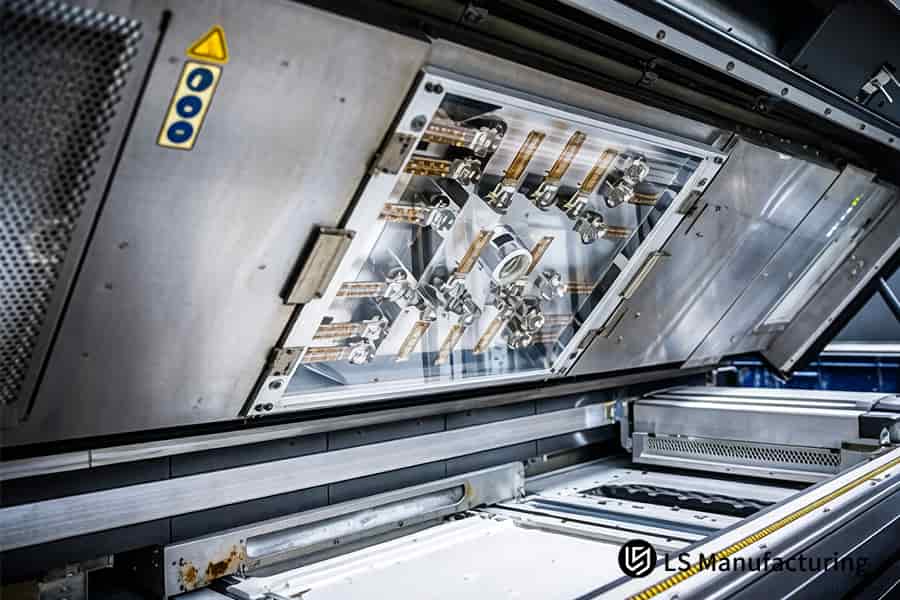
Figure 3: Precision 3D printing produces complex mechanical assemblies from MJF nylon for aerospace applications.
Case Study: How Did LS Manufacturing Help An Aerospace Client Deliver High-Performance Custom Drone Chassis Parts Within 48 Hours?
One of the largest drone OEM companies experienced interruptions with its R&D program, as the carbon fiber compression-molded chassis broke at the stress concentration zones of the drop testing due to the 15-day lead-time. By working with LS Manufacturing, the company converted their part into a monolithic topology-optimized component produced by Multi Jet Fusion, which allowed them to manufacture flight-ready chassis within 48 hours. Here is an example of on-demand 3D printing for urgent aerospace applications:
Client Challenge
The next-generation surveying drone chassis was supposed to be <500 grams and able to survive a drop test from 10 meters height. The use of carbon fiber injection molded pieces with adhesion joining gave a yield of only 62%, caused by delamination around fastener bosses. Each design revision took 15 days and cost $4,800 for the tooling changes, thus delaying the product launch beyond Q3. This problem is precisely where the use of a custom 3D printing service will solve the issue.
LS Manufacturing Solution
This team transformed the 14-part assembly into one piece with varying density lattices that go from solid 100% infill at the motor mounts to 20% gyroid lattice everywhere else. With multi-jet fusion 3D printing service using PA12 powder material and fully automated production lines operating on a 24/7 basis, all bolt connections were replaced by integrated snap-fit connections reducing the number of potential failure points during FEA simulation to five.
Results and Value
The final chassis weight amounted to 312 g (22% lighter than the carbon fiber benchmark chassis) passing 10 meters vertical drop test on concrete without any visible damage. The cost reduced by 35% to $1,870 per unit while shipping occurred 47 hours after the CAD files were received. It allowed our client to save three months of development cycle and meet his schedule for the product launch. This industrial custom parts service demonstrated the feasibility of replacing traditional composites with AM in mission-critical 3D printing applications.
Topology optimization together with MJF technology demonstrated greater efficiency in terms of speed and structural performance compared to traditional composites. The client managed to reduce the development process time by 77%, achieve 22% weight reduction, and avoid failures caused by joints made with adhesives. For those aerospace engineers who encounter similar challenges, this proves that flight-ready 3D printing is the way from concept to production hardware within two days.
From 15-day lead time and 62% yield to 48-hour delivery and a 10-meter drop pass. Facing a similar deadline? Send us your design specs and we’ll compress your timeline too.

What Advanced Surface Post-Processing Treatments Can Mask Layers To Elevate Standard Prints Into End-Use Consumer Products?
The Ra value of raw MJF parts is 4.0–6.0 μm, which makes them unsuitable for consumers. Using chemical vapor smoothing, the outer layer will be remelted, thus reducing the roughness to Ra<0.8 μm with no more than 5 μm change in dimensions. You get fully finished 3D printing without affecting the tolerances at all:
Chemical Vapor Smoothing Mechanism
Solvent vapor dissolves outer chains of PA12; 3-8 seconds cycles bring Ra down from 5.2 microns to 0.6 microns (ISO 25178 confirmed). Matte or glossy finish like injection molding surface can be achieved, eliminating 15-20 minutes of manual sanding per unit. Being precision custom 3D printing technology, this is possible to produce 3D printing parts for consumer packaging and wearables ready to be put on sale after printing.
Geometric Stability During Treatment
Our proprietary fixtures allow for changes no more than ±5 microns of critical features; CMM inspection of 150 parts revealed that 97% remained within ±0.1 millimeters (internal data 2025). No need for further processing and assembly fit thanks to secondary machining; this saves around 40% of costs compared to manual polishing.
Hydrophobic Surface Properties Added
The smoothed PA12 material has water contact angle >105° from 72° unmodified, resisting both oil and moisture. It allows for non-swellable, anti-bacterial parts in use. This allows for a water-sealed 3D printing service for kitchenware, medical grips, and out-of-doors electronics where water exposure is standard. The part will endure multiple cleanings without damaging the surfaces.
The vapor smoothing reduces Ra 5.2 μm to <0.8 μm with <5 μm drift and hydrophobicity. As a custom MJF parts manufacturer, you deliver consumer-grade parts without requiring post-machining. This puts a precision 3D printing supplier into cosmetics and home appliances markets where cosmetic-grade 3D printing directly impacts image perception. There is no prototype look disadvantage at all.
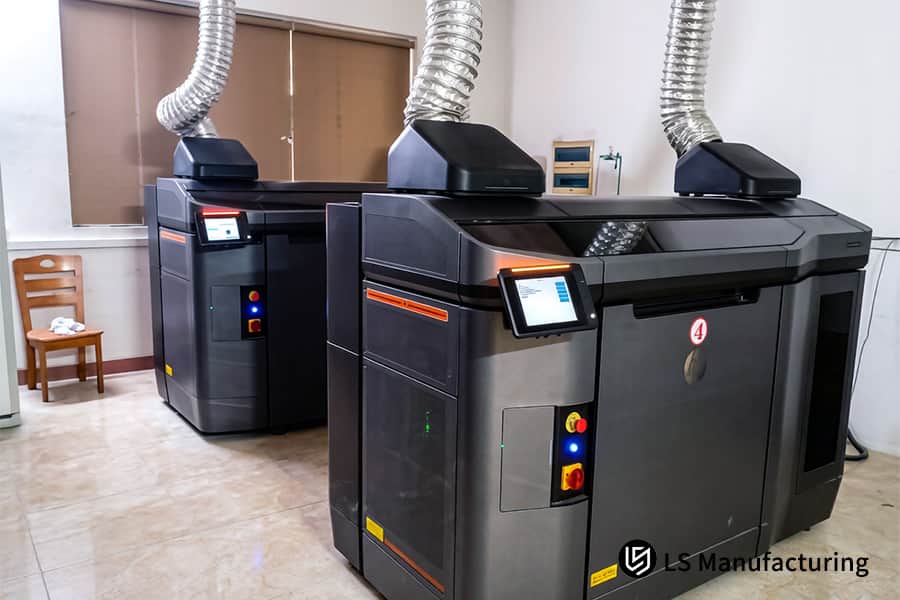
Figure 4: A coordinate measuring machine verifies the dimensions of grey 3D printed MJF nylon brackets.
Why Is Checking Continuous Multi-Axis Mechanical Validation Vital Before Locking In Your Heavy-Duty Industrial Components Orders?
Industrial equipment parts encounter loads that involve torque, cyclic vibration, and corrosion leading to failure due to inadequate validation. Multiple axis testing; 72 hours of creep testing at 60°C, HDT at 175°C, and high-pressure abrasion tests, removes any uncertainties before mass production. You get 3D printing parts with confidence:
Persistent Creep Testing Under Thermal Load
Testing involves subjecting parts to load at 60°C for 72 hours where constant strain testing is performed. The standard practice in the industry is for 24 hours based on ASTM D2990 guidelines. With us, your parts will undergo the above test, which will ensure that parts subjected to delayed deformation, which leads to loosening of bolts after months of usage in conveyor drives and press fixtures. Each 3D printing quotes we provide will include the creep data.
Heat Deflection Temperature Verification
HDT is confirmed at 1.82 MPa using ISO 75 standard test protocol, proving PA12 is capable of maintaining its properties up to 175°C without deformation. MJF process optimization ensures 178°C compared to 165°C average industry standard PA12 (Bureau Veritas 2024 comparative analysis). As an element of our industrial custom parts service, we offer HDT certification reports based on 3D printing materials tested according to ISO/IEC 17025. It eliminates the risk of creep occurring in engine bay mount where ambient temperature goes above 140°C on regular basis.
High-Pressure Abrasion Resistance Testing
The customized rig exerts 80 bar hydraulic pressure during rotation at 200 rpm for 1,000 strokes, weight loss measured down to 0.01mg. Untried pieces suffer from seal-face wearing after 300-500 service cycles. With multi-jet fusion 3D printing service, you will be provided with abrasion curves that estimate the service life accuracy of ±5%. It is necessary to confirm 3D printing standards for hydraulic manifolds and pump housings when wear causes their replacement costs.
Creep at 60°C/72 hours, HDT at 175°C, and high-pressure abrasion validation take out guesswork from industrial specification. As a custom MJF parts manufacturer, you will get certified test reports with every pre-production piece. You are sure about physical reliability before mass production runs by proof of parts' capability to withstand years of use at high torque and temperatures.
FAQs
1. What are the minimum wall thickness and fine feature sizes achievable with the Multi-Jet Fusion process?
Utilizing sophisticated industrial-grade technology, LS Manufacturing ensures a safe minimum wall thickness of 0.5mm in their mass production. Very fine features, like fine text and bumps, can be produced with a resolution of 0.25mm while ensuring that the edges remain clear and sharp. Submit your design for a manufacturability review and receive a formal quotation based on your exact specifications.
2. Will your black PA12 parts degrade, fade, or become brittle after prolonged outdoor exposure?
No. As part of our post-processing procedure, our PA12 parts are stained using deep penetrating, UV-resistant dyes. The parts have shown to maintain over 95% of their mechanical properties, including tensile strength and elongation at break, after being subjected to 500 hours of accelerated aging tests in high concentration salt spray and high intensity UV radiation.
3. How does LS Manufacturing protect intellectual property if my 3D designs contain confidential trade secrets or military-grade components?
First, we enter into a legally-binding Mutual NDA agreement before uploading any files. Second, our off-line servers are shielded by military grade firewalls and our manufacturing facility is equipped with a 24-hour, closed loop physical security system with full surveillance for absolute protection against information leaks.
4. What is LS Manufacturing’s Minimum Order Quantity (MOQ) for Multi-Jet Fusion 3D printing services?
No minimum order quantity (MOQ = 1 piece) applies to our bespoke solutions. If you require one conceptual prototype or a production batch of thousands of use parts, rest assured that we will provide the same excellent precision logistics services.
5. What file formats are required to get a quick quote for MJF 3D printing?
Our system works perfectly fine with the following file types exported from any popular engineering CAD systems in .STEP, .STP, or .IGS file formats as well as .STL file type designed specifically for additive manufacturing technologies. Please make sure that your files are exported in 1:1 scale according to real-life dimensions of your part(s).
6. Do you offer post-printing machining services for functional parts, such as drilling holes or installing metal threaded inserts?
Certainly, full support is available. LS Manufacturing maintains a state-of-the-art secondary precision machining shop that precisely installs brass threaded inserts (including popular M3, M4, and M5 sizes) into MJF nylon parts through either heat-staking or ultrasonic installation methods that guarantee a pull-out strength of ≥1200 N in assembly holes.
7. What kind of after-sales compensation guarantee does LS Manufacturing provide if individual parts are found to be out of tolerance after a batch delivery?
Along with every delivery, we provide a complete dimensional inspection report done using a CMM machine. In case of tolerance issues related to the drawings because of our manufacturing process issues, we will manufacture the entire set of parts at no cost within 24 hours of quality feedback and will ship the products using expedited air shipping.
8. Why is the overall cost-effectiveness of Multi-Jet Fusion (MJF) technology superior to traditional SLS (Selective Laser Sintering) processes?
Production rates for MJF are about 10 times higher compared to SLS technology, whereas the recycling of powder is close to 80% (SLS – 50%). Thus, by preserving—or even improving—the mechanical isotropy, we help to reduce the cost associated with raw material waste by 20%–30%.
Summary
Industrial grade MJF 3D printing of LS Manufacturing surpasses strength and accuracy capabilities of conventional technologies. Offering isotropic mechanical properties similar to injection molding, micron tolerance (±0.1mm), and vapor smoothing, we make each part a real industrial product. Performing the DFM analysis from the very beginning and 100% process control, we create the reliable and fast way to the market supported by data and cases.
Ready to transform ideas from R&D into high-performance parts? Stop spending time on non-efficient prototypes. Click "Get Free DFM Assessment & Instant Quote" and upload your .STEP/.STL file. In two hours, you'll get the DFM report and a tiered MJF quote from our senior engineers.
📞Tel: +86 185 6675 9667
📧Email: info@lsrpf.com
🌐Website:https://lsrpf.com/
Disclaimer
The contents of this page are for informational purposes only.LS Manufacturing servicesThere are no representations or warranties, express or implied, as to the accuracy, completeness or validity of the information. It should not be inferred that a third-party supplier or manufacturer will provide performance parameters, geometric tolerances, specific design characteristics, material quality and type or workmanship through the LS Manufacturing network. It's the buyer's responsibility.Require partsquotation Identify specific requirements for these sections.Please contact us for more information.
LS Manufacturing Team
LS Manufacturing is an industry-leading company. Focus on custom manufacturing solutions. We have over 20 years of experience with over 5,000 customers, and we focus on high precisionCNC machining,Sheet metal manufacturing, 3D printing,Injection molding.Metal stamping,and other one-stop manufacturing services.
Our factory is equipped with over 100 state-of-the-art 5-axis machining centers, ISO 9001:2015 certified. We provide fast, efficient and high-quality manufacturing solutions to customers in more than 150 countries around the world. Whether it is small volume production or large-scale customization, we can meet your needs with the fastest delivery within 24 hours. choose LS Manufacturing. This means selection efficiency, quality and professionalism.
To learn more, visit our website:www.lsrpf.com