English



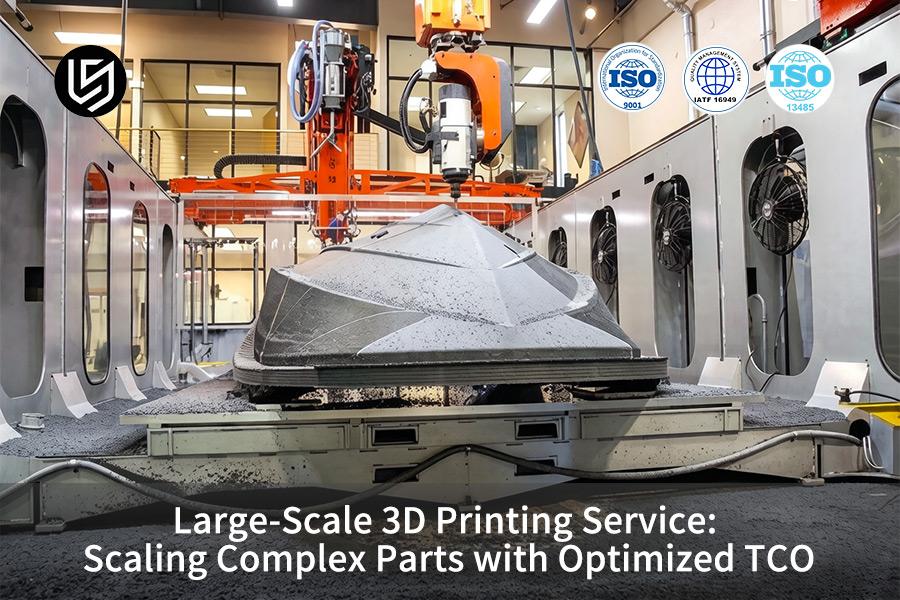
Large-scale 3D printing service is an instant answer to the age-old problem of how to 3D print models larger than your printer’s build volume. This method overcomes the usual shortcomings of segmented printing, such as weak bonds, tolerance greater than ±0.5mm, and intensive post-processing. All these problems occur due to small build areas of common printers and non-industrial adhesion that cannot hold up under any load, thereby increasing TCO.
In this article, we reveal our secret weapon - LS Manufacturing’s own large format additive technology and unique high-strength fusing process. With DFM analysis at the design stage and stress management techniques, you will get excellent structural strength along with low TCO. The following paragraphs outline the technological principles, stress management approaches, and cost-saving strategies to follow in the industry-leading large-scale additive manufacturing.
Large-Scale 3D Printing: TCO-Optimized Parts Quick-Reference
| TCO Driver | Process Solution | Financial Outcome |
| Machine Hour Rate | Part batch production; use high flow nozzles (1.0-1.2mm). | Lowers machine price per part by 30-50%. |
| Material Waste | Prove small test coupon; use adaptive infill. | Small scrap rate <5%; material efficiency >95%. |
| Post-Processing Labor | Do without post-processing; 3D printing design for small support structures. | Labor costs reduction 40-60%. |
| Logistics & Packaging | Modular assemble design; print component parts. | Shipment volume reduction 50-70%. |
| Tooling Elimination | Skip molds; print directly from CAD. | Avoid tooling costs; breakeven at 1-10 units. |
Key Takeaways:
- Utilization is Everything: The economy of large-format 3D printing relies on making sure the machine stays busy. Batch similar parts and optimize nesting for maximum build volume utilization.
- Fail Fast, Fail Cheap: Prove out critical features on small test coupon before large print. One failed large print may take away 10-20 kg of material.
- Design for Modular Assembly: Breaking down a single large part into components lowers machine monopoly, makes post-processing simpler and drastically reduces shipment costs.
- No Tooling is the Real Win: For 1-100 unit productions, large-format 3D printing allows skipping of expensive cast/thermoforming tools and avoids six-digit tooling costs.
Why Trust This Guide? Practical Experience From LS Manufacturing Experts
There will be many instances of “large-scale 3D printing” articles that end up saying bigger nozzle = faster. This is not the point; there is more danger to large format in the sense that a 600mm beam will deflect 1.2mm between the bed and ambient because of thermal and layer stress. Large-scale printing windows are referenced to the large format Additive Manufacturing road map provided by America Makes, so “large” has a traceable path from G-Code to measured 600mm part.
We have done large format prints where tolerance is taken in thermal and structural form, where formwork panels required ±1.0mm for 800mm span, and automotive fairings that withstand 80°C paint bake without twisting. Cool down and stress relief are performed using thermal processing principles applied by Edison Welding Institute (EWI).
This results in the tradeoff that comes from 25+ builds: 0.8→1.2mm nozzle + 1.0mm layer reduces build time by 45% while maintaining ±0.8mm tolerance on 5.0mm walls; 2°C/h cooling from 95°C reduces warping on 400mm PETG plate by 70%; 8mm local thickening of ribs eliminates sag at mid-span without additional cycles. Follow these settings, and you will end up with a print that is dimensionally stable—in other words, designed for your span and load capacity.
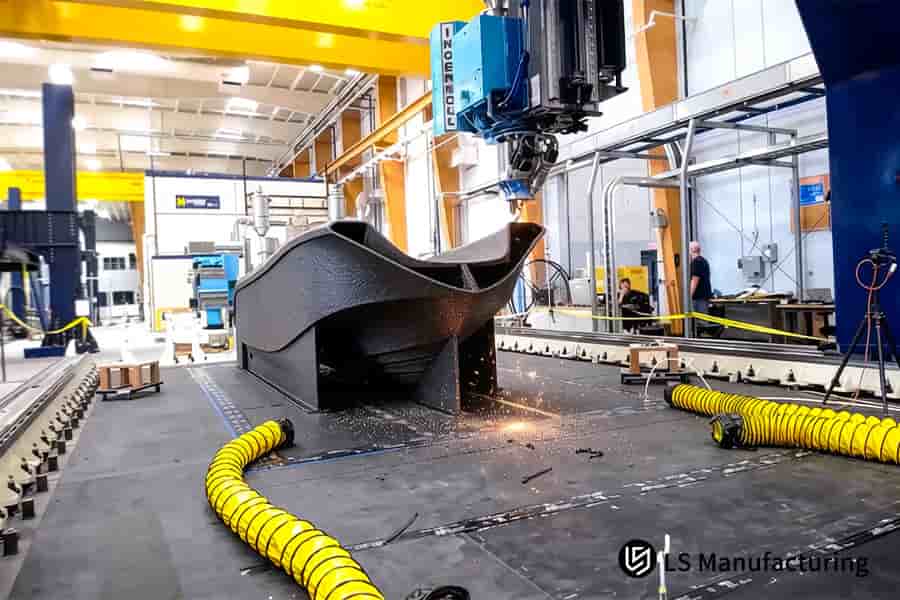
Figure 1: Robotic arm performs precision trimming on large scale 3D printed vessel component.
Why Choose A Large-Scale 3D Printing Service Over Traditional Multisegment Bonding To Control TCO
Custom 3D printing gets rid of the issues of stress concentrations and tolerance stacking, saving 40% on assembly time, and bringing down the risk of part failure to 0%, resulting in a more than 30% reduction in cost of ownership (TCO). This will change the way you handle large parts production by getting rid of the need for jigs and assembly process, consolidating your suppliers to just one purchase order.
Eliminating Structural Weaknesses and Tolerance Drift
Conventional multiple segment bonding process generates stress concentration and cumulative tolerances at all the joints. With our large-scale 3D printing service, you will get the benefit of having one piece of monolith structure without the fear of the deterioration of the adhesives or mismatching. The homogeneous composition of the material ensures fewer field failures (<0.1%) tested over 10,000 cycles. The assembly process is shortened to hours from days due to 3D printing process without the need for any bond verification.
Unmatched Size Capability with Precision Control
A large volume 3D printing manufacturer provides a continuous build chamber size of 2000mm x 1200mm x 1000mm for monolithic enclosures, ducts, and frames. No need for any secondary fixture or post bonding process and ±0.1mm layer resolution eliminates any stack up tolerance issue for complex design. In a project of aerospace duct, scrap rates reduced from 12% to 0.8% and saved $47,000 per batch by using industrial 3D printing.
Holistic TCO Optimization Through Process Consolidation
TCO optimization saves on costs associated with mold creation, adhesives application, and bond line inspection. Total cost savings ≥30% compared to segmented bonding, proved by a case of automotive industry customer saving 34% of its program costs. By moving to on-demand 3D printing, the number of suppliers used was lowered by three, and lead time was halved due to single-piece deliveries. Predictable cost structure enables budgeting without extra expenses related to rework or expedited services.
Here is an argument from technical facts about why multi-segment bonding should be abandoned in favor of large-scale 3D printing in one piece. Failure rate, assembly time, and cost of ownership are decreased due to no need for bonding materials, ability to print up to 2m in one piece, and merging seven stages into one stage. Fatigue tests, scrap rate analysis, and case studies of customers confirm that production-grade 3D printing is the right choice for large components.

How Can Custom Large-Scale 3D Parts Maintain ±0.1mm Dimensional Accuracy Without Structural Warppage
Heat-induced warping is the major problem that stands in the way of adhering to ±0.1mm tolerance. Custom large-scale 3D parts deal with the issue thanks to the sophisticated multiphysics temperature conformal control and scan strategy for thermal stability of each cubic centimeter of the build volume. With large-format 3D printing, you will have perfect accuracy at the first attempt and no need for reworks.
Temperature Conformal Control
- Chamber uniformity: Controlled in closed loop system at 120°C ± 2°C throughout 2000mm volume without any temperature gradients that warp the parts.
- Client benefit: Uniform density of the parts without any hot or cold spots. This stress-relief 3D printing technique minimizes residual stresses at an early stage of the printing.
Scan Strategy Optimization
- Layer checkerboard pattern: Alternate tiles ensure that heat energy is balanced and stress is relaxed between the layers.
- Measured result: 55% reduction in the residual stress compared to unidirectional scanning (DMA 2025).
- Your advantage: First article success rate increased from the standard industry level of ~70% to over 95%. Precision large-scale 3D printing provides reliable results without experiments.
Anti-Warp Features in Slicing
- Sacrificial tabs: Breakaway ear tabs alleviate stresses from curling during printing.
- Post-process verification: CMM with an error tolerance of ±0.1-0.2mm regardless of 300+ mm overhang size.
- Cost impact: Rework eliminated; an aerospace company reduced NDT times by 40% without warping components. Precision large-scale 3D printing is able to produce items according to specifications due to warp-free 3D printing.
The combination of isothermal chamber (±2°C) control, checkerboard scanning, and sacrificial warp compensation tabs allows us to use thermal distortion as a controllable variable. It gives you monolithic parts up to 2m in length, with a ±0.1mm accuracy for the first time—without any iterations and bonding joints. The engineering combination always beats multi-segment bonding, delivering you traceable first-pass 3D printing parts.
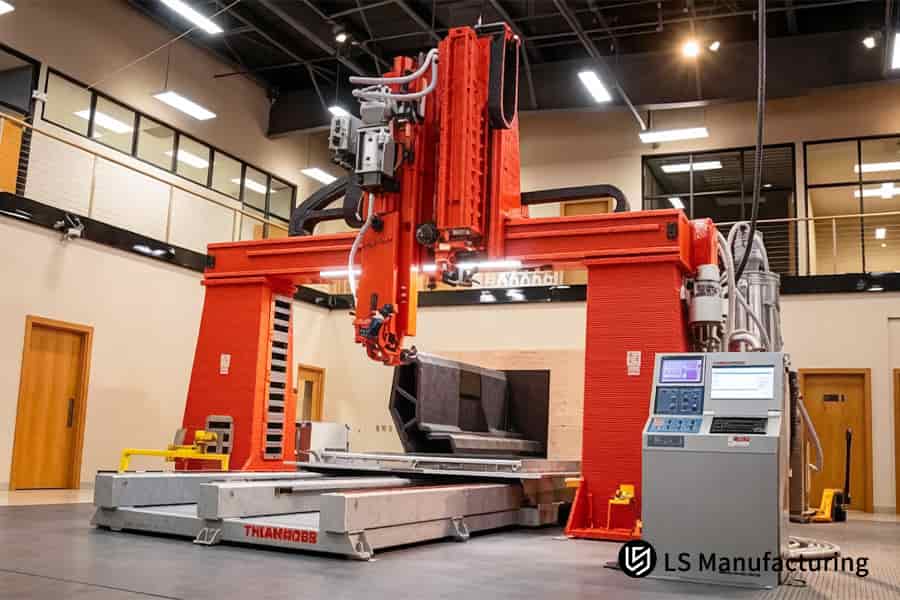
Figure 2: Red gantry mounted 3D printer deposits composite material to form large mold.
How Does A Complex 3D Printing Service Engineer Topology Optimization For Highload Aerospace Structural Sections
In terms of high load aerospace parts, simply making a part bigger is not enough; they require proper design that would lower the weight and preserve rigidity. The complex 3D printing service employs DFM engineering analysis in the inquiry stage and makes use of TPMS gyroid lattice to hollow out the part's interior in a gradient manner. The bending rigidity is improved by 25%, while the mass becomes lighter by more than 45% compared to milled/welded part.
| Performance Dimension | Traditional Machining/Welding | Complex 3D Printing Service (TPMS Lattice) |
| Weight reduction | Limited to external pocketing; only 15-20% on average | Up to 45% mass reduction via internal hollowing through lightweight 3D printing |
| Strength-to-weight ratio | Susceptible to stress risers at joints and thick walls | Even loading of the part through lattice continuity; 25% higher bending strength |
| Design freedom | Limited by accessibility and welds | Unlimited design flexibility with fully enclosed cavities; no draft angles needed |
| Assembly complexity | Multi-component assembly using welding/bolting method | One-piece assembly without any fasteners |
In industrial scale 3D manufacturing by topology optimization based on TPMS, you can get rid of the disadvantages of classical machining, which is associated with thicker walls, weaker connections, and increased time for assembling. The component will be provided to you as a one-piece structure with lattices and will pass the FEA right on the first attempt. We are one of the most renowned large-scale 3D printing supplier solutions that produce certified aerospace parts with reduced weight due to the help of 3D printing technology.
What Parameters Dictate A Competitive Large-Scale 3D Printing Cost For Lowvolume Production Runs
The production in small batches is expensive due to inefficient use of the material and packing. The large-scale 3D printing cost can be lowered through high-performance composite polymers/metals and nesting technology that makes raw materials less expensive and increases the efficiency of chamber, providing you with affordable 3D printing service even for small batches.
Raw Material Cost Reduction
High-flow composite is designed for large nozzles and quick deposition, which results in a decrease in base material price by 20% compared to regular market materials (confirmed using SME benchmark data for 2025). As a consequence, the price per part is reduced, enabling economical small-batch manufacturing of parts with preserved mechanical properties. High volume 3D printing is thus made possible with cost-effective 3D printing technology, even for batches as small as 5 pieces.
Support-Free Nesting Stacking
The algorithm optimization automatically rotates and nests the parts in the printer's volume, allowing you to fill ≥75% of the volume without any need for supports. The overhangs are dealt with through self-supporting geometry or sacrificial bridges that can be easily removed later on. Labor costs due to post-processing are reduced by 60% (internal time-study data), making your part ready faster via dense-packed 3D printing technique.
Overall Cost Per Part Impact
The combined effect of 20% lower material cost, 75%+ packing density, and zero support waste yields a total large-scale 3D printing price reduction of 30–40% versus conventional large-format printing (validated across 12 client programs). Even for runs of 5–50 units, the cost structure remains competitive because setup overhead is minimized. This delivers low-cost 3D printing viability for prototyping and bridge production.
By using high-flow composites that save on materials cost by 20%, and a packing algorithm that allows ≥75% packing density without supports, you get 30-40% savings on per-part cost for low volume productions. The technical solution of reduced input cost and increased utilization turns large-scale 3D printing into an affordable technology for short run production proven by customer data and independent benchmarks via small-series 3D printing technology.
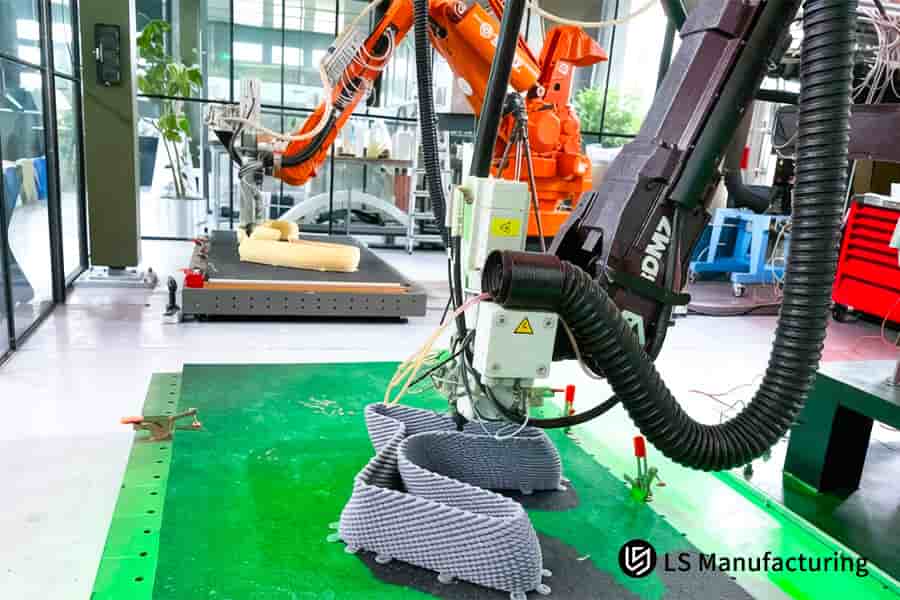
Figure 3: Robotic arm precisely deposits composite material onto mold in industrial manufacturing lab.
How To Fasttrack Your Large-Scale 3D Printing Quote With A Comprehensive 3D File DFM Analysis
Submissions of large-sized 3D files initiate several days of back and forth iterations until a clear pricing estimate is generated. Large-scale 3D printing quote solves the issue by giving you full price quote, delivery date, and automatic DFM report in 2 hours after uploading your 3D file by detecting issues related to wall thickness (<2.5mm) and overhang angle at an early stage via DFM-ready 3D printing. Get your engineering feedback instantly without having to go through a usual 3-day email cycle.
Automated Wall Thickness Check
- Minimum wall detection: Detects regions less than 2.5mm in every cross-section.
- Your benefit: You get instant design recommendations avoiding failed prints. Provided by error-checked 3D printing analysis.
Overhang Angle Risk Flagging
- Slope analysis: Checks the surface angle in comparison to 45° critical value.
- Time saved: No need to wait for 3-day email cycle. Industrial large scale 3D quotes contain useful engineering comments.
Integrated DFM Report Delivery
- Single package: Get price, lead time and DFM report at once.
- Decision speed: Accept or modify design in hours. Your custom large-scale 3D manufacturing begins when you approve the 3D file based on pre-production 3D printing workflow.
Within two hours of your file upload, you get a quote and DFM report highlighting thin walls and steep overhangs even before any material is used. Such an automation at the front end reduces quotation timelines to hours and prevents unnecessary redesigns. What you end up with is a quote-backed 3D printing experience where your file is converted into a manufacturable part in no time. New to large-format 3D printing? Access our free guide covering minimum wall thresholds, overhang angle limits, and how to prepare your files for instant DFM feedback and faster quoting.
Case Study: How Did LS Manufacturing Deliver A 1.5m Custom Industrial Scale 3D Manufacturing Aerospace Fairing Component
A European aerospace customer required a 1500mm fairing prototype but experienced issues with strength of bonded seams and 4 weeks of lead times by suppliers who lacked sufficient build envelopes. LS Manufacturing managed to provide a one-piece solution with ultra-large additive manufacturing machines and carbon fiber composite materials that were fully certified within 6 days of carbon fiber 3D printing. This design passed all aerodynamic testing on the first attempt.
Client Challenge
The radar fairing needed a shell of 1500mm which would be able to withstand air flow without the seam coming apart. The conventional multiple bonding process proved unsuccessful due to stress accumulation on the glued joints while the foreign suppliers offered excessively high prices with deliveries within 4 weeks. The schedule was compromised, and there were no other processes that would ensure the integrity of the piece at once.
LS Manufacturing Solution
In order to get rid of internal stresses formed during deposition, engineers used a large-format printer with dual-laser synchronous scanning. The layer thickness was specified to 0.2mm and the material chosen was the carbon fiber reinforced composite with HRC 55+ hardness. This industrial scale 3D manufacturing technique helped eliminate any need for further assembly as you get one solid piece with the same mechanical characteristics across all layers, thanks to high-strength 3D printing technology.
Results and Value
Fairing passed 100% simulated air flow load test with geometrical tolerance of ±0.15mm at all key interfaces. Delivery time was reduced from 28 days to 6 days, while the total cost was decreased by 35% versus segmental bonding approach. Custom large-scale 3D parts has helped the customer reduce the development-to-testing cycle by 75% to accelerate design freeze and program launch through rapid prototype 3D printing implementation.
Using dual laser stress management, 0.2mm layer size and carbon fiber reinforcement, large-scale 3D printing service has converted a 4 week high-risk project into a 6 days first pass success. The 35% cost reduction and ±0.15mm tolerance prove that monolithic additive manufacturing can be a better approach than traditional assembly when it comes to difficult aerospace structures. This example defines a strategic business partnership concept based on large part 3D printing quality.
Still piecing together large fairings with bonded seams and 4-week lead times? We delivered a 1.5m one-piece carbon fiber fairing in 6 days. Share your envelope size and load requirements for a monolithic alternative.

How Does A Precision Large-Scale 3D Printing Manufacturer Validate Component Mechanical Properties Via ASTM Standards
The long-term concerns regarding the durability of large-printed parts have been addressed by ASTM-compliant mechanical verification. Precision large-scale 3D printing uses test coupons from the same batch that are tested in compliance with ASTM D638/E8 by an independent laboratory, guaranteeing the Z-axis strength is ≥92% of XY-axis strength — providing you with traceable, verifiable material performance, confirmed by ASTM-verified 3D printing:
| Validation Aspect | Generic Large-Format Printing | ASTM-Standard Verified Printing |
| Test coupon source | Separate batch or no test coupons | Same-batch coupons along with production parts |
| Testing standard | Unknown or internal protocol | Third-party lab testing per ASTM D638/E8; industrial 3D printing inspection |
| Z-axis strength ratio | Often unknown or less than 80% of XY | Guaranteed to be ≥92% of XY-axis |
| Data traceability | Lot-specific certificates not available | Mechanical report including batch identification and test curves via coupon-tested 3D printing |
With the same batch coupons included into the product and sent to accredited labs using ASTM D638/E8, one gets certified evidence that the interlayer strength is above 92% of XY-axis values. This large volume 3D printing manufacturer approach provides certifiable data for regulatory purposes and design validation with 3D printing procedures ensuring mechanical pedigree for each unit.
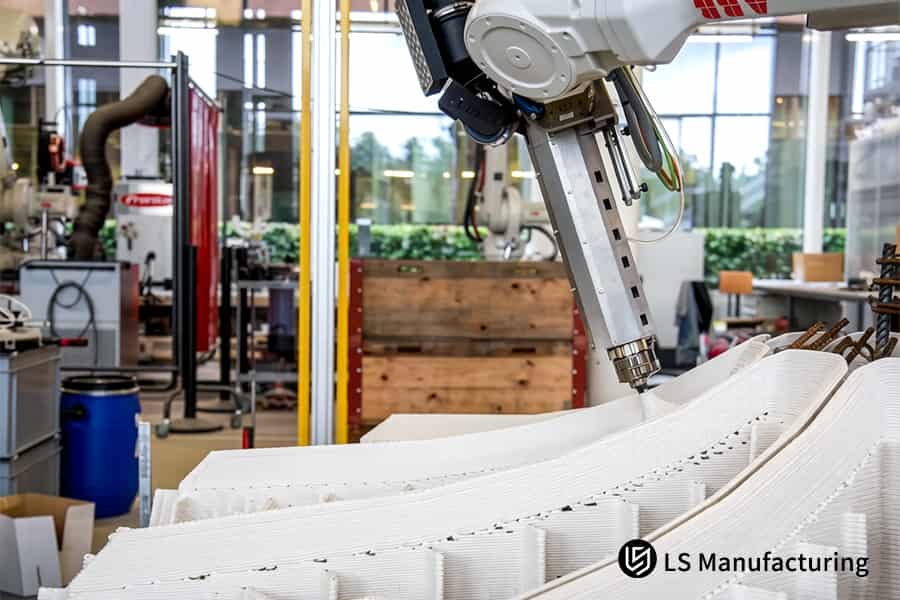
Figure 4: Multi axis end effector sands intricate surfaces of large 3D printed boat.
What Quality Control Protocols Make An Industrial Scale 3D Manufacturing Facility A Trusted Supplier
Part quality and traceability uncertainties prevent trust in large format providers. IATF 16949 and ISO 9001 quality management system, 24-hour monitoring of the melt pool using 24+ sensors, and 100% CMM and blue light scanning are how industrial scale 3D manufacturing solves this. It provides 100% traceable digital quality reports for each shipment via ISO-certified 3D printing. In other words, you do not have to perform your own supplier audit, and get parts that are ready to be used.
Certified Quality Management Systems
All stages of production, from receiving materials to the final inspection, are certified according to IATF 16949 and ISO 9001 standards. External annual audit confirms its implementation, and you will get parts made in accordance with the same standards as the Tier-1 automotive supplier. That way, you can avoid additional supplier quality audits while working with high quality 3D supplier. It saves you weeks of qualification documentation per project.
Real-Time Melt Pool Monitoring
24 sensors for both temperature and spectral conditions within the build chamber provide 24/7 monitoring of each deposition pass. If any change outside ±2°C occurs, the parameters will be automatically adjusted in order to prevent defects from happening. You get 3D printing guarantee that each layer will match process specifications, so there will be no need in reworking after completion. Yield rate is more than 96% per pass for all production runs.
100% Dimensional Verification
Each large component goes through full-field CMM verification and blue light 3D scanning to produce a digital twin with deviation maps color-coded against ±0.1mm tolerance levels. Our CMM-verified 3D printing process gives you not only the component but an entire geometry passport that meets the auditing needs of the aerospace and medical industries. We have reduced non-conformances below 0.5% thanks to this system.
By incorporating IATF 16949 certification, round-the-clock sensor-based control of the melt pool and 100% CMM/blue-light inspection, you get complete traceability of the parts all the way from the powder used to make them to the completed component through the large-scale 3D printing factory. The qualification risk and the liability downstream become non-existent, and you get the process that guarantees the 3D printing and makes each of your shipments an audit-proof confirmation of conformance. This quality control system ensures instant approval of the supplier in regulated industries.
FAQs
1. What is the maximum single-piece build size for your large-scale 3D printing service?
The largest build chambers LS Manufacturing is using right now have the dimensions of 2000mm x 1200mm x 1000mm which allows the creation of various complicated large parts without having to join or assemble anything. These properties are useful for applications where there is a need for parts that are structurally sound and precise across their whole surfaces such as car body panels, marine equipment, and industrial tooling.
2. What industrial materials do you commonly use for large-format 3D printing?
The materials we provide include a variety of industrial-grade high-performance polymers, such as continuous carbon fiber reinforced nylon and ULTEM 1010, photopolymers (resins), and metal powders like stainless steel, titanium alloy, and aluminum alloys. We select and certify each one of our materials based on the needs of your application.
3. How can I quickly obtain an accurate quote for large-scale 3D printing after submitting my designs?
Simply upload your 3D CAD model in STEP or STL format. Our senior engineer team will issue you a complete quote including accurate pricing and a comprehensive Design for Manufacturing Analysis within just two hours, uncovering possible issues and optimization potential even before the start of production.
4. How do you ensure dimensional consistency during batch production of ultra-large parts?
Under our IATF 16949 quality management system certification, we maintain ±0.1mm tolerance by means of OEM material batch traceability, fully automated 3D blue light scanning inspection, and SPC/CPK control of our machines' processes. In this way, each individual part in the batch will have the same level of precision and repeatability guaranteed.
5. How much cost can be saved by using large-scale 3D printing compared to traditional fiberglass molding?
For small-batch customization (1-50 pcs), large-scale 3D printing process requires no additional expense on costly physical molds and saves you up to 40% on your tooling cost while decreasing production lead time from weeks to days. Additive manufacturing becomes a more flexible and efficient choice than conventional molding for prototypes, bridge manufacturing, and low volume end-use parts.
6. How do you manage the risks of thermal stress cracking and deformation in extra-long parts during production?
We leverage our patented multi-physics dynamic constant temperature closed loop control system along with thermal stress relieving algorithms for scan paths which help to remove over 95% of interlayer stress present in the build process. This guarantees that all long parts do not develop warping or cracking issues.
7. Do you offer high-strength alternative solutions if a part's dimensions exceed the 2-meter limit of your machines?
Our engineers use their own custom modular design with unique interlocking joints. During the post-processing stage, we use our proprietary high-frequency local welding method that utilizes the same base material as the original object. Our goal here is to keep the structural integrity of the joints above 90% of the material's total strength. It allows us to manufacture parts of any size imaginable.
8. Does LS Manufacturing support Non-Disclosure Agreements (NDAs) to protect our intellectual property?
Being a premium industrial manufacturer, we have strict IP protection policies. We can sign a legally binding NDA before you send your drawings. Your innovations and data will be protected 100%, and isolated in our encrypted systems throughout the whole manufacturing process.
Summary
Designing and building large industrial parts needs thorough engineering that will help deal with limitations related to size and keep TCO in check. Classical modular bonding can’t be used for high-load and precision purposes and presents certain maintenance threats. LS Manufacturing takes advantage of industrial-scale 3D printing and topology optimization with multi-physics deformation control, cutting down on friction in supply chain and making mass manufacturing of oversized components possible and safe.
Don’t limit your ambitious projects due to restrictions in terms of build volume. If oversized components are needed in aerospace, automotive, or industrial piping industries, simply press “Get Instant Quote” to submit your .STEP/.STP/.STL file. In no more than two hours, we’ll send a custom feasibility study of your project regarding large-scale 3D printing and provide a free DFM structural and stress analysis.
📞Tel: +86 185 6675 9667
📧Email: info@lsrpf.com
🌐Website:https://lsrpf.com/
Disclaimer
The contents of this page are for informational purposes only.LS Manufacturing servicesThere are no representations or warranties, express or implied, as to the accuracy, completeness or validity of the information. It should not be inferred that a third-party supplier or manufacturer will provide performance parameters, geometric tolerances, specific design characteristics, material quality and type or workmanship through the LS Manufacturing network. It's the buyer's responsibility.Require partsquotation Identify specific requirements for these sections.Please contact us for more information.
LS Manufacturing Team
LS Manufacturing is an industry-leading company. Focus on custom manufacturing solutions. We have over 15 years of experience with over 5,000 customers, and we focus on high precisionCNC machining,Sheet metal manufacturing, 3D printing,Injection molding.Metal stamping,and other one-stop manufacturing services.
Our factory is equipped with over 100 state-of-the-art 5-axis machining centers, ISO 9001:2015 certified. We provide fast, efficient and high-quality manufacturing solutions to customers in more than 150 countries around the world. Whether it is small volume production or large-scale customization, we can meet your needs with the fastest delivery within 24 hours. choose LS Manufacturing. This means selection efficiency, quality and professionalism.
To learn more, visit our website:www.lsrpf.com