The application of a closed loop control where the pressure of nitrogen gas used (8-20 bar) is dynamically controlled depending on material thickness and type of cut, ensuring clean molten metal expulsion.
Optimized Beam & Nozzle Alignment
It is essential to align the laser beam and the nozzle in such a way as to achieve coaxial positioning with an accuracy of no more than ±0.01mm in order to achieve high precision EV laser cutting.
Process Parameter Synchronization
Laser power, speed, and gas flow are synchronized according to an optimal set of parameters resulting in surface roughness (Ra) less than 3.2µm.
Elimination of Secondary Processing
Because of a perfectly clean laser cutting process, parts can immediately be used for assembling, which eliminates deburring operations and saves approximately $20 per hour, reducing the risk of short circuits.
The following provides an explanation and documentation of a proven approach that can reduce costs and mitigate risks. This solution involves addressing the client’s challenge of secondary finishing by providing a first-cut, finished-edge technique. The combination of adaptive gas control, proper beam alignment, and parameter lock achieves the precision laser cutting for EV parts with the ability to cut to assemble, which provides a definite advantage.
Why Is Laser Cutting For Battery Thermal Management The Preferred Choice For Complex Multi Alloy Sandwich Plates?
The challenge in complex composites manufacturing, especially in batteries, involves making cuts in varying materials without leading to delamination or any other type of thermal damage. Laser cutting for battery thermal management is far better than others because of its inherent qualities. The below paper shall explain how we process multi-layered substrate materials using our method that plays an essential role in the complex material fabrication:
Dynamic Frequency Modulation Protocol
Our technology incorporates the use of a proprietary dynamic frequency modulation protocol. With varying materials exposed to the laser beam such as aluminum, polyimide, and copper, there will be changes in the frequencies of the laser pulse. This dynamic protocol ensures the highest energy coupling with the material and enables efficient through-cuts with minimal heat generation from advanced laser cutting.
Layer-Specific Energy Input Management
The equipment will automatically regulate the settings that have been established for each material layer inside the stacked plate. The power, speed, and pressure of the assist gas are automatically regulated as the cutting operation transitions from one material layer to the next. The precision provided by such regulation helps ensure that the entire component is cut evenly without overheating sensitive plastics and producing crisp edges on conductive metals.
Advanced Fixturing for Zero-Tolerance Clamping
In order to avoid vibrations and displacement of layers in the composite, which results in mistakes during the cutting process, we employ our proprietary vacuum clamps. These apply uniform pressure onto the entire stack and secure all the layers during the cutting procedure. This ensures that accurate focus setting and cutting precision is maintained during the custom laser cutting for EV parts.
In-Process Monitoring for Quality Assurance
The integrated vision system will monitor both the front and back sides of the plate during the cutting process, thereby allowing for the detection of any anomaly, like excess spatter and insufficient penetration, which will indicate a potential for delamination. In this way, process adjustment will be done on-the-spot to ensure that every part produced meets the standard for clean laser cutting, which must be absolutely flawless from its thermal management perspective.
This paper demonstrates how our value is derived from our skills in addressing the physics challenge in multi-material processing. Our unique processes do away with delamination through system-based solutions, which include dynamic beam control, material-dependent process parameters, and fixturing. This is why we have been able to deliverfiber laser cutting of multi-alloy components through afiber laser to our customer.
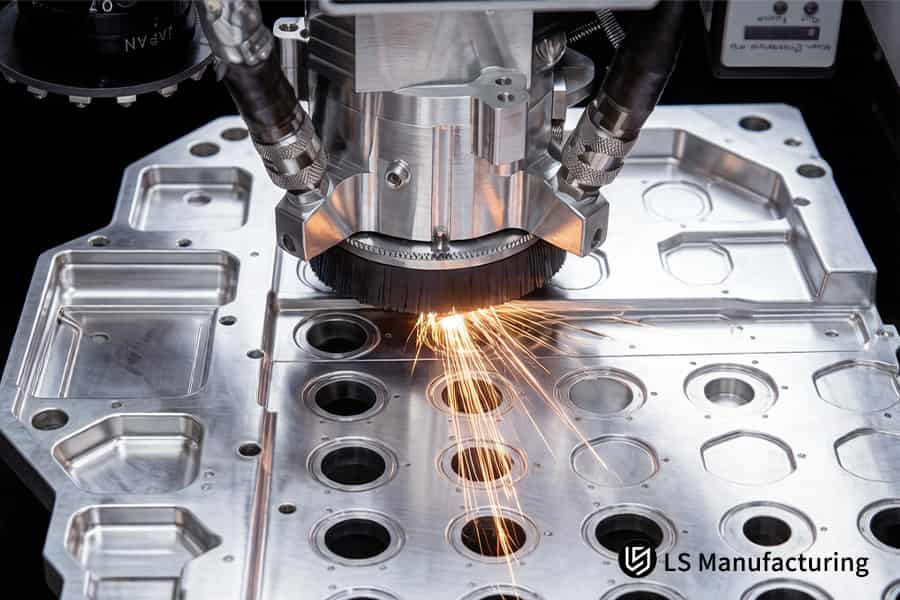
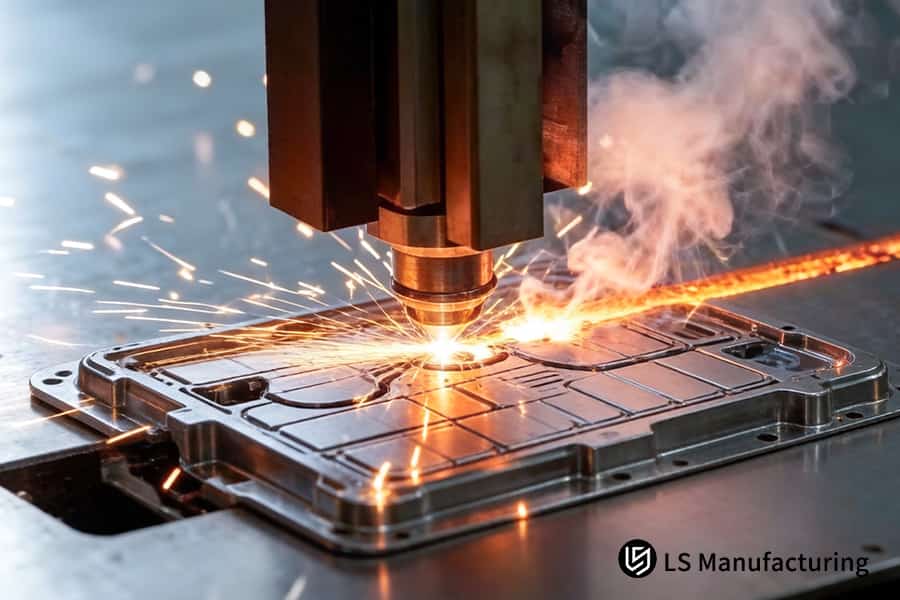
Figure 4: Machining an aluminum alloy cover for EV battery assembly using high-precision laser cutting services.
Case Study: LS Manufacturing Automotive Tier-1 Aluminum Battery Enclosure Custom Precision Solution
This issue involved a Tier-1 supplier worldwide who was unable to deliver a solution due to excessive thermal distortion when trying to manufacture the 2.5mm 5052 aluminum battery underbody tray using conventional methods. Below is a breakdown of how LS Manufacturing was able to solve this tough challenge:
客户挑战
The specific problem to be solved was producing a tray with a dimension of 1.2m with positioning accuracy of ±0.1mm. The current process used to manufacture the EV battery housing laser cutting was creating too much heat, leading to hole drift of 0.8mm and first-pass yield of just 65%. Furthermore, burrs along the edges were destroying the insulating film. Both problems were a major risk factor for the car manufacturer’s deadline for bringing their product to market.
LS 制造解决方案
Our approach included the employment of a 12kW fiber laser coupled with cryogenic nitrogen. The main technology used here included an algorithm that adapted the duty cycle of the pulses depending on the reflective properties of the metal, something important in all processes involving high-power laser cutting. Our Heat Affected Zone (HAZ) was reduced to 0.05mm while the processing time was reduced by 40%, taking care of the major cause of part deformation. Through the high precision EV laser cutting approach, we achieved a perfect and burrless cut in a single operation.
结果和价值
These findings were groundbreaking. The tolerance of the finished components had a ±0.04 mm tolerance with a first-pass assembly yield rate of 99.8%. The clean laser cutting technique allowed for an automatic reduction in post-processing operations, resulting in a reduction in costs by 22% for each part. The restored consistency of the manufacturing process reduced the client's development cycle by two weeks, allowing LS Manufacturing to become the single-source supplier.
This example illustrates LS Manufacturing’s ability to engineer solutions to complex thermal distortion issues through our approach. Our method has provided measurable results based on a unique, parameterized process forhigh-speed laser cutting. We took a flawed part and turned it into a successful one using this technique.
Stop 0.8mm hole drift. Achieve 99.8% assembly yield for aluminum battery trays with our laser cutting.
常见问题解答
1. What is the maximum tolerance your EV battery housing laser cutting service can guarantee?
Through our closed-loop linear encoder positioning system, we can assure linear dimensional tolerances of ±0.05 mm within a distance of 1.5 meters.
2. How does LS Manufacturing prevent oxidation during laser cutting services for aluminum parts?
Our laser cutting service uses 99.999% pure nitrogen as a protective shielding gas, ensuring that the cut ends retain their metallic finish without any oxidation layer formation.
3. Can you handle custom laser cutting for battery thermal management systems involving complex cooling paths?
Yes, our CAD/CAM technology is able to support such a small kerf width as 0.15mm, making it possible to produce very complex fluid-cooling paths in restricted dimensions.
4. Why is your high-precision EV laser cutting service more cost-effective for large-volume orders?
Through automation technologies for efficient nesting, the materials yield may reach 92%. Using the fast cutting processes of our kilowatt-class lasers, we are able to achieve 15%-25% lower unit processing costs.
5. What is the lead time for a detailed quote on custom laser cutting for EV parts?
Just upload the STEP or DXF model files of the components, and we'll supply you with an official quotation accompanied by a Design for Manufacturability analysis in 12-24 hours.
6. Does LS Manufacturing provide secondary services following the laser cutting of EV battery housings?
CNC bending, deburring and polishing, anodizing, and full-dimensional control by optical measurement are among our secondary services.
7. How do you protect sensitive components during the battery housing laser cutting process?
We employ non-contact laser sensing and collision avoidance technology, along with specialized protective film applied to the sheet metal surface, to ensure that the finished product remains free of any scratches or laser-induced puncture marks.
8. Why choose LS Manufacturing as a long-term strategic supplier for EV parts?
We are certified under the IATF 16949 automotive quality management standard and maintain rigorous process documentation and CPK index controls, making us a reliable partner for mitigating the risks associated with global supply chain disruptions.
摘要
In today’s competitive EV supply chain, manufacturing precision drives product competitiveness. LS Manufacturing’s advanced laser cutting technology solves key battery housing bottlenecks—from controlling Heat-Affected Zones to 0.1mm to delivering consistent, high-quality enclosures. We provide engineering solutions that enhance battery thermal management, not just processing services, securing both safety and efficiency for your powertrain systems.
Don’t let poor laser cutting slow your EV battery R&D. Your designs deserve micron-level precision. Upload your STEP/PDF drawings for a free personalized thermal deformation risk assessment and process optimization review. Inquire now to receive a competitive quote and a comprehensive DFM report from our senior engineering team.
Upload your battery housing design drawings, and LS Manufacturing experts will provide you with a free thermal deformation assessment report and a mass production quotation.
本页内容仅供参考。 LS Manufacturing services 对于信息的准确性、完整性或有效性,不作任何明示或暗示的陈述或保证。不应推断第三方供应商或制造商将通过 LS Manufacturing 网络提供性能参数、几何公差、具体设计特征、材料质量和类型或工艺。这是买家的责任。 需要零件报价 确定这些部分的具体要求。请联系我们了解更多信息。
LS 制造团队
LS Manufacturing 是一家行业领先的公司。专注于定制制造解决方案。 We have over 20 years of experience with over 5,000 customers, and we focus on high precision CNC machining, Sheet metal manufacturing, 3D printing, Injection molding. Metal stamping,and other one-stop manufacturing services. Our factory is equipped with over 100 state-of-the-art 5-axis machining centers, ISO 9001:2015 certified.我们为全球150多个国家的客户提供快速、高效、高质量的制造解决方案。无论是小批量生产还是大规模定制,我们都能以最快的24小时内交货满足您的需求。选择LS制造。 This means selection efficiency, quality and professionalism. To learn more, visit our website:www.lsrpf.com.
 中文 (简体)