English



Overmolding vs insert molding services from LS Manufacturing deliver precision-engineered plastics bonding solutions, including the comprehensive overmolding vs. insert molding: key differences and selection guide designed to solve high-volume production defects.
Our high-precision injection molding services are specialized manufacturing protocols that integrate multi-material substrates to achieve ±0.02mm dimensional accuracy and ≥0.02 MPa airtight sealing (IP68), directly eliminating critical engineering failures such as thermal expansion (CTE) mismatch warpage, interfacial delamination, and insert misalignment during mass production.
Here you have a practical look at what is required to manufacture reliable and high-volume products. You will get predictable results, including ±0.02mm dimensions accuracy and ≥0.02 MPa airtight seal, by controlling the thermal gate balance, regulating the mold temperature and preheating the insert, all resulting in minimal TPC and no scrap batches. Learn from the point of view of an LS Manufacturing senior engineer about solving difficult manufacturing problems.
Overmolding VS Insert Molding Services: Quick-Reference
| Key Factor | Overmolding | Insert Molding |
| Process Sequence | A substrate material, typically stiff, is initially molded, followed by molding another material, typically flexible, around it. | An already manufactured insert, made of metal, ceramic, or plastic, is inserted into the mold, which is followed by injection of plastic. |
| Primary Goal | First, a substrate (often rigid) is molded, followed by molding a second material (often flexible) over/around the substrate. | A prefabricated insert (metal, ceramic, plastic) is inserted into the mold, after which plastic is injection-molded around the insert. |
| Bonding Mechanism | The creation of a two-material component for improved gripping, sealing, aesthetic effects, or vibration damping. | The production of an integrated metal-plastic assembly for added features such as threads and contacts. |
| Typical Tolerances | Primarily involves the chemical or adhesive bonding of two different types of plastic overmolding. | Depends on mechanical interlocking and chemical bonding between the plastic and the surface of the insert. |
| Best Application | Medium (±0.1mm and up), since alignment occurs between two injection-molded plastic pieces. | Tight (±0.05mm or tighter), because the positioning of the insert is fixed by the mold. |
| Our Process Selection | Soft-grip handles, watertight seals, and two-color consumer products. | Electrical connectors with brass inserts, reinforced assemblies, surgical instruments. |
Summary of table: While overmolding achieves seamless sealing, insert molding provides superior ±0.05mm structural precision by fixing components mechanically within the tool.
Key Takeaways:
- Function Drives Choice: If material characteristics are needed (soft grip, seal), then use overmolding; if additional components are necessary (metal components, circuit boards), then choose insert molding.
- Bonding is Different: Overmolding works best when materials are compatible with each other; while insert molding depends on mechanical fit.
- Precision Varies: The insert molding process allows greater accuracy since the position of the insert itself is mechanically formed within the mold.
- Design for the Process: Both processes require particular design guidelines for manufacturing; the decision has to be made early during part design.
Why Trust This Guide? Practical Experience From LS Manufacturing Experts
Many tutorial sources for injection molding are available online. However, our tutorial is unique since it has been produced by specialists of LS Manufacturing focused on multi-material insert injection and high-volume polymer bonding operations. Thanks to the International Organization for Standardization (ISO) quality control concept, we fully understand how we can get close tolerances of ±0.015mm during mass production.
We supply the production of critical parts: reliable enclosures for medical devices that provide hermetic IP68/IP69K seals, strong waterproof connectors for automotive new energy vehicle (NEV), and structural electronics components. Electrical safety, insulation resistance, and EMC compatibility of molded parts in such applications conform to the top international standards established by the International Electrotechnical Commission (IEC) – one of the most recognized organizations involved in developing standards for electrotechnical activities.
The expertise of LS Manufacturing was built on the shop floor. We learned scientific molding procedures to ensure the elimination of interfacial delamination, proper synchronization of mold temperature within ±1.5°C, optimal control of injection pressure holding to prevent any core pin deflections, and the latest advancements in automation through End-of-Arm Tooling (EOAT). We would like to share our technology with you in order to maximize DFM and reduce costly failures related to tool damage, flashing, and deformations.
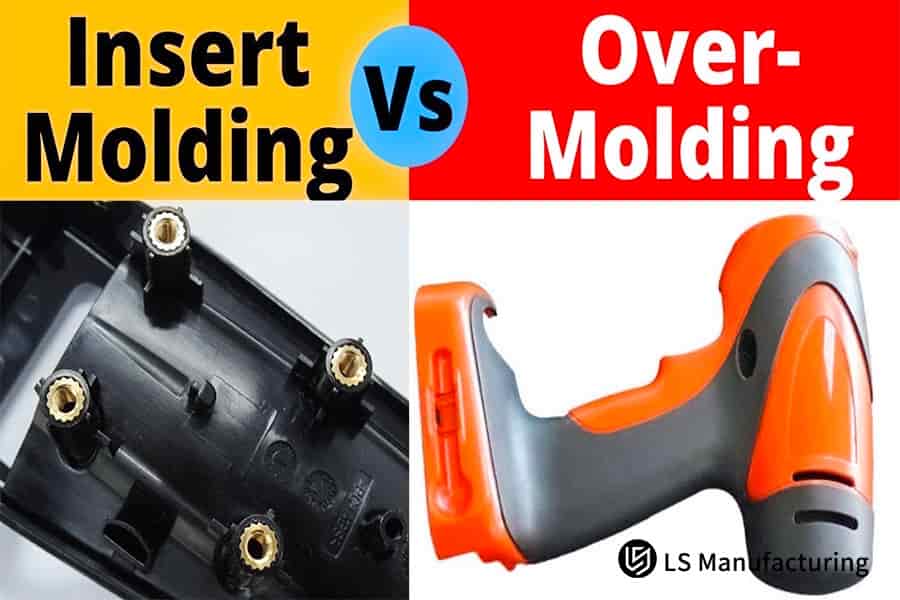
Figure 1: The chart contrasts a black part with brass inserts and a two-tone overmolded grip for industrial tools.
Why Do Medical Electronics Fail IP68 Sealing Tests In High Volume Overmolding Service?
For high-rate manufacturing, IP68 seal failure problems in medical devices are frequently due to adhesive bond failure at the interface. To solve this critical issue, we utilize surface engineering along with process control in order to guarantee thermal reliability. The critical issue and the proposed solution are as follows:
Interfacial Bonding Engineering: The Foundation
Achieving a robust bond between the PC insert and fluid LSR begins with surface science. We mandate and validate a high volume overmolding service prerequisite: plasma treatment combined with a controlled insert surface roughness of Ra ≥ 1.6 μm. This dual approach chemically activates the surface and provides mechanical interlocking, preventing the >40% bond strength degradation observed after 1000 thermal cycles (-40°C to 85°C). This step is non-negotiable for mass production overmolding reliability.
Process Window Optimization: Precision Molding
In addition to surface preparation, however, even a overmolding insert molding comparison processes indicates a preference for LSR for seals; precise parameters have to be maintained in order for it to work properly. In our high-precision overmolding process, for example, injection pressure should not exceed 80 MPa with a multi-stage packing curve to eliminate pre-curing shear stresses and any knit line formation near seals.
Tooling and Flow Path Design
Effective tooling and flow robust overmolding design requires emphasis on laminar flow and thermal control. For this purpose, we incorporate a cascading venting system with temperature controlled inserts to ±1.5°C to avoid air entrapment while ensuring LSR curing at 150°C. Such a controlled environment is an important part of developing a scalable overmolding solution which guarantees that each successive unit is manufactured just like the previous one – no variations allowed.
System-Level Validation Protocol
Our approach is backed by correlated physical testing. All custom overmolding services protocol include peel strength tests before and after 1000-cycle thermal shock, and pressure decay tests with a sensitivity of ±2.5%. This allows us to feedback into our surface energy parameters and packing times to form a loop. This validated overmolding protocols provide IP68 level not on a one-off sample but in production.
As this paper shows, achieving IP68 in quantity is not a one-shot deal. It requires synchronization between materials science aspects (surface modification using plasma, roughness) and dynamics of the manufacturing process (pressure, temperature profiles). This unique approach, combining preparation and manufacturing, makes our custom overmolding services unique in providing hermetically sealed products in high volumes for medical applications.

How Can Precision Insert Molding Service Solve Core Shift Defects In Sensor Mass Production?
Core movement and pin distortion associated with high volume insert molding can be expected but are not inevitable, rather predictable and solvable forces. We counter these forces through melt flow physics calculations and actively compensate during mold filling, guaranteeing a consistent tolerance of ±0.015mm. The principles governing our approach are built on three pillars:
Predictive Simulation: Quantifying the Destructive Force
- Analysis Focus: Through predictive insertion molding simulation, we analyze the shear rates (>500,000 1/s) generated from gates as small as 0.8mm and calculate the precise lateral force that will be applied to the core pin.
- Actionable Output: The amount of data obtained helps us determine the amount of counterforce required, and therefore helps in positioning the right type of retainer systems needed prior to tool design; thereby, we turn a problem into a design criterion for our precision insert molding service.
Active Mold Control: Dynamic Insert Retention
- Core Technology: Active insert retention systems such as hydraulic micro-core pins which engage with the inserts upon closure of the mold.
- Precision Timing: These pins are actuated to retracted automatically after 95% of the cavity is filled when the status shifts from viscosity drag force to pressure holding force.
- Result: This solution helps us mass production insert molding with inserts retaining their positions; an achievement which was only feasible through manual loading of prototypes.
Process-Integrated Validation & Closed-Loop Control
- In-Line Metrology: The post-ejection optical coordinate measuring system gives us the ability to perform 100% position check on critical features with data logging into SPC system.
- Feedback Loop: Trends derived from the closed-loop insert molding monitoring system are used to provide feedback to correct pin retraction timing or clamp forces resulting in a self-rectifying production process for custom insert molding services.
We use the combination of CAE simulation, mold actuator technology, and live data monitoring to ensure perfect dimensions that will make our overmolded sensors suitable for use in automotive applications. The uniqueness of overmolding vs insert molding services that we offer lies in our solution to high-volume molding problems.
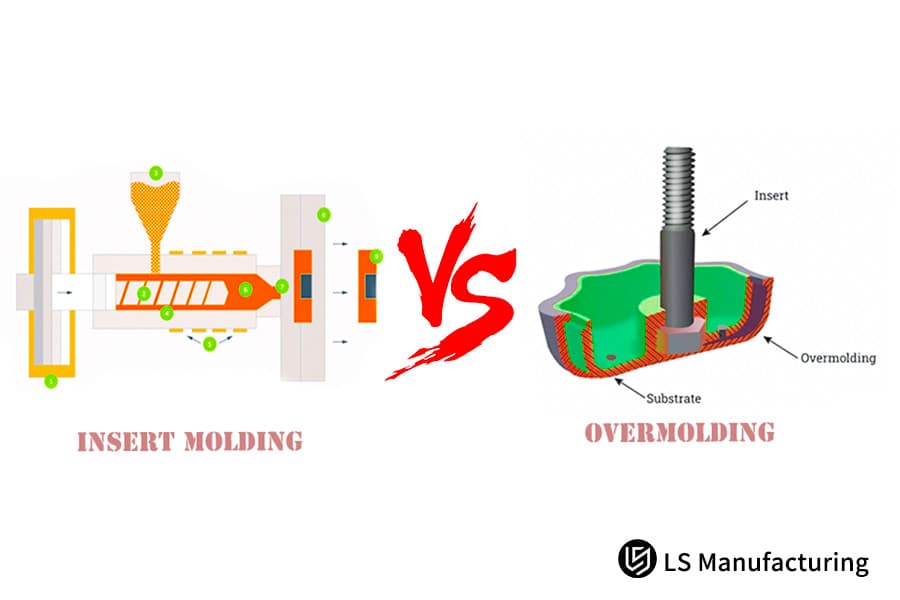
Figure 2: The diagram contrasts material flowing around a metal insert with material overmolding a substrate.
Which Tooling Gate Designs Prevent Weld Line Weakness In Custom Overmolding Services?
There is no denying that weld lines in overmolds can be problematic because they affect the appearance of the mold and reduce its impact resistance by more than 30%. As part of our discussion on high volume overmolding service, we delve into the problem and introduce a proactive tooling technique that eliminates all weld lines and guarantees optimal performance. The comparison table is shown below:
| Design Aspect | Conventional Approach (Problem) | Our Strategic Solution (Action & Result) |
| Gating System | With side gating, there are numerous melting fronts. | With valve-gate hot runners, there is only one front, which makes this technique critical for precision insert molding service. |
| Thermal Management | Static mold temperature leads to early freezing. | Dynamic mold temperature cycling (30°C - 120°C) ensures ideal merge point temperature for a reliable overmolding process. |
| Outcome | Obvious weld lines and poor bond strength. | Result in superior aesthetic and structural qualities necessary for mass production overmolding. |
| Process | Scalability Inconsistency makes volume manufacturing impossible. | Ensures consistent production vital for all custom overmolding services. |
Our method is based on using valve gated systems and dynamic mold temperature cycling, thus controlling the physics behind plastic injection and joining. The result is guaranteed compliance with all mechanical parameters outlined in the overmolding vs insert molding services comparison. Stop accepting 30% weaker parts from weld lines. To lock in a validated, high-strength overmolding process, submit your part design for a gate optimization analysis and production quote.
What Parameter Window Keeps Metal Inserts From Deforming During Mass Production Insert Molding?
Zero plastic deformation of thin-wall (<0.5 mm) metal inserts due to high clamping force is crucial for mass production insert molding. To ensure this, our approach involves the perfect control of clamp force, injection dynamics, and insert support to prevent any deformation of stamping or damage of tooling. These requirements are fulfilled by defining the process window in which the part is formed within 22 seconds:
Progressive Clamping Force Profiling
In contrast to using the full tonnage at once, we use multi-step clamping force profiling. The mold is closed with less force, permitting engagement of the patented insert molding of thin inserts system with the molded part. Only after securing the thin insert can the full tonnage be used, spreading the pressure evenly and avoiding buckling, which is an essential feature of our custom insert molding services for fragile parts.
Optimized Filling Strategy to Minimize Impact
Rapid injection speed results in considerable lateral forces acting on the mold. A segment injection method is employed, decreasing the injection speed gradually from 120 mm/s to 45 mm/s before reaching the metal component. This ensures that the dynamic pressure acting on the thin walls will not deform the part during filling. That is what distinguishes a protected insert molding process.
Active In-Mold Support & Process Synchronization
The core innovation is a mold design featuring active, spring-countered supports behind the insert. These supports dynamically counteract injection pressure, preventing deflection during fill. This system ensures positional stability within ±0.02mm, defining our precision insert molding service. Synchronizing support retraction with packing onset maintains the target ≤22s cycle, enabling a profitable insert molding operation.
Validated Production Window for Zero Defects
All of these variables fall within a process window that is tested, backed up with data. This ensures accurate temperatures of melts, transition points from velocity to pressure, and cooling times. The result is a robust insert molding design that eliminates stamping deformation completely and cuts down mold maintenance costs by at least 18%.
Such a methodology eliminates force dominance and ensures precise synchronization. Our unique advantage is our ability to combine activemold supports and dynamicmachine control to form an environment where delicate inserts can be handled. The methodology addresses the problem of the contradiction between production efficiency and perfection at the level of the whole system, which is one of the major distinguishing features in an overmolding insert molding comparison.
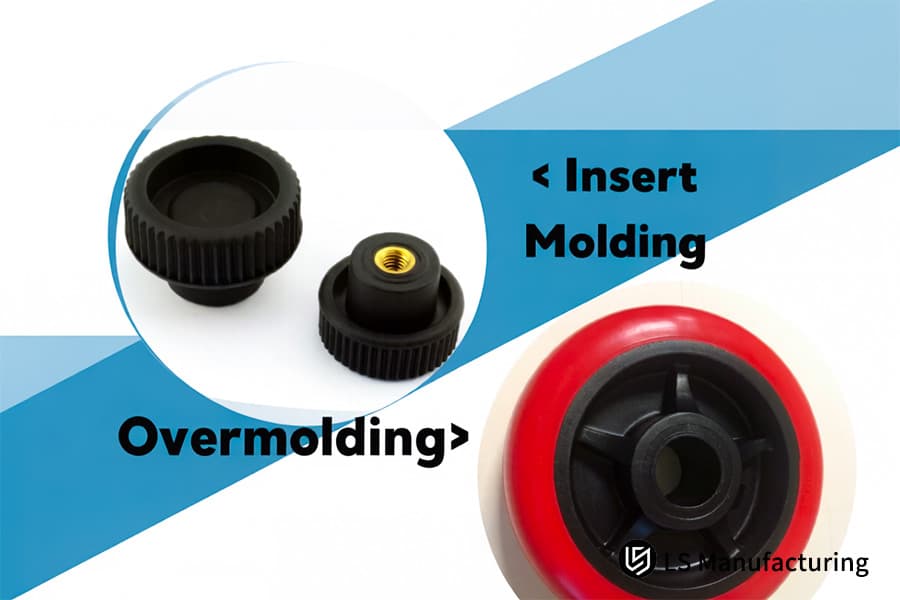
Figure 3: The graphic contrasts black insert molded gears with a red and black overmolded knob for assemblies.
How Does Material Compatibility Guide The Choice In Overmolding Insert Molding Comparison?
Material selection is one of the critical considerations when it comes to ensuring reliable bond and performance. This article goes beyond common tips and presents a scientific methodology that involves material interfacial shear strength data and well-defined design rules. The basic idea behind the methodology is to maximize chemical bonds; otherwise, mechanical interlocks should be considered as follows:
Data-Driven Selection for Chemical Bonding
- Strategy: We start with a proprietary database relating substrate/overmold material pairs to quantified values of bond strength under given process conditions.
- Application: For compatible pairs (such as PA66-GF/TPU), we use optimized temperatures of melt and molds to achieve optimal bond strength (more than 5 N/mm²), which is enough for structural overmolding design without mechanical aids.
Engineered Mechanical Interlocking Design
- Strategy: When incompatible material pairs do not share a chemical bond, we require the design of unique mechanical characteristics.
- Design Rule: Interlocking geometries, whether dovetail slots, holes, or undercuts, must be designed with a minimum thickness and width ≥0.8mm. This criterion guarantees that the mechanical bond will resist peel and shear forces for multi-material overmolding applications.
Systematic Design Validation & Selection
- Strategy: The design goes through a two-step validation process, starting with simulation of stress on interlock features, then followed by shear testing of molded samples.
- Outcome: The empirical validation procedure, which is inherent to our custom overmolding services, gives us an unequivocal pass/fail criterion that will definitely determine the success or failure of the particular strategy, which will be used in our overmolding insert molding comparison.
The proposed method creates a very clear way of decision making. Prioritization of chemical bonding occurs via the use of material library in our custom insert molding services, otherwise designing on the ≥0.8mm mechanical lock. Our overmolding vs insert molding services discussion is therefore guided by principles of adhesion that are backed up by data and facts rather than tradition. This technique guarantees that the chosen technique will work perfectly in complex overmolding assemblies.
Can Smart Insert Preheating Optimize Cycle Times In Custom Insert Molding Services?
Sealing IP68 in medical devices in high volume overmolding service is essentially an issue of interface. The problem arises when there is a separation of the two materials, due to heat, during the production process. The process can be solved through a careful engineering of the bond from both the mechanical and molecular levels. Our targeted method will take the following path:
Surface Energy Optimization: Creating a Bond-Ready Interface
The bonding takes place before the closure of the mold. In accordance with our standards and testing, we require and ensure that the surface will have a roughness of Ra ≥ 1.6 μm with an atmospheric plasma pre-treatment. The combination of the two enhances the surface area and generates active bonding points, such that the bonding of the LSR happens not only on physical but also chemical levels. This stage is essential in obtaining the needed durable interphase in complex overmolding assemblies, which does not reduce the >40% bond strength in more than 1000 thermal cycles (-40°C to 85°C).
Process Control for Minimized Stress
Accuracy of the controlled overmolding process is a must-have. We use multi-step injection profiles with maximum pressure of ≤80 MPa to avoid dislocation or flashing, which will result in failure of the seal. Optimized packing curve guarantees that the mold cavity is filled without any risk of residual stresses appearing on the bond line. This accurate control is the key to successful implementation of a reliable overmolding process at mass production overmolding.
Validated Performance Under Dynamic Conditions
Validation is more than the seal performance test. The assembly undergoes severe thermal cycling and pressure decay tests, while the results are being analyzed with respect to our process variables. Through the feedback loop we adjust the process window to guarantee optimal results when it comes to long-term product performance. This is the heart of our custom overmolding services.
Design for Manufacturing (DfM) Integration
Designing success into the project from day one is how we operate. We simulate mold flow to determine part geometry and gate placement in order to avoid air traps or weld lines that could be detrimental to crucial sealing areas. By applying design for manufacturability considerations during design stage, we make the molding process easier by designing an inherently robust precision overmolding design. Proper analysis is crucial in the comparison of overmolding vs insert molding services.
The approach we take from surface molecular activation to dynamic testing focuses on solving delamination problems at their core. We differentiate ourselves through this process-oriented approach to engineering, ensuring hermetic seals are achieved consistently across multi-material overmolding applications. It allows us to address the problem of keeping an effective hermetic seal despite multiple thermal cycles, a must-have for high volume life-critical medical devices.
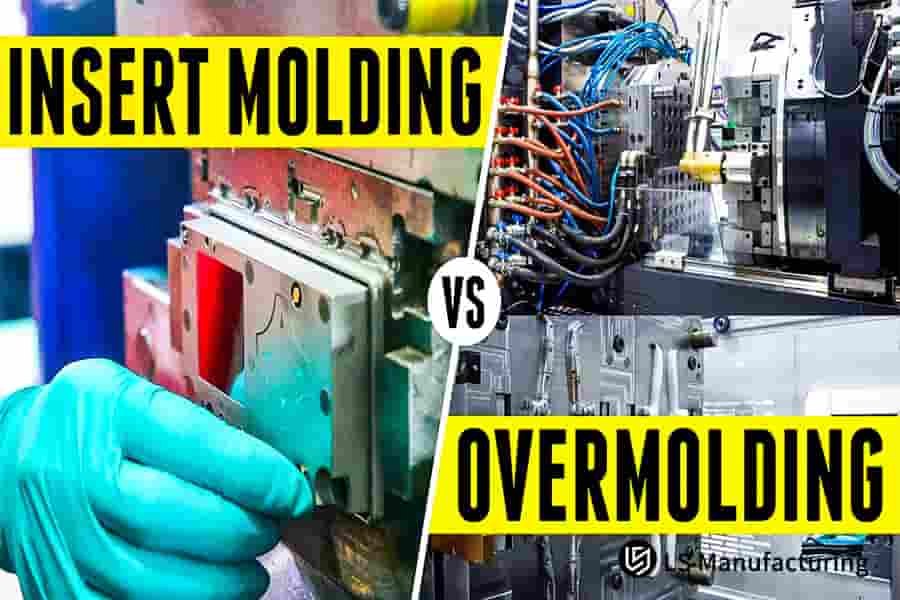
Figure 4: The image contrasts a manual insert molding setup with automated overmolding machinery for equipment.
How Do Automated EOAT Configurations Maximize Yield In Mass Production Overmolding?
In high volume overmolding service and two-shot molding, End-of-Arm Tooling (EOAT) is an integral component that greatly impacts the yield at the end of the manufacturing process. Inaccurate part handling can lead to part surface damage, misalignment, and deformation. In this document, the solution by which the company can design a purpose-driven, vision-guided robotic EOAT to provide ±0.02mm repeatability and eliminate human errors in order to ensure predictable deliveries in its mass production overmolding is explained.
| Challenge / System Aspect | Our EOAT Solution & Quantified Outcome |
| Positioning Accuracy | Vision-guided robot servos attain ±0.02mm repeatability, thereby preventing misalignment defects during precision overmolding process. |
| Handling Delicate Parts | The company EOAT will feature vacuum and servo grippers that will prevent marking of soft TPEs/TPUs, required in custom overmolding services. |
| Process Integration | Automated overmolding cell control will make it possible to perform overmolding tasks simultaneously, increasing machine uptime. |
| In-Process Quality | On-E0AT sensors deliver 100% inspection capability with zero ppm human error rate and ensuring reliable overmolding bonds. |
The above discussion reveals that the need for optimizing yields is essentially an automation engineering problem. It can be addressed through vision guided robot with specific tooling coupled with real-time sensors. Such a system tackles the reliability issue in overmolding insert molding comparison, which ensures that the product maintains its cosmetic appearance and has consistent yields in complex overmolding applications.
Why Choose LS Manufacturing As Your Precision Insert Molding Service Partner For Cost Control?
Proper cost control when using precision insert molding service means reducing waste and eliminating variability. These two aspects can be accomplished by combining design optimization with production excellence. We ensure that our customers have reduced costs in their products due to consistent parts and tooling longevity through our proven process. Some of the ways we save costs are:
Upfront DFM: Preventing Cost Before It Exists
Cost control starts from the design phase. Our team performs a free DFM analysis that concentrates on the optimization of runner systems and gate location. This initial analysis, one of the most essential parts of our custom insert molding services, allows us to reduce material waste by more than 35%, resulting in better cavity balance and reduced costs and cycle time right from the start of production.
Investment in Tooling for Lifetime Consistency
Durable molds are designed right from the start through the use of high-quality tool steels such as ASSAB Stavax ESR, known to have an impressive lifespan of more than 1,000,000 cycles. As such, wear and tear will be kept at the lowest possible level. This is key in an automated insert molding cell where you must be sure that even the 500,000th molded part retains the ±0.015mm tolerances of the first. Nothing can beat the devastating consequences of tool failure mid-way through production.
Scientific Process Control for Predictable Yield
Controlling costs involves minimizing scrap. In our insert molding process, the scientific approach involves controlling and monitoring a narrow but data-driven process window for each key parameter (e.g., pressure, temperature, speed). Any deviation is quickly detected and corrected for to achieve process capability (Cpk>1.67). With predictable yield comes near zero-defect production – the biggest factor influencing cost of the final parts when considering overmolding vs insert molding services.
Cost reduction results from engineering the uniformity of parts to each other. We offer it via DFM in material savings, million-cycle tooling, and scientific process control that eliminates scrap. This provides predictable, high-yield high-volume insert molding production and is the only way of achieving true cost savings, distinguishing us from other overmolding insert molding comparison.
How LS Manufacturing Optimized Automotive New Energy Vehicle Waterproof Connector Overmolding And Saved A Tier-1 Supplier $45,000 In Tooling Costs
The story is about solving an urgent yield problem of a Tier-1 automotive supplier. The situation concerned a complicated multi-stage overmolding process involving a high voltage waterproof connector, where scrap was due to pin deflection at the rate of 22%. We solved this problem via engineering to reduce tooling costs.
Client Challenge
It needed precision insert molding of PBT resin around stainless steel pins, followed by FKM overmolding for IP69K sealing. The existing injection molding process caused deflection of ±0.08mm in pins due to asymmetric filling at 270°C. As a result, the failure rate in pressure decay test reached 22%, causing significant wastage of FKM material and potentially delaying the project with penalties.
LS Manufacturing Solution
We focused on solving the underlying problems of this case. Firstly, we optimized gate design by switching it to balanced overmolding gates (twin sub-gates). Secondly, we utilized advanced porous metal vents, resulting in a 300% increase in exhaust efficiency. In the case of FKM, we used the gated overmolding system with clamp force monitoring (±2 kN).
Results and Value
This resulted in a highly profitable overmolding production line. Deflection was managed to within ±0.012mm and yields went up to more than 99.85%. The cycle time was decreased from 32 seconds to 24.5 seconds and savings in materials were achieved, totaling 15% material savings. By redesigning the tool using our durable insert molding design principles, we helped our client save money and delivered on schedule ($45,000).
This case demonstrates our core value: solving expensive failures through applied engineering science. We excel in custom insert molding services by combining simulation-driven design with precise process control. This approach to complex overmolding vs insert molding services challenges transforms technical risks into reliable, cost-effective production for our partners.
To move from 25% scrap to validated near-zero defect rates, submit your PEEK component for a failure analysis and a production-proven annealing protocol with formal quotation.

FAQs
1. What is the primary difference in high volume overmolding service versus custom insert molding services?
Insert molding encapsulates a pre-placed substrate, like a metal insert, within a single injection cycle. Overmolding injects a secondary, flexible polymer over a previously molded rigid component, typically using a more complex two-shot or rotary multi-station tool process to achieve the bond.
2. Which materials achieve the strongest chemical bonding bond without primer in mass production overmolding?
Excellent, primerless chemical adhesion is achieved between substrates like Polycarbonate (PC) or ABS and thermoplastic elastomers (TPE/TPU). This requires strict melt temperature control between 230°C and 250°C to enable optimal molecular chain interdiffusion at the material interface for a durable bond.
3. How does your precision insert molding service control the tolerance of metal stampings during high pressure injection?
We control tolerance using custom hydraulic core-pulling pins and multi-stage scientific injection profiling. This carefully ramps down volumetric flow rates to ≤25 cm³/s near the insert, maintaining its precise positioning with tolerances as tight as ±0.015mm throughout the high-pressure fill.
4. Why do flash defects occur in mass production insert molding and how do your engineers mitigate them?
Flash typically occurs due to mismatched insert tolerances or slight steel deflection under high packing pressure. LS Manufacturing engineers solve this by utilizing custom EDM-machined shut-off blocks and programming precise, cavity pressure-matched clamping force profiles to eliminate any parting line gaps.
5. What is the optimal surface roughness for mechanical interlocking in overmolding insert molding comparison?
For materials with low inherent chemical compatibility, we recommend an EDM texture of VDI 27 to 33 (Ra 2.2 μm to 4.5 μm). This should be combined with continuous mechanical undercut depths of ≥0.5mm in the substrate design to create maximum shear resistance and a robust mechanical lock.
6. How do you prevent thermal degradation of delicate electronic components in custom insert molding services?
We prevent thermal degradation by implementing Low-Pressure Molding (LPM) techniques. This uses specialized ultra-low viscosity polyamides injected at low pressure, combined with fast-cooling beryllium-copper (BeCu) mold inserts to rapidly dissipate heat within a brief 8 to 12-second cooling window.
7. Can high volume overmolding service achieve an airtight seal capable of surviving a 0.05 MPa underwater leak test?
Yes, our high volume overmolding routinely achieves this. We integrate inline atmospheric plasma treatment on the substrate and deploy a balanced hot runner valve-gate system, enabling production of seals that consistently pass leak testing at pressures ≥0.1 MPa, exceeding the 0.05 MPa threshold.
8. What factors dominate the tooling cost amortization when scaling custom overmolding services up to 500,000 pieces?
Multi-cavity hot runner optimization and the selection of premium H13 or Stavax ESR tool steel dominate cost factors. This configuration minimizes cycle time, reduces downtime, and virtually eliminates continuous flash trimming labor, allowing for efficient amortization across high-volume runs. Get a quote today to see the scalable value for your project.
Summary
Choose Overmolding if your part requires a soft-grip handle, multi-color aesthetics, or an IP68 watertight seal. Slight errors in positioning or temperature can escalate into batch defects during volume production. Only with deep curing insight, advanced moldflow simulation, and automated handling can you ensure zero-defect delivery while reducing total cost.
Facing airtightness failures, severe flash, or pin deformation? Stop wasting resources on blind mold trials. Click for a free DFM review and submit your STEP/IGES drawings. Our overmolding engineers will provide a feasibility report with fill analysis, gate optimization, and stress validation—mitigating 98% of risks before tooling begins.
📞Tel: +86 185 6675 9667
📧Email: info@lsrpf.com
🌐Website: https://lsrpf.com/
Disclaimer
The contents of this page are for informational purposes only. LS Manufacturing services There are no representations or warranties, express or implied, as to the accuracy, completeness or validity of the information. It should not be inferred that a third-party supplier or manufacturer will provide performance parameters, geometric tolerances, specific design characteristics, material quality and type or workmanship through the LS Manufacturing network. It's the buyer's responsibility. Require parts quotation Identify specific requirements for these sections.Please contact us for more information.
LS Manufacturing Team
LS Manufacturing is an industry-leading company. Focus on custom manufacturing solutions. We have over 20 years of experience with over 5,000 customers, and we focus on high precision CNC machining, Sheet metal manufacturing, 3D printing, Injection molding. Metal stamping,and other one-stop manufacturing services.
Our factory is equipped with over 100 state-of-the-art 5-axis machining centers, ISO 9001:2015 certified. We provide fast, efficient and high-quality manufacturing solutions to customers in more than 150 countries around the world. Whether it is small volume production or large-scale customization, we can meet your needs with the fastest delivery within 24 hours. choose LS Manufacturing. This means selection efficiency, quality and professionalism.
To learn more, visit our website:www.lsrpf.com.